Overview
Hover to read
Click to keep this side open
Overview
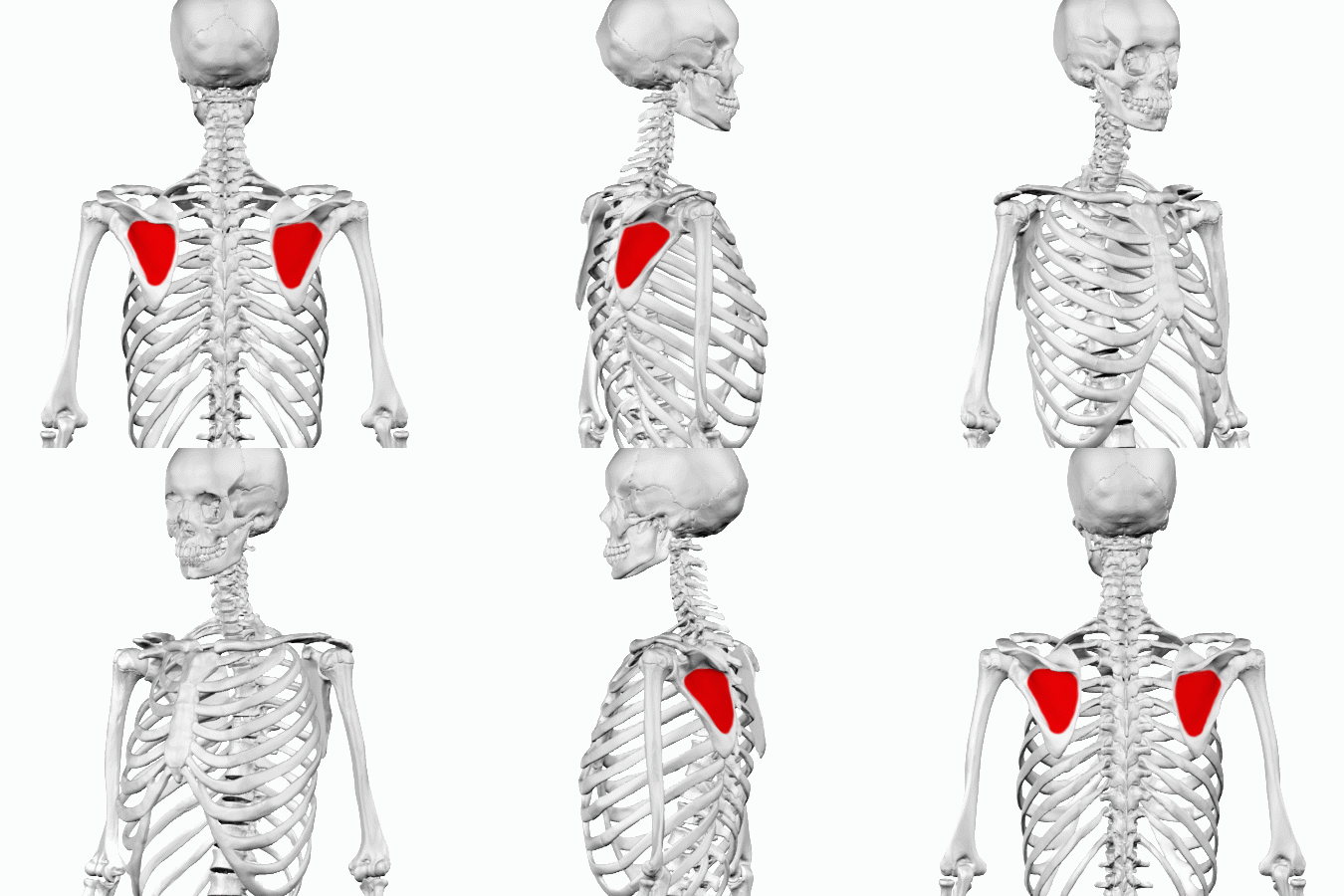
In mammalian anatomy, the infraspinatus muscle is a thick triangular muscle which occupies the chief part of the infraspinatous fossa. As one of the four muscles of the rotator cuff, the main function of the infraspinatus is to externally rotate the humerus and stabilize the shoulder joint.
Click again to return to the front
Origin
Hover to read
Click to keep this side open
Origin
Infraspinous fossa of the scapula
Click again to return to the front
Insertion
Hover to read
Click to keep this side open
Insertion
Middle facet of greater tubercle of the humerus
Click again to return to the front
Actions
Hover to read
Click to keep this side open
Actions
External rotation of arm and stabilization of glenohumeral joint
Click again to return to the front
Innervation
Hover to read
Click to keep this side open
Innervation
Suprascapular nerve
Click again to return to the front



Blood Supply
Hover to read
Click to keep this side open
Blood Supply
Suprascapular and circumflex scapular arteries
Click again to return to the front
Palpation
Hover to read
Click to keep this side open
Palpation
Position the client comfortably and identify the muscle's bony landmarks. Ask for a gentle, pain-free contraction that matches the muscle's action, then palpate from the proximal attachment toward the distal attachment. Avoid forceful palpation over acute injury, inflamed tissue, major neurovascular structures, or areas outside the massage therapist's scope.
Click again to return to the front
Massage Applications
Hover to read
Click to keep this side open
Massage Applications
Use broad warming strokes, compression, kneading, and longitudinal work based on the muscle's size, depth, fiber direction, and client tolerance. Use focused work only after careful assessment. Avoid aggressive pressure with acute strain, suspected tear, infection, unexplained swelling, recent surgery, fracture, or other contraindications.
Click again to return to the front
Common Conditions
Hover to read
Click to keep this side open
Common Conditions
Possible concerns include strain, overuse, protective guarding, trigger-point activity, altered movement patterns, weakness, and referred discomfort. The exact clinical presentation depends on the muscle's location and function and should be evaluated within the massage therapist's scope of practice.
Click again to return to the front
Stretching
Hover to read
Click to keep this side open
Stretching
Move the related joint slowly in the direction opposite the muscle's primary action. Stabilize the proximal segment, remain within a pain-free range, and avoid bouncing or forcing the stretch.
Click again to return to the front
Strengthening
Hover to read
Click to keep this side open
Strengthening
Use low-load, controlled movement in the direction of the muscle's primary action. Begin with isometric activation when appropriate, then progress through a comfortable range while maintaining proper alignment and avoiding compensation.
Click again to return to the front
Media Credits
Attribution and licensing information for the pictures and videos used in this lesson:
- Picture 1: Infraspinatus muscle animation.gif — Anatomography — CC BY-SA 2.1 jp — Source
- Picture 2: Infraspinatus fossa - animation.gif — Polygon data is from BodyParts3D — CC BY-SA 2.1 jp — Source
- Picture 3: Gerrish's Text-book of Anatomy (1902) - Fig. 300.png — Frederick Henry Gerrish (1845-1920) — Public domain — Source
- Picture 4: Gray — musculus infraspinatus.png — Henry Vandyke Carter — Public domain — Source
- Picture 5: Infraspinatus.PNG — Mikael Häggström. When using this image in external works, it may be cited as: Häggström, Mikael (2014). "Medical gallery of Mikael Häggström 2014". WikiJournal of Medicine 1 (2). DOI:10.15347/wjm/2014.008. ISSN 2002-4436. Public Domain. or By Mikael Häggström, used with permission. — Public domain — Source
- Video 1: Infraspinatus Muscle - Attachments & Action Function - Human Anatomy Kenhub 1.webm — Kenhub Template:Author of Illustration : Yousun Koh — CC BY 3.0 — Source