Section 01 of 20
Introduction
Transversus abdominis is the deepest of the three flat muscles that make up the sides of the abdominal wall, lying beneath the internal oblique. Unlike the external and internal obliques, its fibers run mostly horizontally around the trunk, like a wide belt.
Because of this horizontal fiber direction, it is especially effective at compressing the abdominal contents and stabilizing the spine and pelvis, rather than producing large trunk movements. It is a key muscle in core stability training.
Section 02 of 20
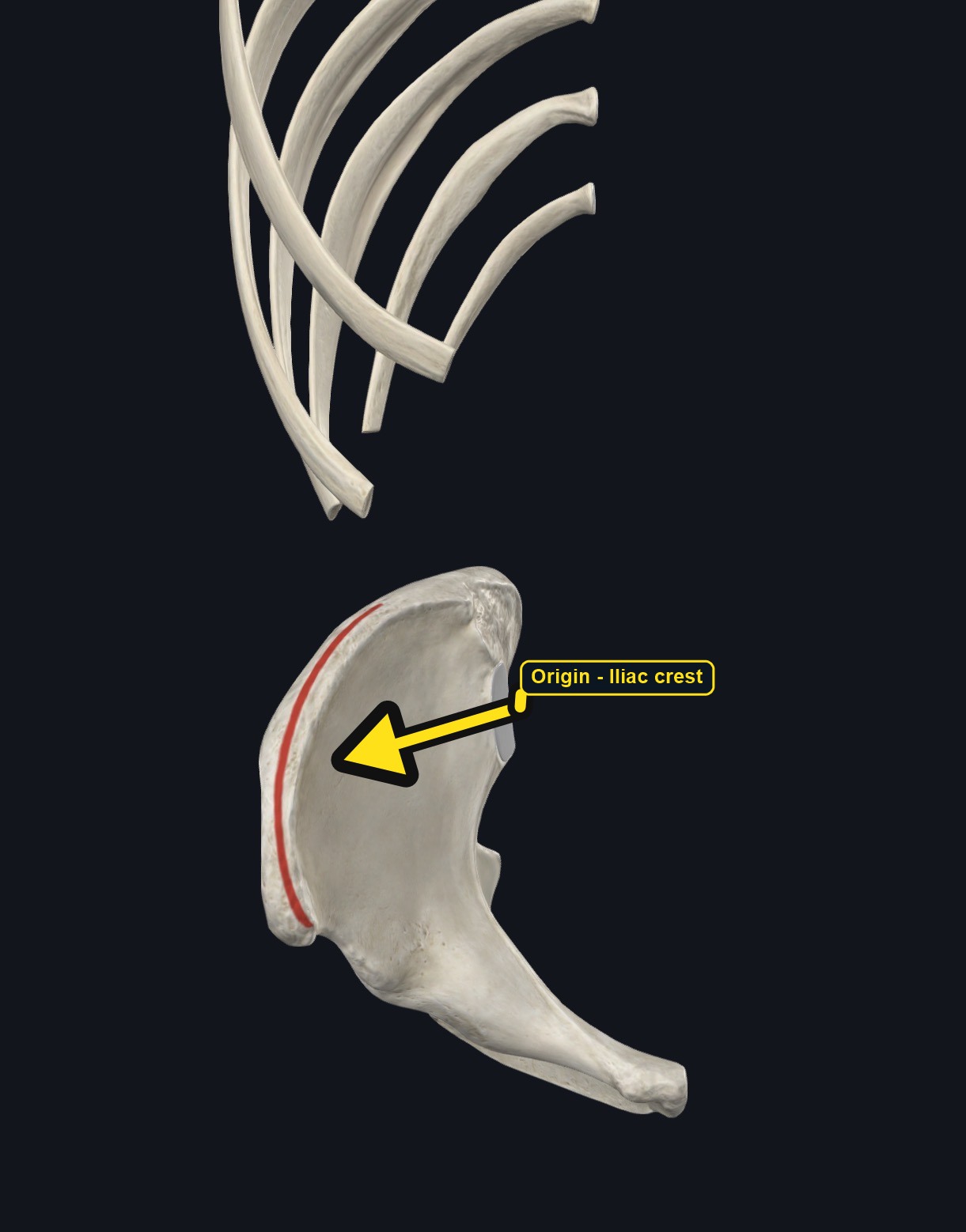
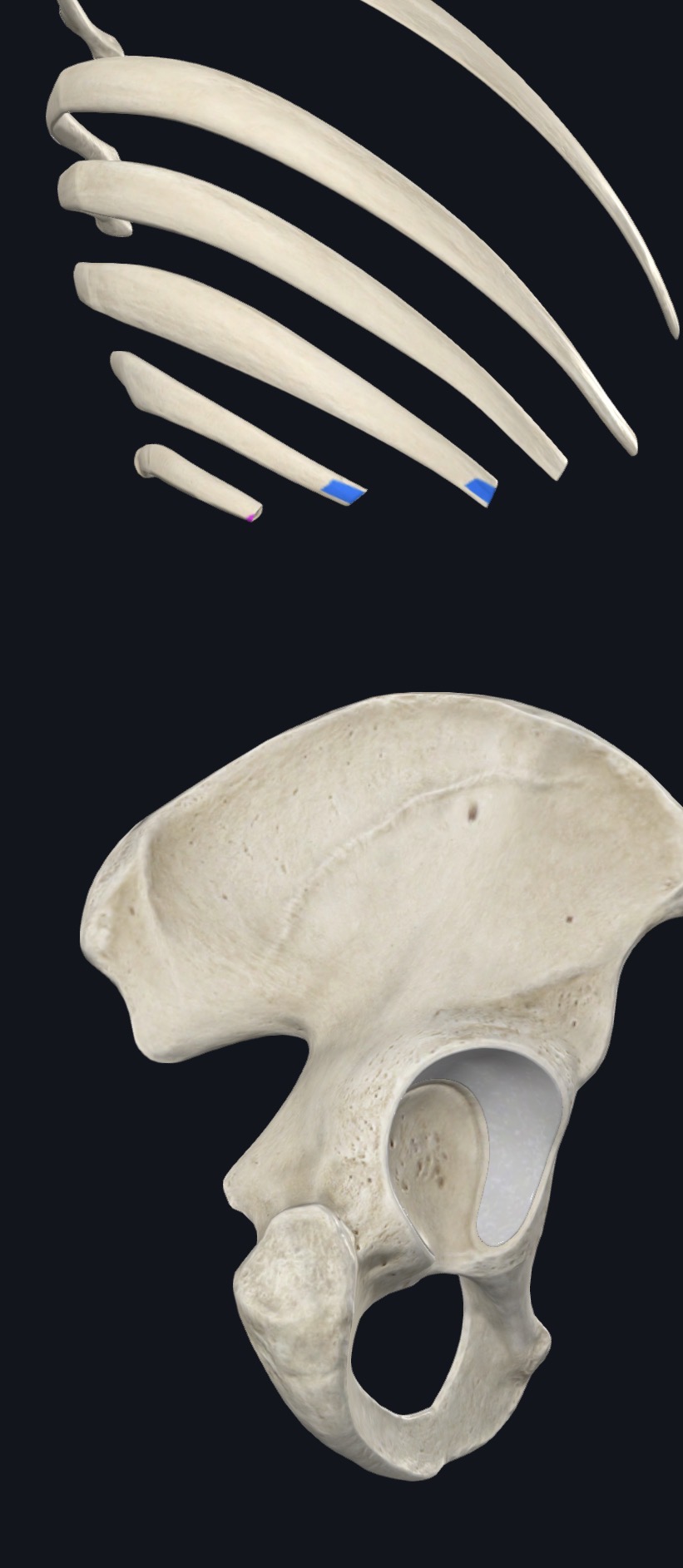
Origin
| Origin | The inner surfaces of the costal cartilages of ribs 7–12, the thoracolumbar fascia, the iliac crest, and the lateral third of the inguinal ligament. |
|---|
Section 03 of 20
Insertion
| Insertion | The linea alba through the rectus sheath, and the pubic crest and pectineal line by the conjoint tendon, shared with internal oblique. |
|---|
An anatomical image for this section will be added when verified source media becomes available.
Section 04 of 20
Actions
No dedicated action video is currently available. This movement is explained below and video will be added when verified source media becomes available.
| Primary action | Abdominal compression. |
|---|---|
| Secondary actions | Trunk and spine stabilization, support for forced exhalation, and support during childbirth, defecation, and vomiting. |
| Movement at the joint | No direct joint action; it stabilizes the lumbar spine and pelvis indirectly. |
| Heads / fiber groups | Single horizontal sheet of fibers. |
| Functional examples | Bracing before lifting; coughing and sneezing; blowing up a balloon; core stability and controlled breathing exercises. |
Abdominal compression
Draws the abdominal wall inward, compressing the abdominal contents; this is its primary role.
Trunk and spine stabilization
Contracts before limb movement to stabilize the spine and pelvis, acting like a natural weight belt.
Support for forced exhalation
Helps push air out during coughing, sneezing, and forceful breathing out.
Support for childbirth and elimination
Assists in bearing down during childbirth, defecation, and vomiting.
Section 05 of 20
Nerve Innervation
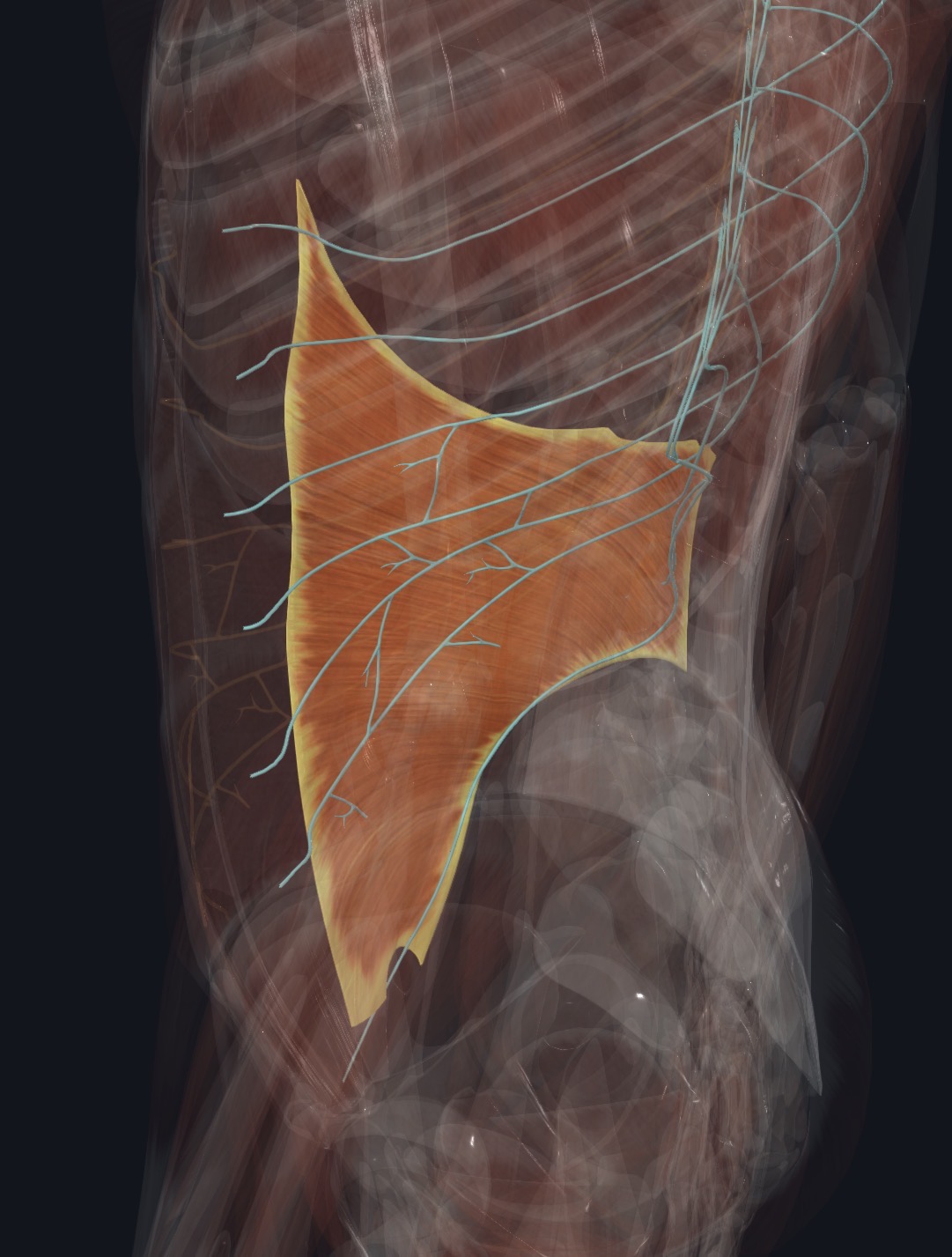
| Nerve | The anterior rami of the lower six thoracic nerves (T7–T12, including the subcostal nerve) and the iliohypogastric and ilioinguinal nerves (L1). |
|---|
The iliohypogastric and ilioinguinal nerves run between transversus abdominis and internal oblique before reaching the groin and genital region. Burning, numbness, or pain in the lower abdomen or groin may reflect nerve irritation, not only muscle tightness.
Section 06 of 20
Blood Supply
| Blood | The deep circumflex iliac artery, the inferior and superior epigastric arteries, and the lower posterior intercostal and subcostal arteries. |
|---|
Section 07 of 20
Pictures and Visual Anatomy
The pictures for this muscle are shown with the Origin, Insertion, Nerve Innervation, and other sections where they teach best.
Section 08 of 20
Functional Movement
Transversus abdominis is active before almost every movement of the arms or legs, bracing the spine and pelvis. It is heavily used in lifting, coughing, blowing up a balloon, and exercises that focus on core control, such as controlled breathing and pelvic stabilization work.
Section 09 of 20
Synergists and Antagonists
Synergists: the internal and external obliques and the pelvic floor muscles (abdominal compression and core stability), and the diaphragm and multifidus in coordinated core control. Antagonists: none in the usual sense, since it works with the other core muscles rather than opposing a single antagonist; the diaphragm's inflation can be seen as an opposing pressure during inhalation.
Section 10 of 20
Palpation and Location
Client position and technique
Position the client supine with the knees bent and the abdomen relaxed. Because it lies deep to the obliques, it is felt indirectly: place the fingers gently below the navel and slightly lateral, and ask the client to draw the navel in toward the spine (an abdominal hollowing action) without holding the breath, to feel the deep layer engage.
Protect nearby structures
Obtain clear consent and use secure draping. The abdominal organs lie directly beneath this muscle. Use very light, flat-hand pressure, never press on a lump, a pulsating area, or a painful spot, and avoid the area entirely in pregnancy and after recent abdominal surgery.
Section 11 of 20
Massage Therapy Relevance
Transversus abdominis is central to core stability and is frequently addressed in low back pain rehabilitation and postpartum recovery. Because it lies over the abdominal organs, gentle technique and clear consent are especially important.
Section 12 of 20
Dysfunction: What Happens When Movement Goes Wrong
Changes in how a muscle works can change how a joint moves. The points below describe possibilities that may be associated with altered muscle function; they are not diagnoses, and one muscle is never assumed to be the sole cause of a problem.
When the muscle is weak
Weakness or poor timing of activation is often discussed in relation to low back pain and reduced core control, though the relationship is complex.
When it is tight or shortened
Excessive or poorly coordinated bracing may be associated with restricted breathing mechanics and a feeling of abdominal tightness.
When it is overused
Repeated heavy lifting or intense core training without adequate recovery may be associated with deep abdominal or flank discomfort.
When it is strained
A strain may cause deep lower abdominal or flank pain with coughing or sudden trunk movement; hernia and visceral causes can look similar.
When it is inhibited or others compensate
Reduced or delayed activation may be associated with less effective spinal bracing and more load on the lumbar spine during lifting.
When it does not coordinate well with synergists and antagonists
Poor coordination with the diaphragm, pelvic floor, and multifidus may alter core stability and may be associated with low back or pelvic symptoms.
Section 13 of 20
Conditions, Pathologies, and Pain Relationships
Core weakness and low back pain
Reduced control of transversus abdominis is often discussed in relation to low back pain, though the relationship is complex and many other factors contribute.
Diastasis recti
Along with rectus abdominis, transversus abdominis function may be affected by the midline separation common in and after pregnancy.
Abdominal wall strain
Sudden forceful trunk movements or heavy coughing may strain the deep abdominal wall and cause lower abdominal or flank discomfort.
Differential considerations
Hernia, gastrointestinal conditions, gynecologic and urinary problems, and referred pain from the spine can all cause abdominal pain that may be mistaken for muscular causes.
Section 14 of 20
Example Clinical Relationship
A client recovering from childbirth reports a persistent doming or bulging along the midline of the abdomen when sitting up, along with mild low back discomfort. Transversus abdominis and rectus abdominis function may be affected by diastasis recti, and the pattern may be associated with reduced core support, but a hernia and pelvic floor problems can look similar. Gentle activation cues and light work on nearby muscles may support comfort, while a painful or non-reducible bulge needs referral.
Section 15 of 20
Massage and Treatment Approaches
For healthy, non-acute tissue with clear consent, position the client supine with the knees supported. Use only very light pressure and gentle guided breathing or abdominal hollowing cues rather than deep massage, since this muscle is best addressed through movement and breath retraining.
| Movement | Use gentle abdominal hollowing and diaphragmatic breathing cues within comfort; this muscle responds best to guided activation, not deep pressure. |
|---|---|
| Regional work | Consider the obliques, the diaphragm, the pelvic floor, and the lumbar multifidus when assessment supports it, within scope of practice. |
| Avoid | Deep pressure on the abdomen, over a hernia, scar, or diastasis, over any pulsation, or at any tender point. |
Section 16 of 20
Precautions and Contraindications
Precautions and contraindications
- Pregnancy (especially after the first trimester), recent abdominal surgery, or a known hernia or diastasis recti.
- Use caution with inflammatory bowel disease, abdominal pain of unknown cause, or after a full meal.
- Use caution with anticoagulant use or easy bruising; avoid deep pressure over a known aortic aneurysm.
- Always obtain explicit consent and use secure draping.
Section 17 of 20
Red Flags and When to Refer
Red flags and referral
- Severe or worsening abdominal pain, fever, vomiting, or a rigid abdomen.
- A new, painful, or non-reducible bulge in the abdominal wall or groin.
- A pulsating abdominal mass, blood in the stool or vomit, or black stool.
- Abdominal pain with chest pain, shortness of breath, or unexplained weight loss.
Section 18 of 20
Study Summary
Attachments
Origin: costal cartilages of ribs 7–12, thoracolumbar fascia, iliac crest, inguinal ligament. Insertion: linea alba and pubic crest.
Actions
Compresses the abdomen and stabilizes the trunk and spine.
Supply
T7–T12 and iliohypogastric/ilioinguinal nerves (L1); epigastric and circumflex iliac arteries.
Section 19 of 20
Instructor Narration
Open narration transcript
Transversus abdominis is the deepest abdominal wall muscle, with fibers running horizontally like a natural corset.
It arises from the costal cartilages of the lower ribs, the thoracolumbar fascia, the iliac crest, and the inguinal ligament, and inserts on the linea alba and the pubic crest.
It compresses the abdomen and stabilizes the trunk and spine, working with the obliques and the rest of the core. It also assists forced exhalation, coughing, and bearing down.
The lower thoracic nerves and the iliohypogastric and ilioinguinal nerves supply it, and the epigastric and circumflex iliac arteries provide its blood.
Because it is deep, it is felt indirectly: ask the client to gently draw the navel toward the spine while breathing normally. Use very light pressure, and obtain consent for any abdominal work.
Core weakness, diastasis recti, and abdominal wall strain are relevant, and hernia and organ conditions must be considered. Refer severe or worsening abdominal pain, a new painful bulge, a pulsating mass, or bleeding.
Remember: lower costal cartilages, thoracolumbar fascia, iliac crest, and inguinal ligament to the linea alba and pubic crest; abdominal compression and trunk stability; T7 to T12 and L1.
Section 20 of 20