Section 01 of 20
Introduction
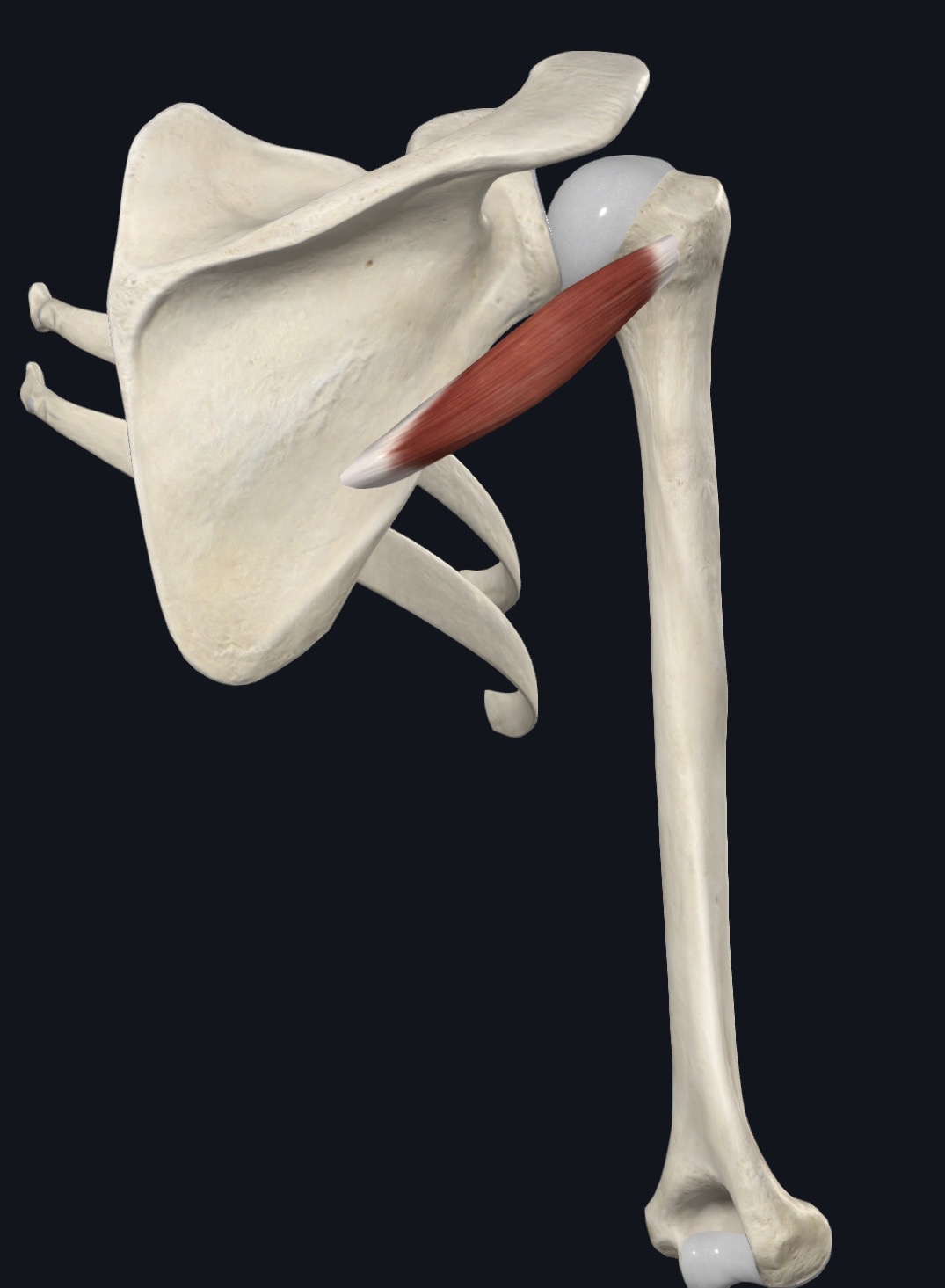
Teres minor is a narrow, cylindrical muscle that runs along the lower part of the lateral border of the scapula to the upper arm bone. It is the smallest of the four rotator cuff muscles and lies just below infraspinatus, sharing a similar action.
Along with the other rotator cuff muscles, subscapularis, supraspinatus, and infraspinatus, teres minor helps keep the head of the humerus centered in the shallow shoulder socket during arm movement, in addition to producing rotation.
Section 02 of 20
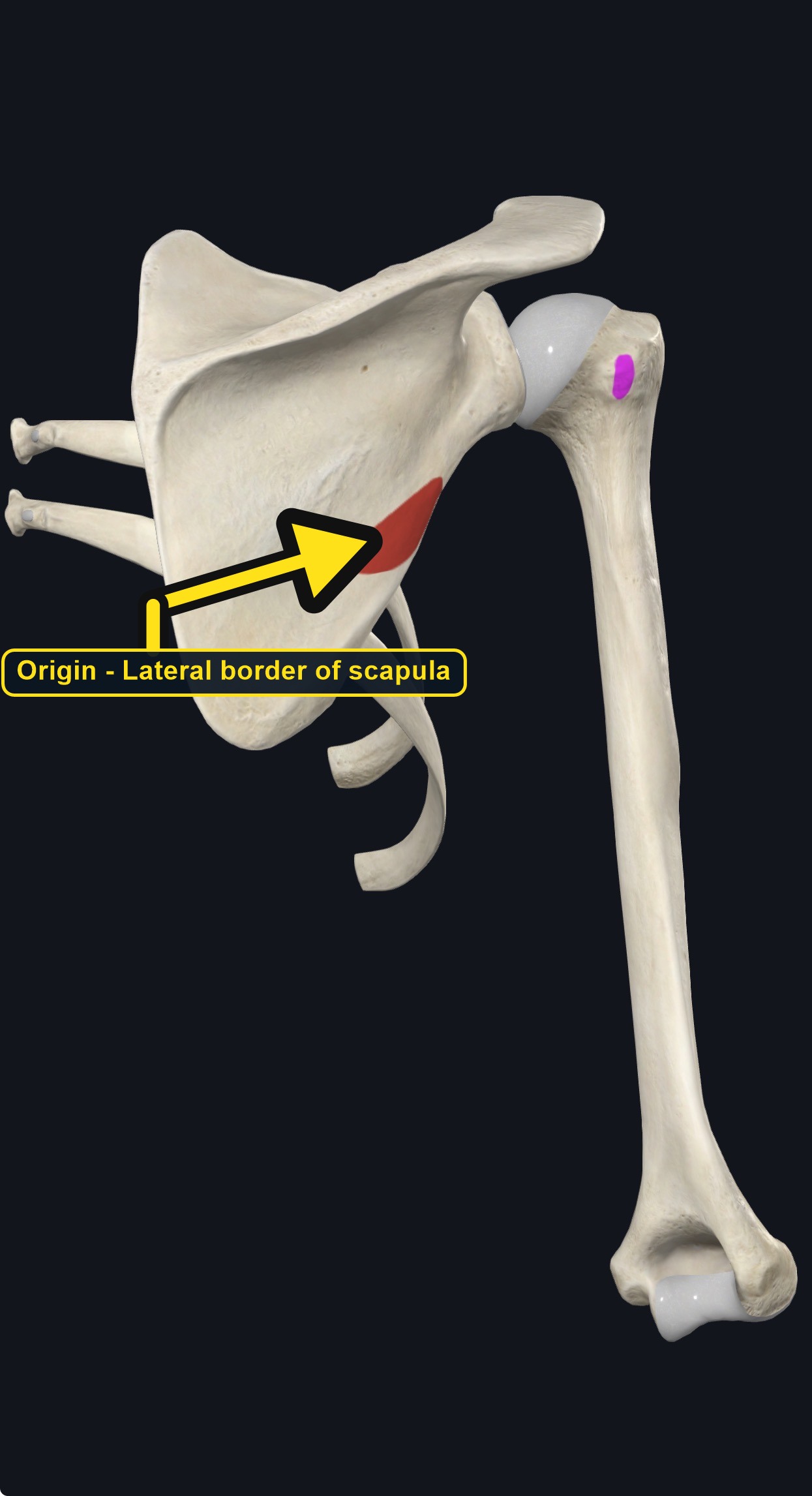
Origin
| Origin | The upper two-thirds of the posterior surface of the lateral border of the scapula. |
|---|
Section 03 of 20
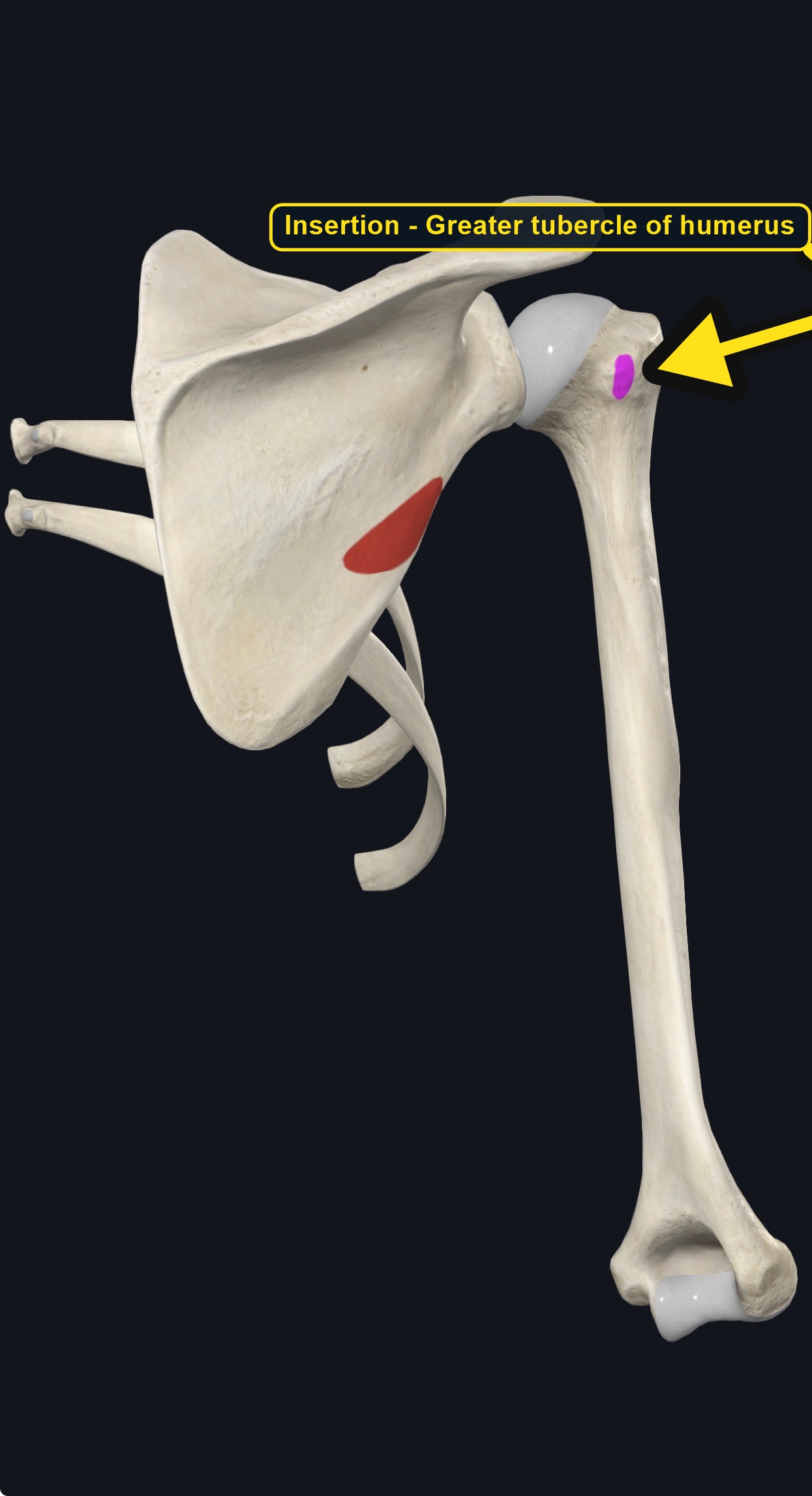
Insertion
| Insertion | The lowest of the three facets on the greater tubercle of the humerus, and the posterior surface of the surgical neck of the humerus. |
|---|
Section 04 of 20
Actions
No dedicated action video is currently available. This movement is explained below and video will be added when verified source media becomes available.
| Primary action | Lateral rotation of the shoulder. |
|---|---|
| Secondary actions | Weak adduction and dynamic stabilization of the humeral head. |
| Movement at the joint | Glenohumeral (shoulder) joint. |
| Heads / fiber groups | Single narrow muscle. |
| Functional examples | Throwing (follow-through); reaching out to the side; serving in tennis; stabilizing the shoulder during overhead activity. |
Lateral (external) rotation of the shoulder
Turns the arm outward, together with infraspinatus.
Weak adduction
May assist a small amount of adduction of the arm.
Dynamic shoulder stabilization
Helps hold the head of the humerus in the glenoid socket during arm movement, especially overhead activity.
Section 05 of 20
Nerve Innervation
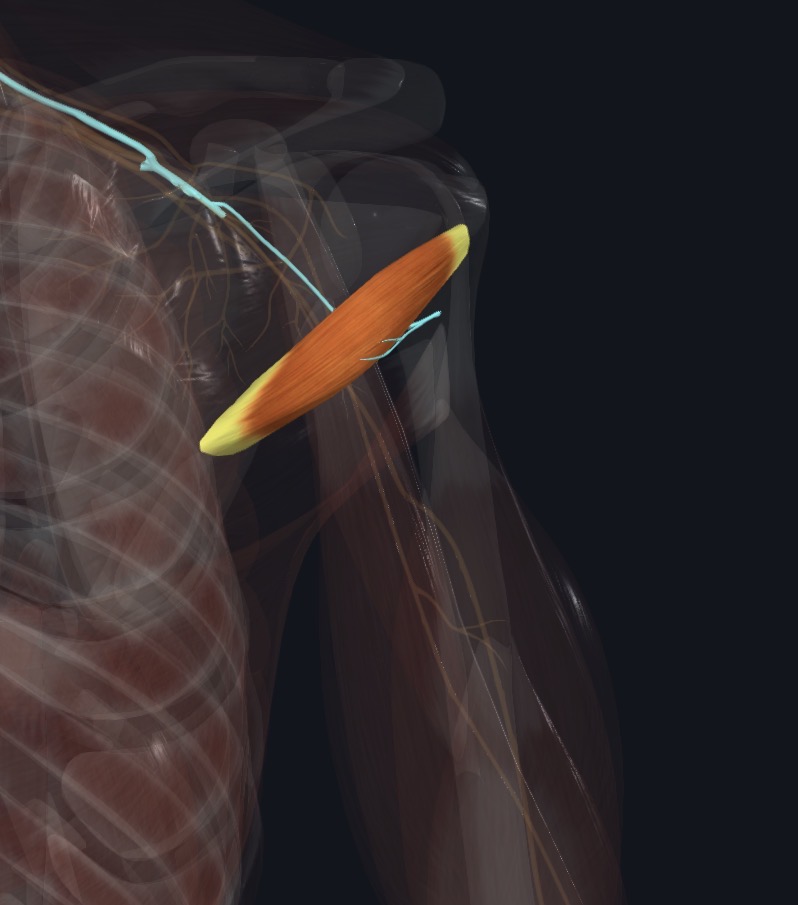
| Nerve | Axillary nerve, roots C5–C6. |
|---|
The axillary nerve also supplies the deltoid and wraps around the surgical neck of the humerus, where it can be injured in shoulder dislocations or fractures. Weakness of lateral rotation with numbness over the shoulder may reflect axillary nerve involvement, not only muscle tightness.
Section 06 of 20
Blood Supply
| Blood | The circumflex scapular artery (a branch of the subscapular artery), with contributions from the posterior circumflex humeral artery. |
|---|
Section 07 of 20
Pictures and Visual Anatomy
Section 08 of 20
Functional Movement
Teres minor works with infraspinatus whenever the arm rotates outward, such as reaching to the side, throwing, and the follow-through phase of a tennis serve or a baseball pitch. It is also constantly active in a small way to stabilize the shoulder during everyday arm movement.
Section 09 of 20
Synergists and Antagonists
Synergists: infraspinatus (lateral rotation) and the posterior deltoid. Antagonists: subscapularis and pectoralis major (medial rotation).
Section 10 of 20
Palpation and Location
Client position and technique
Position the client prone with the arm resting off the side of the table or supported. Locate the lateral border of the scapula below the level of the spine of the scapula, where teres minor lies above teres major. Ask the client to laterally rotate the arm against light resistance to feel it tighten alongside infraspinatus.
Protect nearby structures
Use moderate pressure and work slowly, since this area is often tender in shoulder problems. Avoid deep pressure directly in the armpit, where the axillary nerve and vessels pass, and stop if the client reports tingling, numbness, or sharp pain.
Section 11 of 20
Massage Therapy Relevance
Teres minor is one of the four rotator cuff muscles and is involved in throwing and overhead athletic activities. Rotator cuff symptoms have many possible sources, so careful assessment and appropriate referral are important.
Section 12 of 20
Dysfunction: What Happens When Movement Goes Wrong
Changes in how a muscle works can change how a joint moves. The points below describe possibilities that may be associated with altered muscle function; they are not diagnoses, and one muscle is never assumed to be the sole cause of a problem.
When the muscle is weak
Weakness may reduce lateral rotation strength and shoulder stability and may be associated with more load on infraspinatus and the posterior deltoid.
When it is tight or shortened
Tightness may be associated with limited medial rotation and a feeling of tightness at the back of the shoulder.
When it is overused
Repetitive throwing and overhead activity may overload the muscle and tendon and may contribute to posterior shoulder pain.
When it is strained
A strain may cause pain at the back of the shoulder with resisted lateral rotation; other rotator cuff and joint problems can look similar.
When it is inhibited or others compensate
Reduced activation may be associated with poor shoulder control and increased risk of instability during overhead movement.
When it does not coordinate well with synergists and antagonists
Poor coordination with infraspinatus, subscapularis, and the scapular muscles may alter shoulder mechanics and may be associated with shoulder symptoms.
Section 13 of 20
Conditions, Pathologies, and Pain Relationships
Rotator cuff strain or tendinopathy
Repetitive overhead throwing or lifting may strain teres minor or its tendon, causing pain at the back of the shoulder.
Quadrilateral space syndrome
Compression of the axillary nerve and posterior circumflex humeral artery near teres minor may cause deep shoulder ache and numbness over the outer shoulder.
Rotator cuff tear
A sudden injury or degenerative tear involving teres minor or the surrounding cuff muscles may cause weakness of lateral rotation and shoulder pain; imaging and medical assessment are needed.
Differential considerations
Cervical radiculopathy, other rotator cuff and labral injuries, and referred pain from the neck can all cause similar shoulder symptoms.
Section 14 of 20
Example Clinical Relationship
A baseball pitcher reports a deep ache at the back of the shoulder after throwing sessions, along with some numbness over the outer shoulder. Teres minor and the surrounding rotator cuff may be involved, and the pattern may be associated with overuse or possible nerve involvement near the muscle, but cervical and other shoulder problems can look similar. Gentle work along the scapula may support comfort once assessed, while sudden weakness after a fall or persistent numbness needs referral.
Section 15 of 20
Massage and Treatment Approaches
For healthy, non-acute tissue, position the client prone with the arm supported. Begin with light effleurage over the back of the shoulder blade, then use gentle kneading along the lateral border of the scapula, working within comfortable pressure and avoiding the armpit.
| Movement | Use gentle shoulder rotation within comfort; do not force range in an irritable shoulder. |
|---|---|
| Regional work | Consider infraspinatus, teres major, the posterior deltoid, and the rhomboids when assessment supports it. |
| Avoid | Deep pressure in the armpit, over an acute strain or suspected tear, or at any point that reproduces numbness or tingling in the arm. |
Section 16 of 20
Precautions and Contraindications
Precautions and contraindications
- Acute shoulder injury, suspected rotator cuff tear, dislocation, or recent shoulder surgery.
- Use caution with shoulder instability or a history of dislocation.
- Use caution with anticoagulant use or easy bruising.
- Stop if pressure causes sharp pain, numbness, or tingling in the arm.
Section 17 of 20
Red Flags and When to Refer
Red flags and referral
- Sudden shoulder weakness after a fall or injury, especially with an inability to lift the arm.
- Numbness over the outer shoulder with deep aching pain (possible quadrilateral space syndrome).
- Shoulder pain with fever, night pain, or unexplained weight loss.
- Progressive arm weakness, numbness, or signs of a rotator cuff tear that do not improve.
Section 18 of 20
Study Summary
Attachments
Origin: upper two-thirds of the lateral border of the scapula. Insertion: lowest facet of the greater tubercle of the humerus.
Actions
Laterally rotates the shoulder and helps stabilize the humeral head.
Supply
Axillary nerve (C5–C6); circumflex scapular artery.
Section 19 of 20
Instructor Narration
Open narration transcript
Teres minor is the smallest rotator cuff muscle, running along the lower lateral border of the scapula, just below infraspinatus.
It arises from the upper two-thirds of the lateral border of the scapula and inserts on the lowest facet of the greater tubercle of the humerus.
It laterally rotates the shoulder and helps stabilize the head of the humerus in the socket. Infraspinatus and the posterior deltoid help it, and subscapularis and pectoralis major oppose it.
The axillary nerve supplies it, from C5 to C6, and the circumflex scapular artery provides its blood.
Palpate with the client prone, along the lateral border of the scapula below the spine of the scapula, and ask for gentle lateral rotation. Avoid deep pressure in the armpit.
Rotator cuff strain, quadrilateral space syndrome, and rotator cuff tears are important considerations, and cervical and other shoulder problems can overlap. Refer sudden shoulder weakness after a fall, numbness over the outer shoulder with deep ache, or shoulder pain with fever.
Remember: lateral border of the scapula to the greater tubercle of the humerus; lateral rotation; axillary nerve.
Section 20 of 20