Section 01 of 20
Introduction
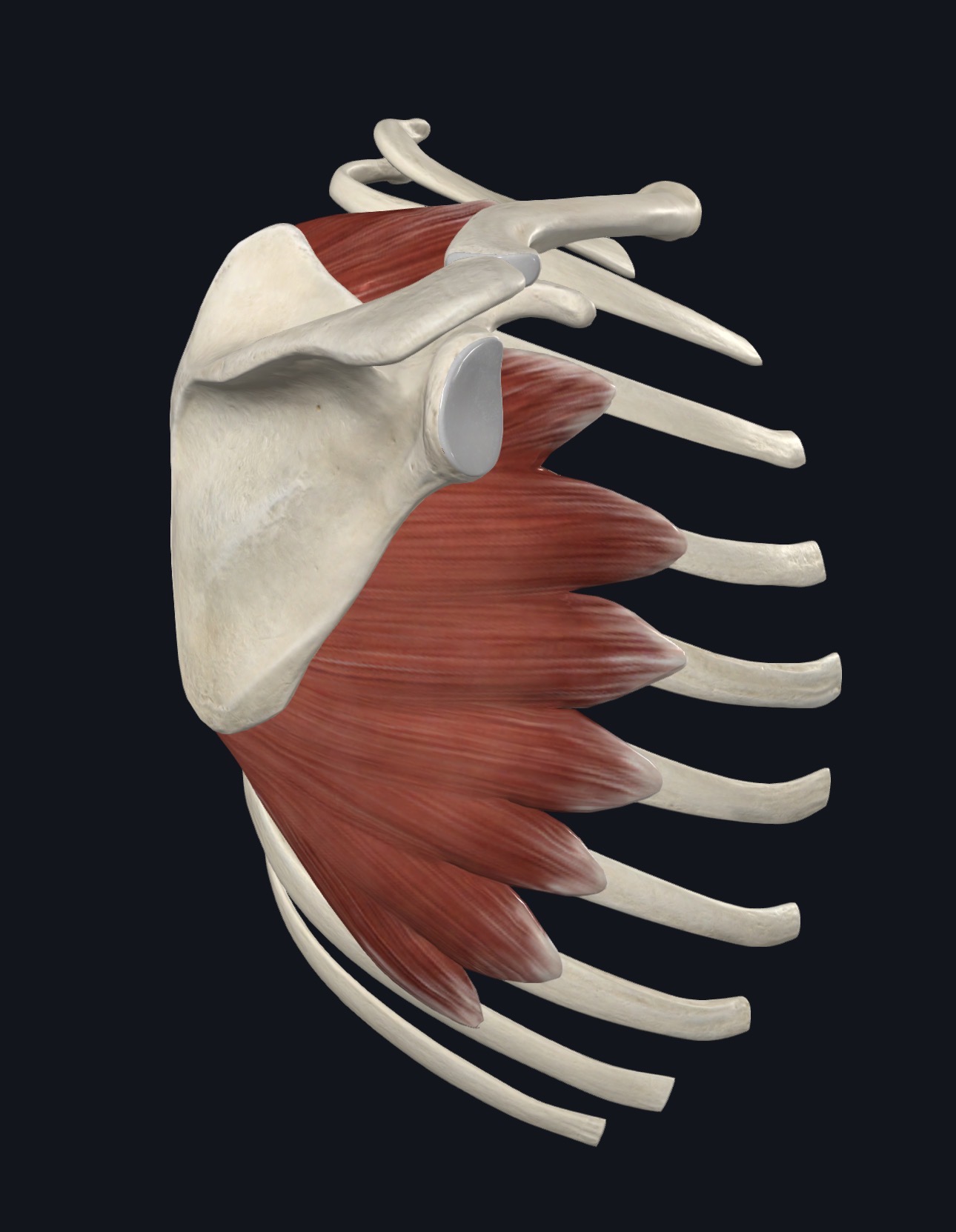
Serratus anterior is a broad, fan-shaped muscle on the lateral wall of the rib cage, named for the saw-toothed (serrated) appearance of its rib attachments. It originates as a series of slips from the upper ribs and wraps around the side of the chest wall to attach along the inside edge of the shoulder blade, effectively sitting between the ribs and the scapula.
Serratus anterior is essential for normal scapular mechanics: it holds the scapula firmly against the rib cage (preventing it from winging away from the back) and works together with the trapezius to rotate the scapula upward during overhead arm movement. It is sometimes informally called the "boxer's muscle" because of its strong involvement in punching and pushing movements, where the scapula must protract firmly around the rib cage.
For massage therapists, serratus anterior is important both for its role in general shoulder blade mechanics and because dysfunction of this specific muscle is associated with a distinctive and recognizable postural sign: scapular winging.
Section 02 of 20
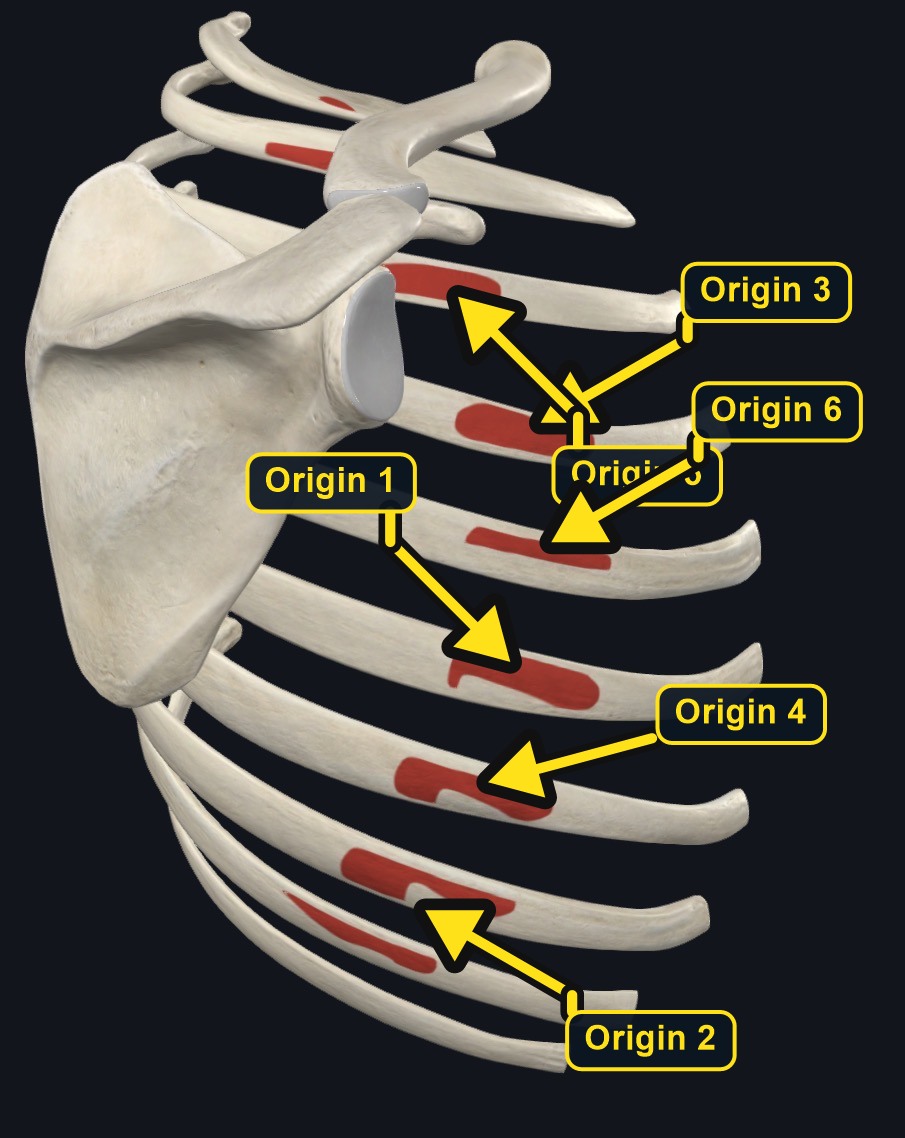
Origin
| Origin | External surfaces and superior borders of the upper eight or nine ribs, via a series of finger-like muscular slips along the lateral rib cage. |
|---|
Section 03 of 20
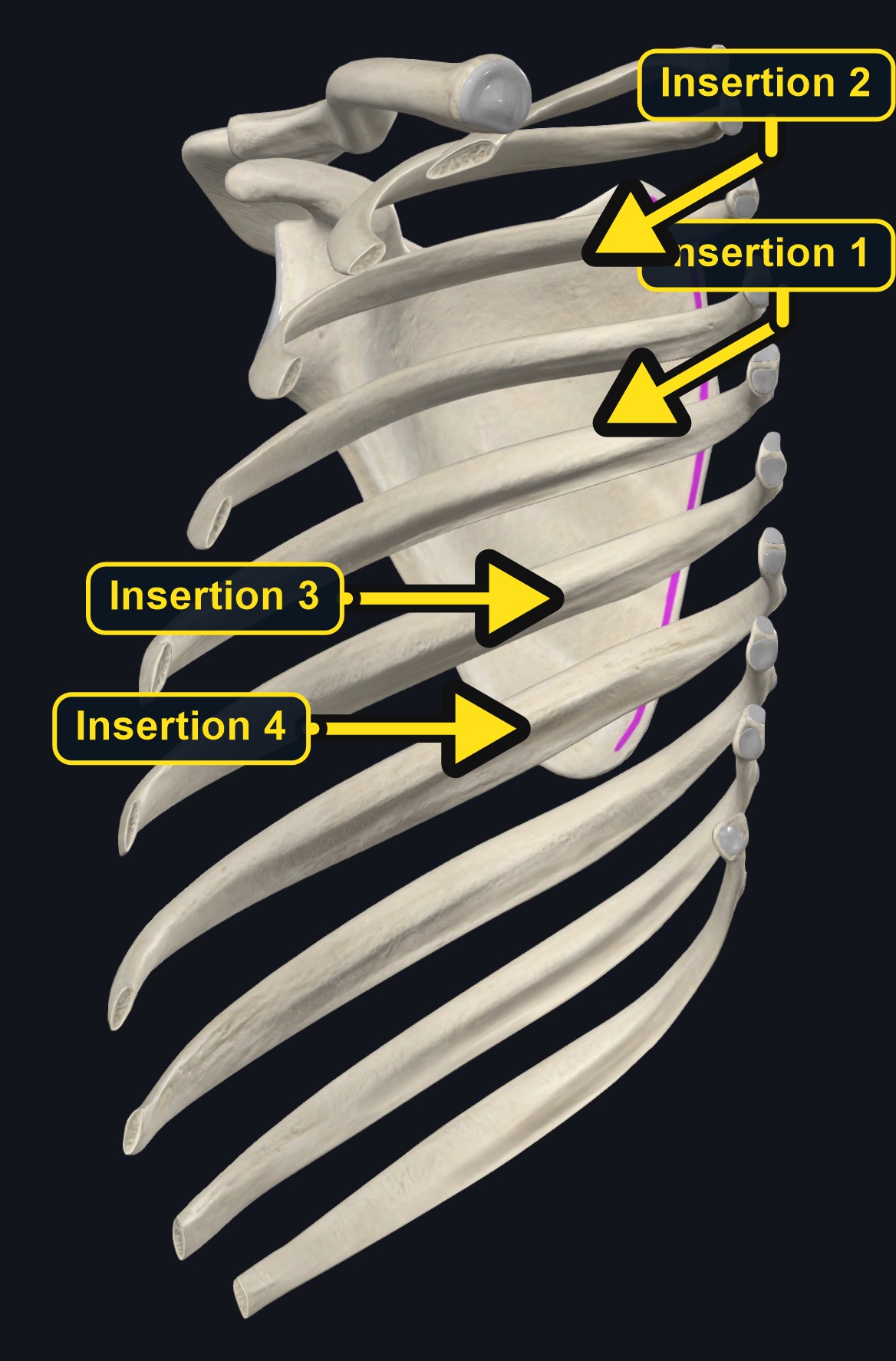
Insertion
| Insertion | Anterior (costal) surface of the medial border of the scapula, running the length of the border, with particularly strong attachments at the superior and inferior angles. |
|---|
Section 04 of 20
Actions
| Primary action | Scapular protraction (drawing the scapula forward around the rib cage). |
|---|---|
| Secondary actions | Upward rotation of the scapula (with trapezius); holds the medial scapular border against the ribs; the lower fibers may assist rib elevation in forced inspiration. |
| Movement at the joint | Scapulothoracic joint. |
| Heads / fiber groups | Upper, middle, and lower fiber groups; the lower fibers are important for upward rotation. |
| Functional examples | Reaching forward; punching; push-ups; raising the arm overhead; carrying a heavy load in front. |
Primary actions
- Protraction of the scapula — draws the shoulder blade forward around the rib cage (e.g., reaching or punching forward).
- Holds the medial border of the scapula firmly against the rib cage, preventing it from lifting away from the back (winging).
- Upward rotation of the scapula, working as a critical partner with the trapezius during arm elevation above shoulder height.
Section 05 of 20
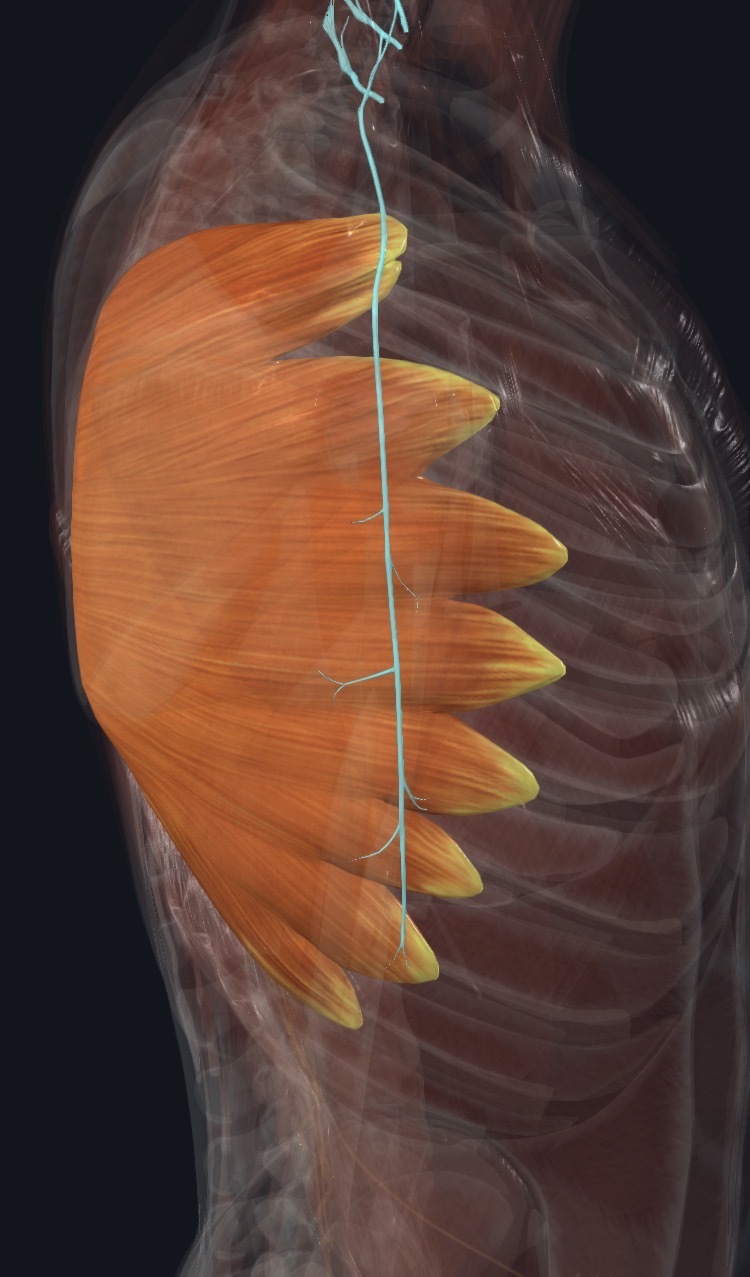
Nerve Innervation
| Nerve | Long thoracic nerve |
|---|---|
| Roots | C5, C6, C7 |
| Relationship | The long thoracic nerve arises directly from the roots of the brachial plexus (rather than from one of its later branches) and travels down the lateral rib cage, running superficially along the muscle it supplies. This superficial course makes it particularly vulnerable to injury (for example, during certain surgical procedures or from direct trauma/compression), and long thoracic nerve injury is the classic cause of serratus anterior-related scapular winging. |
Section 06 of 20
Blood Supply
Serratus anterior is supplied primarily by the lateral thoracic artery, with additional contribution from branches of the thoracodorsal artery and the posterior intercostal arteries.
Section 07 of 20
Pictures and Visual Anatomy
Section 08 of 20
Functional Movement
Serratus anterior holds the scapula against the rib cage and moves it forward and upward around the chest when you reach, push, punch, or lift the arm overhead. It works with the upper and lower trapezius to rotate the scapula upward so the arm can be raised fully.
Section 09 of 20
Synergists and Antagonists
Synergists
Pectoralis minor (protraction); upper and lower trapezius (upward rotation, forming a well-known "force couple" with serratus anterior).
Antagonists
Rhomboids and middle trapezius (retraction) generally oppose the protraction action of serratus anterior.
Section 10 of 20
Palpation and Location
Client position
Client side-lying or supine with the arm relaxed, allowing access to the lateral rib cage.
Landmarks and technique
- The muscle's serrated slips can often be felt along the lateral rib cage, roughly in the area between the axilla and the lower ribs, especially in leaner clients.
- Asking the client to gently push their arm forward against light resistance (a protraction motion, as if punching forward) will help the therapist feel the muscle contract.
- The medial border of the scapula can be used as a reference point — serratus anterior's insertion runs along the underside of this border, though it is not directly accessible for palpation without lifting the scapula away from the rib cage (a specific assessment technique, not a general palpation approach).
- Because this region overlies the rib cage and is close to breast tissue in some clients, palpation should respect draping, consent, and professional boundaries at all times, and should remain gentle given the sensitivity of the lateral chest wall for many people.
Section 11 of 20
Massage Therapy Relevance
Serratus anterior is functionally linked to pectoralis minor, both being protractors of the scapula, and clients with rounded-shoulder posture often show tightness or imbalance involving both muscles together with a relatively weaker mid-back (rhomboid/trapezius) group.
Because serratus anterior is essential to smooth overhead arm movement (as part of the upward-rotation force couple with trapezius), general tension, weakness, or pain in this muscle can influence overall shoulder mechanics during reaching activities, and is worth considering in clients reporting general shoulder discomfort during overhead tasks.
This muscle is also relevant to breathing mechanics given its rib attachments, and is sometimes discussed in relation to general chest wall and rib mobility work.
Section 12 of 20
Dysfunction: What Happens When Movement Goes Wrong
Changes in how a muscle works can change how a joint moves. The points below describe possibilities that may be associated with altered muscle function; they are not diagnoses, and one muscle is never assumed to be the sole cause of a problem.
When the muscle is weak
Weakness may cause the medial border of the scapula to lift away from the ribs (scapular winging) and may be associated with reduced overhead reach and shoulder pain; long thoracic nerve problems should be considered.
When it is tight or shortened
Tightness may be associated with a protracted scapula and rib-side tenderness during deep breathing.
When it is overused
Repetitive pushing, punching, or overhead work may overload the muscle and may contribute to lateral chest wall ache.
When it is strained
A strain may cause pain along the ribs with reaching or deep breathing; chest wall pain also has lung, cardiac, and rib causes.
When it is inhibited or others compensate
Reduced activation may be associated with compensation from the upper trapezius and pectoralis minor and an altered scapular rhythm.
When it does not coordinate well with synergists and antagonists
Poor coordination with the trapezius, rhomboids, and pectoralis minor may alter scapular position and may be associated with shoulder impingement symptoms.
Section 13 of 20
Conditions, Pathologies, and Pain Relationships
Long thoracic nerve palsy and scapular winging
What it is: Weakness or paralysis of serratus anterior due to long thoracic nerve injury, resulting in the classic sign of a "winged scapula" — the medial border of the shoulder blade lifting away from the rib cage, especially when pushing against resistance (such as pushing against a wall).
Why the muscle may be involved: Serratus anterior is the primary muscle holding the scapula against the rib cage; without adequate function, this stabilization is lost.
Typical symptoms: Visible winging of the scapula, weakness with overhead reaching or pushing movements, and sometimes shoulder discomfort from altered mechanics.
Similar-presenting conditions: Trapezius dysfunction (spinal accessory nerve injury) can also cause a form of scapular winging, though with a somewhat different pattern and orientation.
Refer when: Any suspected or observed scapular winging warrants medical/neurological evaluation to determine the underlying cause; this is a diagnostic and often neurological issue outside massage therapy scope.
Serratus anterior strain / overuse tension
What it is: Muscle strain or general fatigue-related tightness from repetitive protraction or pushing/punching-type activities.
Why the muscle may be involved: High demand during repetitive forward pushing or overhead reaching activities.
Typical symptoms: Lateral rib cage discomfort, sometimes aggravated by deep breathing or arm movement.
Similar-presenting conditions: Intercostal muscle strain, rib pathology, referred pain from the shoulder or spine.
Refer when: Pain is severe, persistent, or associated with breathing difficulty, chest pain, or other systemic symptoms — chest wall pain always warrants careful screening given its proximity to the ribs, lungs, and heart.
Section 14 of 20
Example Clinical Relationship
Why smooth overhead reaching depends on serratus anterior
Normal arm elevation above shoulder height relies on a coordinated pattern called scapulohumeral rhythm, in which the scapula upwardly rotates in a fairly consistent ratio with humeral elevation. Serratus anterior and the trapezius are the primary force couple producing this upward rotation; when either is weak, tight, or poorly coordinated, this rhythm can be disrupted, potentially contributing to compensatory strain elsewhere in the shoulder complex (including the rotator cuff) and to a general sense of shoulder dysfunction during overhead activity.
Massage therapists should understand this relationship as a piece of general shoulder-complex reasoning rather than a tool for diagnosing specific movement disorders. Persistent overhead movement dysfunction, significant weakness, or visible winging should be referred for appropriate physical therapy or medical assessment.
Section 15 of 20
Massage and Treatment Approaches
The following approaches may be considered for a generally healthy client with no contraindications present.
Broad warming strokes
Why: Prepares the lateral chest wall tissue.
Direction/location: Broad strokes along the lateral rib cage, respecting draping and breast tissue boundaries.
Pressure: Light.
Gentle compression and kneading
Why: May help address general tightness along the serrated rib attachments.
Direction/location: Gentle contact along the palpable slips on the lateral rib cage.
Pressure: Light to moderate, following the contour of the ribs; avoid pressing between ribs with a narrow, poking contact.
Myofascial techniques
Why: May help address fascial restriction linking the chest wall and scapular region.
Direction/location: Slow, broad contact across the lateral chest wall and toward the scapular border.
Pressure: Light, sustained.
Active/passive movement
Why: Gentle protraction/retraction movement (e.g., a supported reaching motion) can help assess and support general scapular mobility.
Pressure: Light guidance only, not resistance training.
Section 16 of 20
Precautions and Contraindications
Use caution or avoid the area when any of the following are present
- Any chest pain, pressure, or tightness — treat as a possible medical emergency and refer immediately rather than proceeding with massage.
- Acute rib injury or suspected rib fracture.
- Recent thoracic or shoulder surgery without medical clearance for massage.
- Unexplained swelling, lump, or skin changes in the chest wall.
- Signs of infection or acute inflammation.
- Visible scapular winging of unknown cause, until medically evaluated.
Vulnerable structures — general awareness
- Breast tissue — respect draping, consent, and professional boundaries at all times.
- The intercostal spaces between ribs — avoid narrow, poking, or excessively deep pressure between individual ribs.
Section 17 of 20
Red Flags and When to Refer
Postpone massage and refer for medical evaluation if a client reports or shows:
- Chest pain, pressure, or tightness — especially with shortness of breath, sweating, nausea, or pain radiating to the jaw, neck, or arm. Treat as a possible cardiac emergency.
- Visible scapular winging, especially if new or associated with weakness.
- New or progressive weakness in the shoulder or arm.
- Signs of infection (fever, redness, warmth) in the chest wall.
- Unexplained lump, swelling, or skin changes in the breast or chest wall.
- Recent significant trauma to the chest or shoulder.
Section 18 of 20
Study Summary
External surfaces of the upper 8-9 ribs.
Anterior (costal) surface of the medial border of the scapula.
Scapular protraction, holds scapula against the rib cage, upward rotation (with trapezius).
Long thoracic nerve (C5, C6, C7).
Essential to normal overhead shoulder mechanics; dysfunction linked to visible scapular winging; functionally paired with pectoralis minor and trapezius.
Section 19 of 20
Instructor Narration
Open narration script (readable / for audio conversion)
Section 20 of 20