Section 01 of 20
Introduction
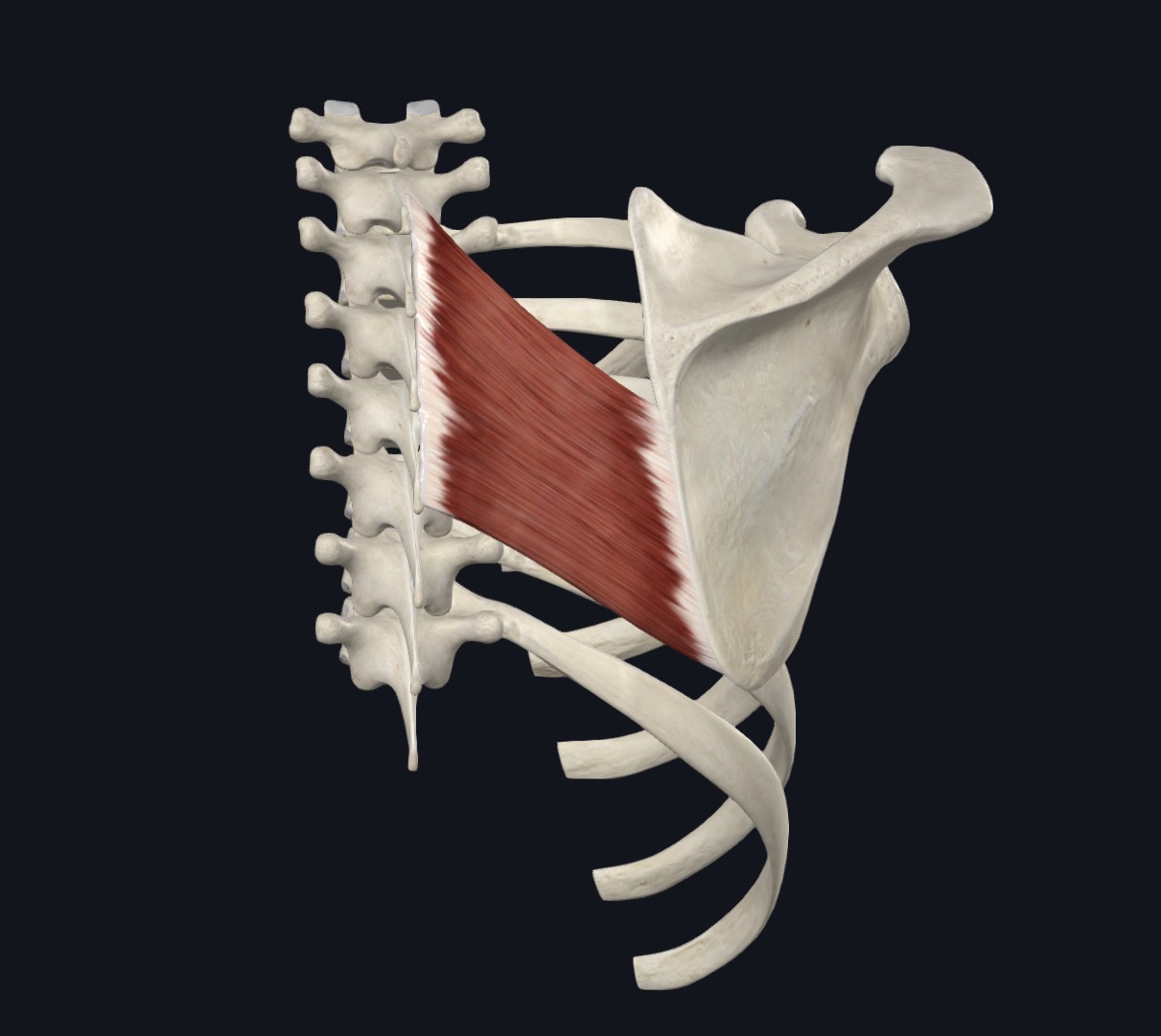
Rhomboid major is a broad, flat, parallelogram-shaped muscle in the upper back. It runs down and outward from the spine of the upper thoracic vertebrae to the medial border of the scapula, deep to the trapezius and just below the smaller rhomboid minor.
Its fibers hold the shoulder blade snugly against the rib cage and pull it toward the spine, which is why it works constantly to control the position of the shoulder blade when the arm is used.
Section 02 of 20
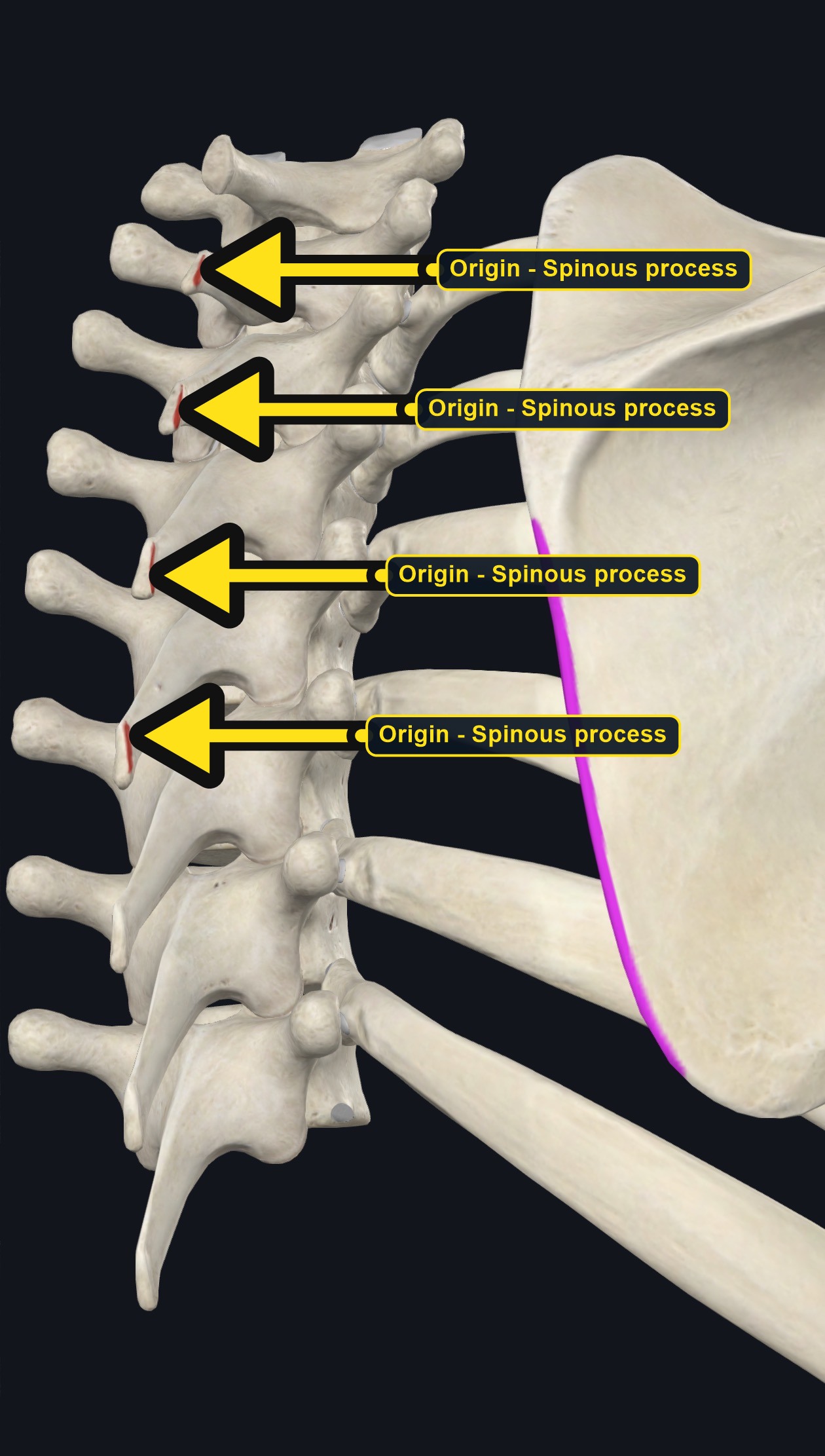
Origin
| Origin | The spinous processes of the vertebrae T2–T5 and the supraspinous ligaments between them. |
|---|
Section 03 of 20
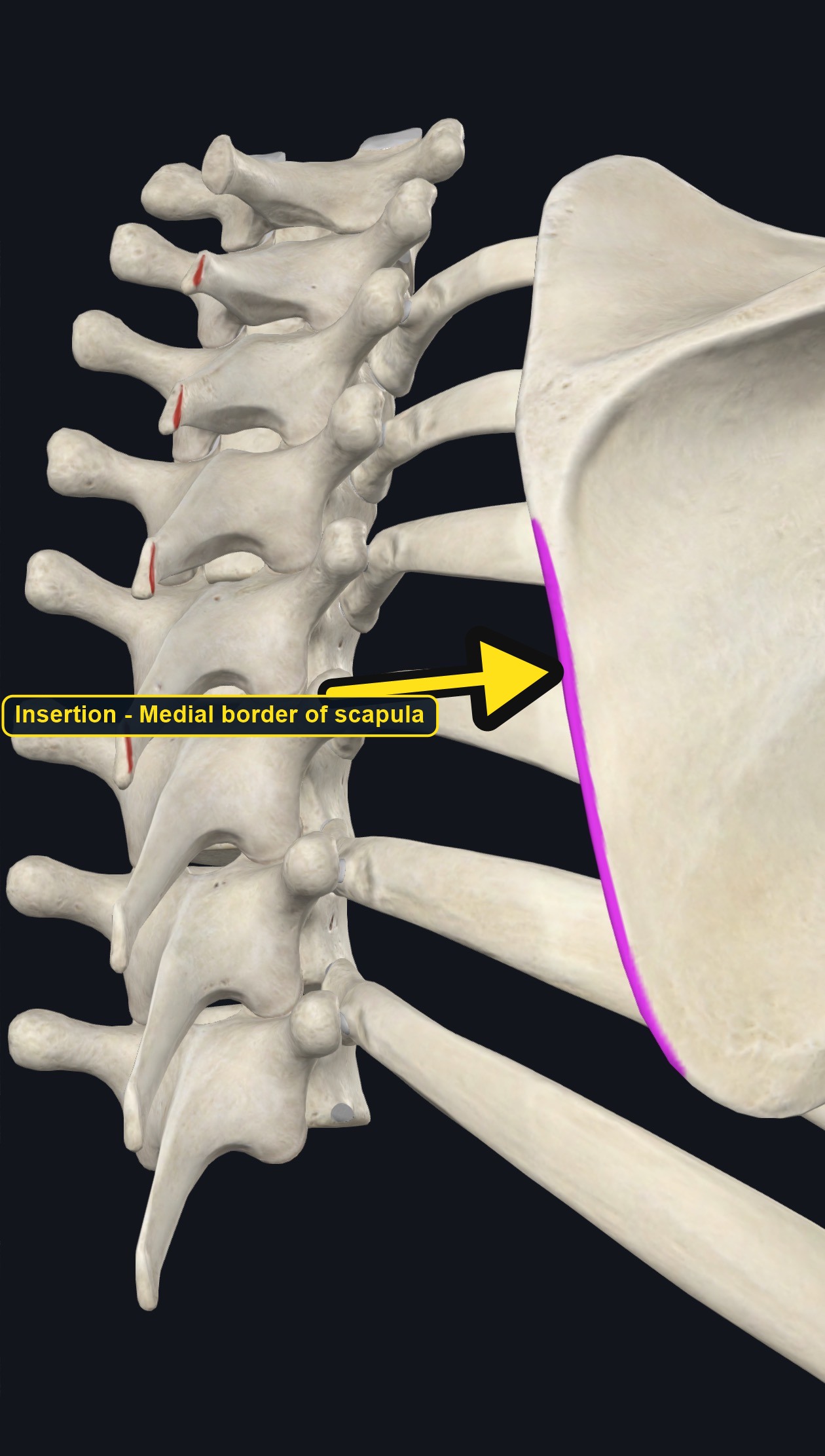
Insertion
| Insertion | The medial border of the scapula between the root of the spine of the scapula and the inferior angle. |
|---|
Section 04 of 20
Actions
No dedicated action video is currently available. This movement is explained below and video will be added when verified source media becomes available.
| Primary action | Retraction of the scapula. |
|---|---|
| Secondary actions | Downward rotation of the scapula, slight elevation, and stabilization against the rib cage. |
| Movement at the joint | Scapulothoracic movement. |
| Heads / fiber groups | Single broad muscle, larger and lower than rhomboid minor. |
| Functional examples | Rowing; pulling; squeezing the shoulder blades together; lowering the arm against resistance; sitting upright. |
Scapular retraction
Pulls the scapula toward the spine, as in squeezing the shoulder blades together.
Downward rotation of the scapula
Rotates the shoulder joint socket downward as the arm is lowered.
Scapular elevation and stabilization
Helps lift the scapula slightly and holds it firmly against the rib cage.
Section 05 of 20
Nerve Innervation
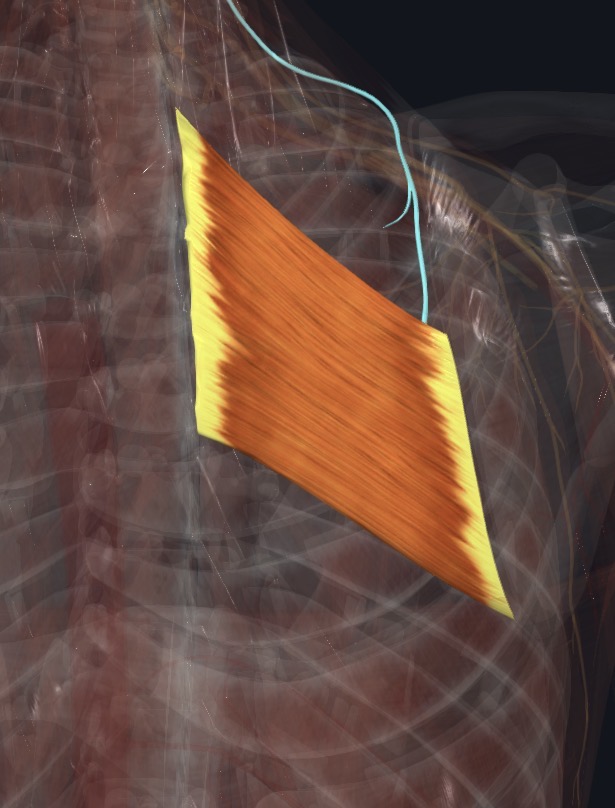
| Nerve | Dorsal scapular nerve, roots C4–C5 (mainly C5). |
|---|
The dorsal scapular nerve passes through the scalene muscles and runs along the medial border of the scapula. Weakness of scapular retraction with a winged shoulder blade, or pain along the medial border, may reflect a nerve problem, not only muscle tightness.
Section 06 of 20
Blood Supply
| Blood | The dorsal scapular artery (the deep branch of the transverse cervical artery), with contributions from the posterior intercostal arteries. |
|---|
Section 07 of 20
Pictures and Visual Anatomy
Section 08 of 20
Functional Movement
Rhomboid major works when rowing, pulling, lowering the arm against resistance, sitting upright with good posture, and holding the shoulder blade steady while the arm reaches or carries. It also resists the forward pull of heavy loads.
Section 09 of 20
Synergists and Antagonists
Synergists: rhomboid minor, the middle trapezius (retraction), and levator scapulae (elevation and downward rotation). Antagonists: serratus anterior and pectoralis minor (protraction), and the upper and lower trapezius for upward rotation.
Section 10 of 20
Palpation and Location
Client position and technique
Position the client prone with the arm relaxed at the side, or seated. Locate the medial border of the scapula and the spinous processes between T2 and T5, then feel for the muscle between them, deep to the trapezius. Ask the client to place the hand on the low back and lift it slightly, or to squeeze the shoulder blades together, to feel the muscle tighten.
Protect nearby structures
Use moderate, broad pressure. Avoid pressing hard on the ribs or the spinous processes, and stop if the client reports sharp pain, tingling, or pain that feels deep in the chest.
Section 11 of 20
Massage Therapy Relevance
Rhomboid major is commonly tender between the shoulder blades, especially with rounded-shoulder posture, desk work, and carrying loads. It is often described as overstretched and weak rather than tight, and pain between the shoulder blades can also come from the spine, the ribs, and internal organs.
Section 12 of 20
Dysfunction: What Happens When Movement Goes Wrong
Changes in how a muscle works can change how a joint moves. The points below describe possibilities that may be associated with altered muscle function; they are not diagnoses, and one muscle is never assumed to be the sole cause of a problem.
When the muscle is weak
Weakness may be associated with rounded shoulders, a slightly winged scapula, and poor control of the shoulder blade during pulling.
When it is tight or shortened
Tightness may be associated with a pinched feeling between the shoulder blades and limited protraction and reaching.
When it is overused
Repeated pulling and long periods of holding the shoulders back may overload the muscle and may contribute to interscapular ache.
When it is strained
A strain may cause sharp pain along the medial border of the scapula with pulling and deep breathing; rib and spine problems can look similar.
When it is inhibited or others compensate
Reduced activation may be associated with more work by the upper trapezius and levator scapulae and a forward shoulder posture.
When it does not coordinate well with synergists and antagonists
Poor coordination with the trapezius, serratus anterior, and lats may alter scapular position and may be associated with shoulder and upper back symptoms.
Section 13 of 20
Conditions, Pathologies, and Pain Relationships
Rhomboid strain and tenderness
Sudden pulling, heavy lifting, and prolonged forward posture may be associated with a dull ache or sharp pain along the medial border of the scapula.
Overstretched and weak muscle
Long periods of rounded shoulders may keep the rhomboids lengthened and may be associated with poor scapular control and tension between the shoulder blades.
Dorsal scapular nerve involvement
Compression or injury may weaken the muscle, leading to a slightly winged scapula and a burning pain along the medial border.
Differential considerations
Cervical radiculopathy, thoracic facet or rib joint dysfunction, rotator cuff problems, and referred pain from the gallbladder, heart, or lungs can all cause pain between the shoulder blades.
Section 14 of 20
Example Clinical Relationship
A client who spends long hours at a desk with rounded shoulders reports a burning ache between the shoulder blades that eases when the shoulders are pulled back. The rhomboids may be overstretched and involved, and the pattern may be associated with postural strain, but spine, rib, and nerve problems can look similar. Gentle work between the shoulder blades may support comfort, while chest pressure, fever, or progressive weakness needs referral.
Section 15 of 20
Massage and Treatment Approaches
For healthy, non-acute tissue, position the client prone or seated with the arm relaxed. Begin with broad effleurage over the upper back, then use gentle kneading and slow strokes along the fibers, and consider gentle stretching of the muscle by moving the arm across the chest within comfort.
| Movement | Use gentle scapular protraction and arm cross-body movement within comfort; encourage gentle postural awareness. |
|---|---|
| Regional work | Consider the trapezius, levator scapulae, pectoralis minor, serratus anterior, and the thoracic paraspinals when assessment supports it. |
| Avoid | Deep pressure over the ribs and spinous processes, over an acute strain, or at any point that reproduces chest pain or arm tingling. |
Section 16 of 20
Precautions and Contraindications
Precautions and contraindications
- Acute back injury, rib fracture, suspected fracture, or recent thoracic surgery.
- Use caution with severe osteoporosis, anticoagulant use, or easy bruising.
- Avoid strong pressure over the ribs and the spine.
- Stop if pressure causes sharp pain, chest discomfort, or arm tingling.
Section 17 of 20
Red Flags and When to Refer
Red flags and referral
- Pain between the shoulder blades with chest pressure, shortness of breath, sweating, or pain that spreads to the jaw or left arm.
- Right shoulder blade pain with nausea, vomiting, fever, or pain after fatty meals (possible gallbladder disease).
- Progressive arm weakness, numbness, or a shoulder blade that is clearly winging.
- Back pain with fever, unexplained weight loss, or night pain.
Section 18 of 20
Study Summary
Attachments
Origin: spinous processes T2–T5. Insertion: medial border of the scapula (spine root to inferior angle).
Actions
Retracts the scapula, rotates it downward, and holds it to the ribs.
Supply
Dorsal scapular nerve (C5); dorsal scapular artery.
Section 19 of 20
Instructor Narration
Open narration transcript
Rhomboid major is the diamond-shaped muscle between the spine and the shoulder blade, deep to the trapezius.
It arises from the spinous processes of T2 to T5 and inserts on the medial border of the scapula between the spine root and the inferior angle.
It pulls the scapula toward the spine, rotates it downward, and holds it against the rib cage. The rhomboid minor and middle trapezius help it, and the serratus anterior and pectoralis minor oppose it.
The dorsal scapular nerve, C5, supplies it, and the dorsal scapular artery provides its blood.
Palpate with the client prone, find the medial border of the scapula, and feel the muscle deep to the trapezius as the client squeezes the shoulder blades together. Avoid pressing hard on the ribs.
Strain, overstretching, and nerve problems are common, and cervical, rib, and organ problems can cause pain between the shoulder blades. Refer chest pressure, right shoulder blade pain with fever or nausea, progressive weakness, or a winging scapula.
Remember: T2 to T5 spinous processes to the medial border of the scapula; retraction and downward rotation; dorsal scapular nerve.
Section 20 of 20