Section 01 of 20
Introduction
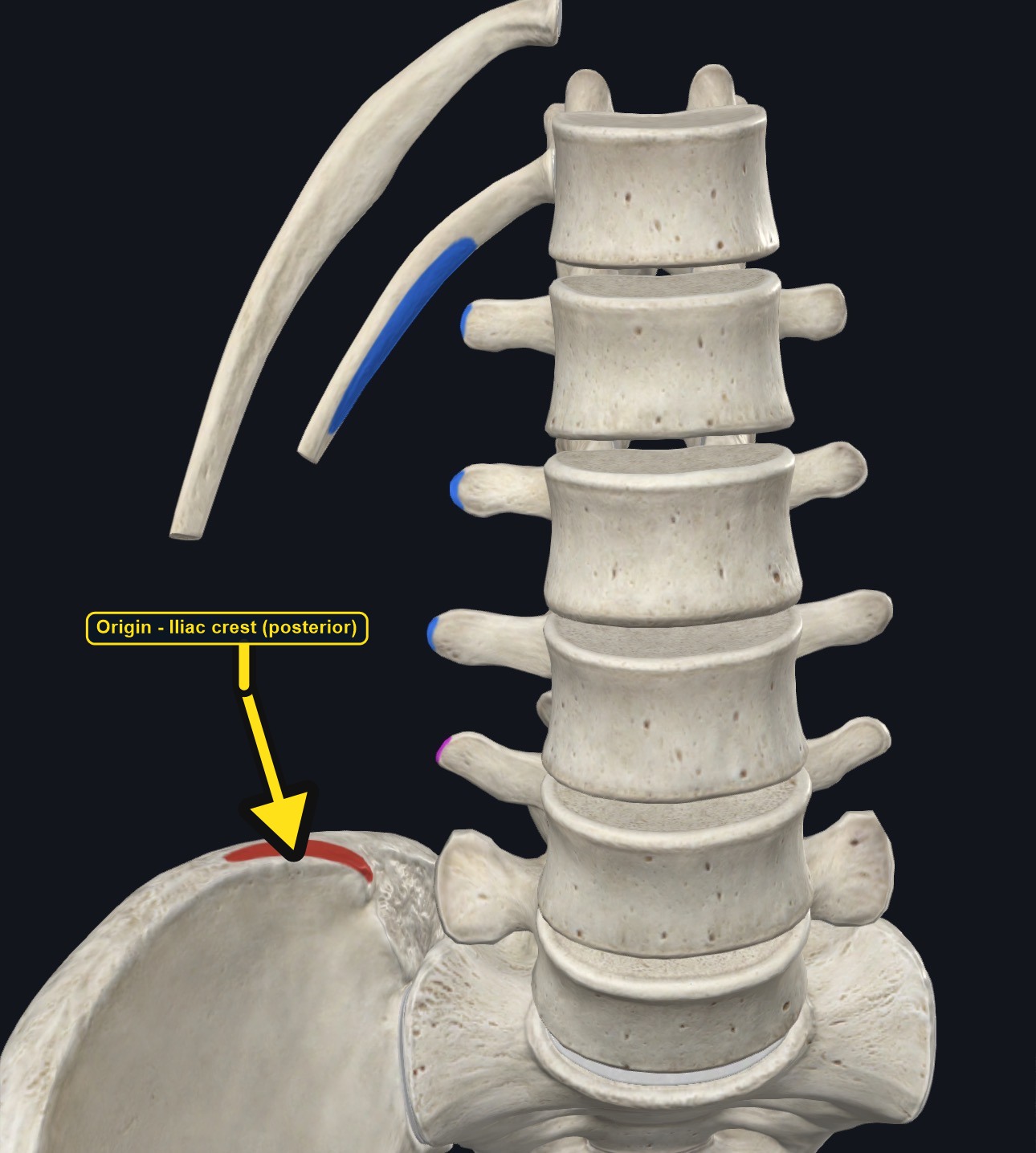
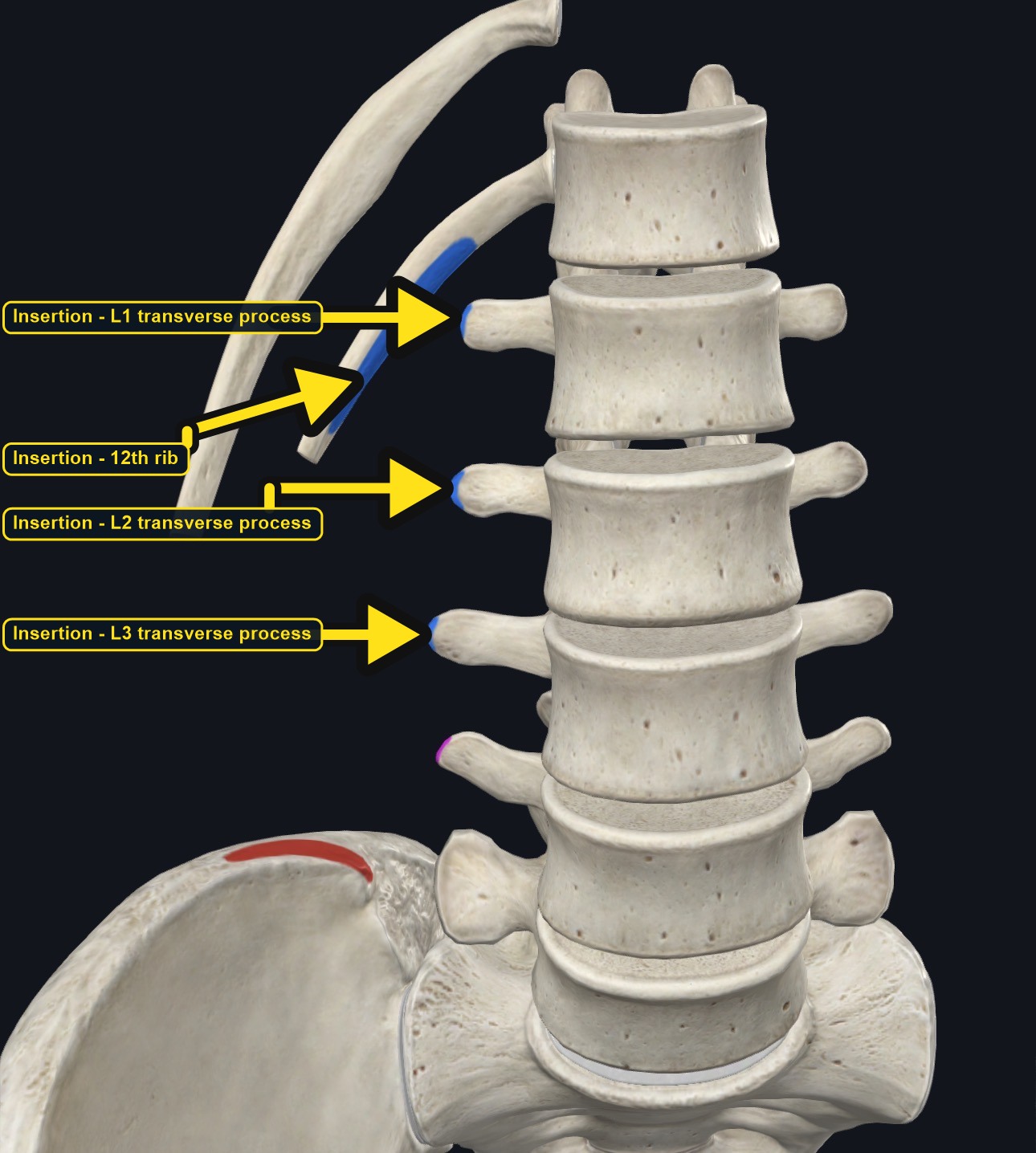
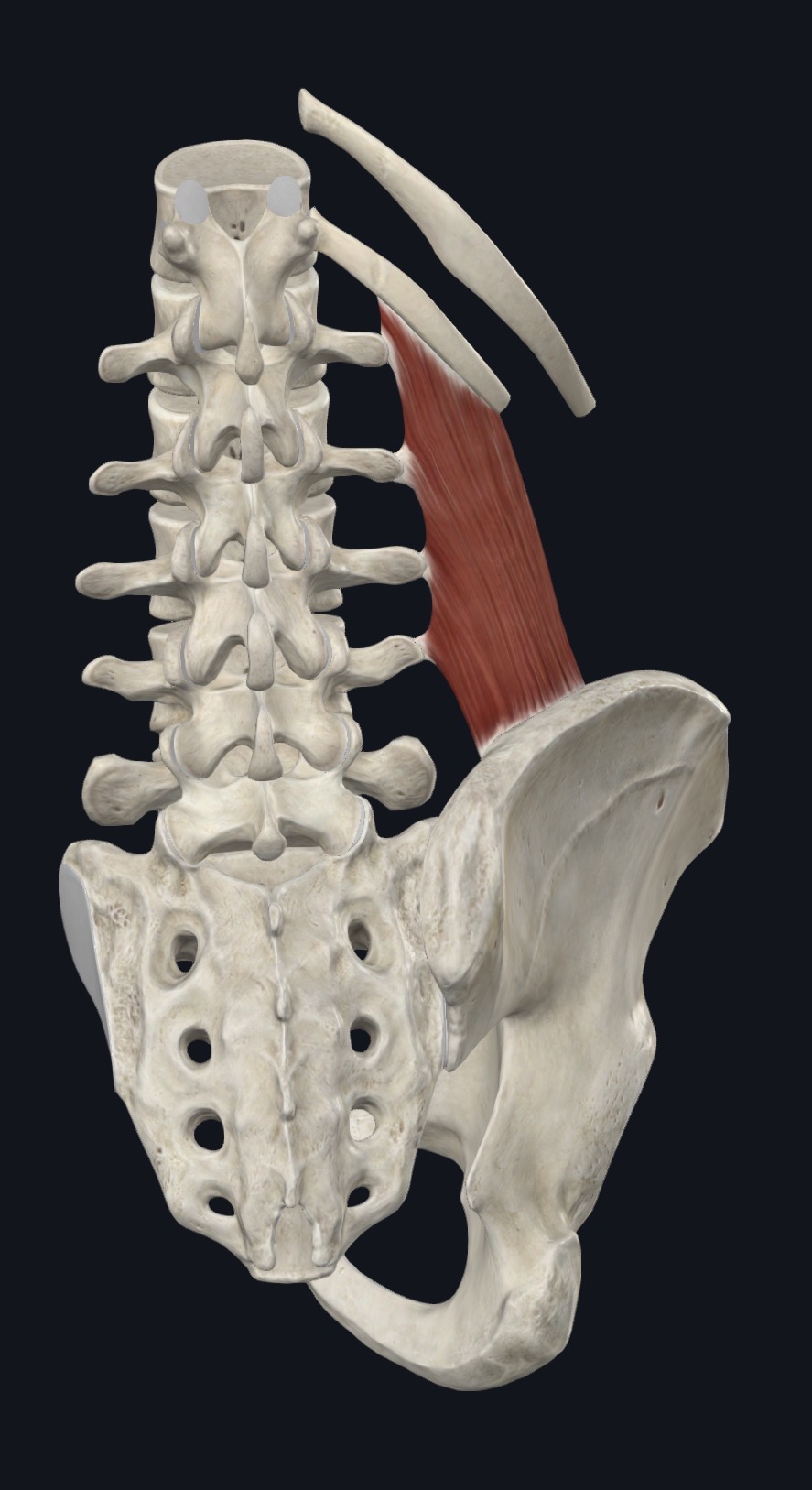
Quadratus lumborum is a flat, four-sided muscle in the deep low back. It runs vertically from the back of the iliac crest to the 12th rib and the tips of the lumbar transverse processes. It lies beside the lumbar spine, in front of the erector spinae, and behind the psoas major and the kidney.
Its name means the squared muscle of the lower back. It is a key stabilizer of the last rib and the pelvis, and it is one of the most common muscles to be tender in people with low back pain, although many other structures cause similar pain.
Section 02 of 20
Origin
| Origin | The iliolumbar ligament and the posterior part of the iliac crest. |
|---|
Section 03 of 20
Insertion
| Insertion | The medial half of the inferior border of the 12th rib and the tips of the transverse processes of the upper four lumbar vertebrae (L1–L4). |
|---|
Section 04 of 20
Actions
No dedicated action video is currently available. This movement is explained below and video will be added when verified source media becomes available.
| Primary action | Lateral flexion of the trunk (side-bending). |
|---|---|
| Secondary actions | Hip hike, stabilization of the 12th rib, and lumbar extension and stability when both sides act. |
| Movement at the joint | Lumbar spine and the pelvis; the 12th rib. |
| Heads / fiber groups | One four-sided muscle with iliocostal, iliolumbar, and lumbocostal fibers. |
| Functional examples | Walking on a slope; side-bending; carrying a bag on one hip; standing on one leg; coughing; deep breathing. |
Lateral flexion of the trunk
One side bends the trunk to that side (side-bending).
Hip hike
With the trunk fixed, one side lifts the pelvis on that side, as in walking on a slope.
Stabilizing the 12th rib
Anchors the last rib downward during breathing so the diaphragm can pull against a stable base.
Lumbar extension and stability
Both sides together help extend and stabilize the lumbar spine.
Section 05 of 20
Nerve Innervation
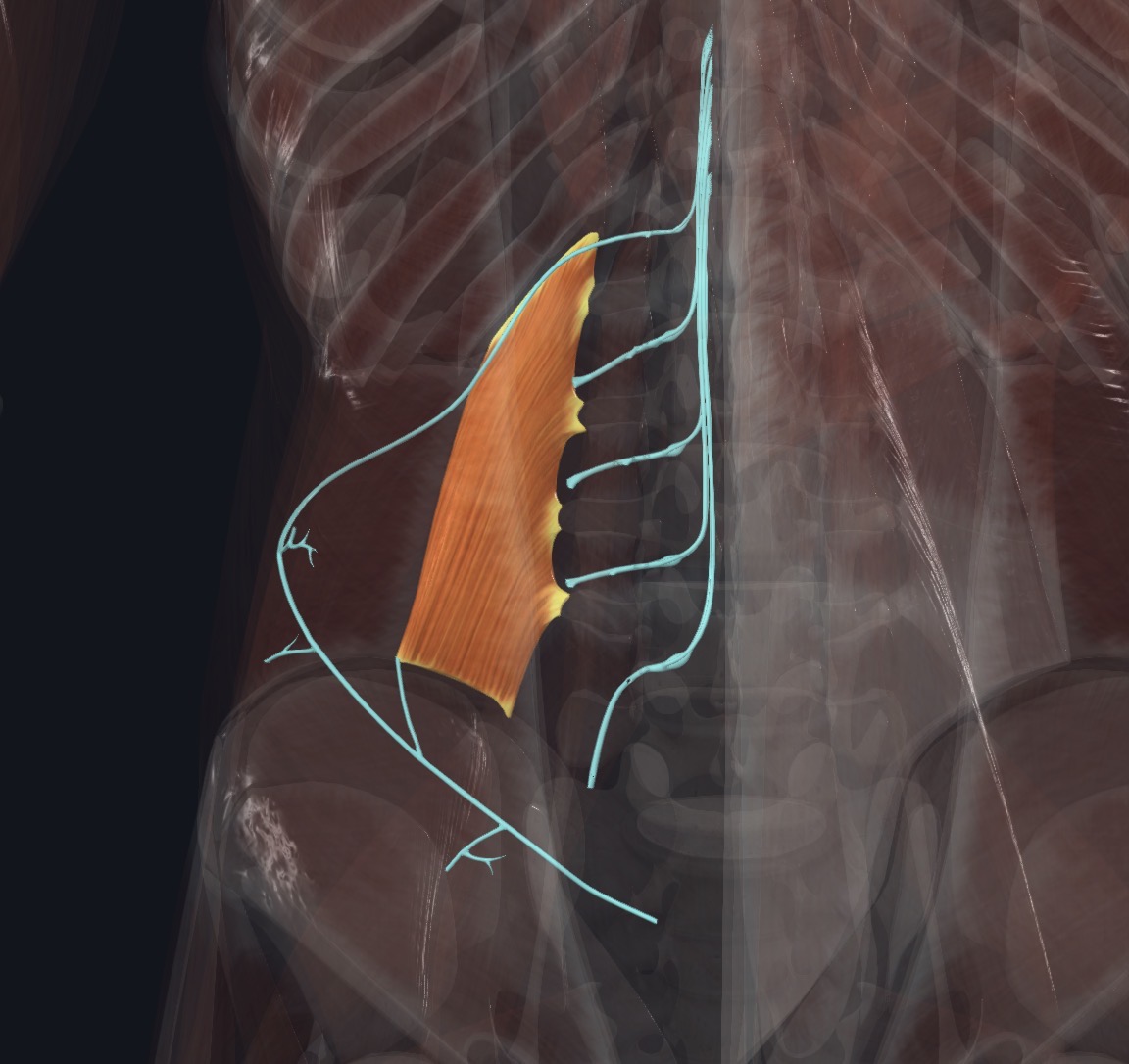
| Nerve | Anterior rami of T12 (subcostal nerve) and L1–L3, sometimes L4. |
|---|
The kidney, ureter, and the iliohypogastric and ilioinguinal nerves lie close to the muscle. Flank pain, blood in the urine, or fever may reflect a kidney problem, not muscle tightness.
Section 06 of 20
Blood Supply
| Blood | Lumbar arteries, the subcostal artery, and the iliolumbar artery. |
|---|
Section 07 of 20
Pictures and Visual Anatomy
Section 08 of 20
Functional Movement
Quadratus lumborum is active in walking (level pelvis), side-bending, lifting one side, carrying a bag on one hip, coughing, and deep breathing. It works constantly to steady the pelvis and lumbar spine when standing on one leg.
Section 09 of 20
Synergists and Antagonists
Synergists: the internal and external obliques and the erector spinae (side-bending), psoas major (lumbar stability), and the diaphragm (12th rib fixation). Antagonists: the opposite-side quadratus lumborum and obliques (lateral flexion), and the abdominal muscles and psoas for lumbar extension.
Section 10 of 20
Palpation and Location
Client position and technique
Position the client side-lying with a pillow under the waist and the top arm overhead, or prone with a pillow under the abdomen. Locate the 12th rib, the iliac crest, and the erector spinae bulk beside the spine. Slide the fingertips lateral to the erector spinae, between the rib and the crest, and ask for a gentle hip hike to feel the muscle tighten.
Protect nearby structures
The kidney sits directly in front of the upper part of the muscle, and the 12th rib is a floating rib. Use moderate, broad pressure, never jab or press sharply under the rib, and stop if the client reports sharp pain, tingling, nausea, or pain that feels deep in the flank.
Section 11 of 20
Massage Therapy Relevance
Quadratus lumborum is a common contributor to low back tension, one-sided back ache, and pain when getting out of a chair or car. Because it connects the pelvis, spine, and rib cage, it is often assessed in posture and gait, but disc, joint, kidney, and other causes must be considered.
Section 12 of 20
Dysfunction: What Happens When Movement Goes Wrong
Changes in how a muscle works can change how a joint moves. The points below describe possibilities that may be associated with altered muscle function; they are not diagnoses, and one muscle is never assumed to be the sole cause of a problem.
When the muscle is weak
Weakness may be associated with poor pelvic control on one-leg stance and more load on the lumbar spine and hip.
When it is tight or shortened
Tightness may be associated with a hiked hip, limited side-bending to the opposite side, and one-sided low back ache.
When it is overused
Prolonged standing on one leg, carrying loads on one side, and repeated twisting may overload the muscle and may contribute to low back pain.
When it is strained
A strain may cause sharp one-sided low back pain with bending and coughing; kidney and disc problems can look similar.
When it is inhibited or others compensate
Reduced activation may be associated with poor lumbar stability and more work by the erector spinae and hip muscles.
When it does not coordinate well with synergists and antagonists
Poor coordination with the obliques, gluteus medius, and the diaphragm may alter pelvic and rib control and may be associated with low back symptoms.
Section 13 of 20
Conditions, Pathologies, and Pain Relationships
Quadratus lumborum strain or tightness
Sudden bending or twisting, or prolonged standing on one leg, may be associated with one-sided low back pain that hurts when coughing, bending sideways, or turning in bed.
Trigger point referral
Tender points may refer pain to the iliac crest, the outer hip, the buttock, and the sacroiliac area, but disc, joint, and nerve problems can look the same.
Postural asymmetry
Scoliosis, a leg-length difference, or a habitual hip hike may be associated with a chronically shortened muscle on one side.
Differential considerations
Kidney stones, kidney infection, lumbar disc problems, sacroiliac joint pain, facet joint pain, and hip disease can all cause similar low back and flank pain.
Section 14 of 20
Example Clinical Relationship
A client who often carries a heavy bag on one hip reports a dull ache on that side of the low back that worsens when getting out of a chair. Quadratus lumborum may be involved, and the pattern may be associated with tightness or strain, but disc, joint, and kidney problems can look similar. Gentle, broad work between the rib and crest may support comfort, while fever, blood in the urine, or leg weakness needs referral.
Section 15 of 20
Massage and Treatment Approaches
For healthy, non-acute tissue, position the client side-lying with the waist supported, or prone with a pillow under the abdomen. Begin with broad effleurage over the low back, then use gentle kneading and slow strokes along the fibers between the rib and crest, working with the client's breathing.
| Movement | Use gentle side-bending and pelvic tilt within comfort; do not force stretch. |
|---|---|
| Regional work | Consider the erector spinae, psoas major, gluteus medius, the obliques, and the thoracolumbar fascia when assessment supports it. |
| Avoid | Deep pressure under the 12th rib or over the flank, over acute pain, or at any point that reproduces leg symptoms. |
Section 16 of 20
Precautions and Contraindications
Precautions and contraindications
- Acute low back injury, suspected fracture, or recent spinal or abdominal surgery.
- Use caution with known kidney disease or kidney stones, severe osteoporosis, or anticoagulant use.
- Avoid deep pressure over the flank and under the 12th rib.
- Stop if pressure causes sharp pain, nausea, or tingling in the leg.
Section 17 of 20
Red Flags and When to Refer
Red flags and referral
- Flank or back pain with fever, chills, burning urination, or blood in the urine.
- Sudden severe back or abdominal pain, especially with a pulsating feeling or a fall in blood pressure (possible vascular emergency).
- Numbness in the saddle area, or new bladder, bowel, or sexual changes with back pain.
- Progressive leg weakness, back pain after trauma, or unexplained weight loss.
Section 18 of 20
Study Summary
Attachments
Origin: iliolumbar ligament and posterior iliac crest. Insertion: 12th rib (lower border) and L1–L4 transverse processes.
Actions
Lateral flexion, hip hike, stabilizes the 12th rib and lumbar spine.
Supply
T12–L3 (L4) anterior rami; lumbar, subcostal, and iliolumbar arteries.
Section 19 of 20
Instructor Narration
Open narration transcript
Quadratus lumborum is the deep four-sided muscle of the low back. It runs from the iliac crest to the 12th rib and the lumbar transverse processes.
It arises from the iliolumbar ligament and the back of the iliac crest, and inserts on the lower border of the 12th rib and the tips of the transverse processes of L1 to L4.
It side-bends the trunk, hitches the hip, anchors the 12th rib during breathing, and helps stabilize the lumbar spine. The obliques and erector spinae help it, and the opposite-side muscles oppose it.
The subcostal nerve and the upper lumbar nerves supply it, and the lumbar, subcostal, and iliolumbar arteries provide its blood.
Palpate with the client side-lying, lateral to the erector spinae between the 12th rib and iliac crest, and ask for a hip hike. The kidney lies in front of the upper part, so avoid sharp or deep pressure under the rib.
Strain, trigger points, and postural asymmetry are common, and kidney, disc, sacroiliac, and hip problems can overlap. Refer flank pain with fever or blood in the urine, sudden severe pain, saddle numbness, or progressive leg weakness.
Remember: iliac crest and iliolumbar ligament to the 12th rib and L1 to L4; lateral flexion and hip hike; T12 to L3.
Section 20 of 20