Section 01 of 20
Introduction
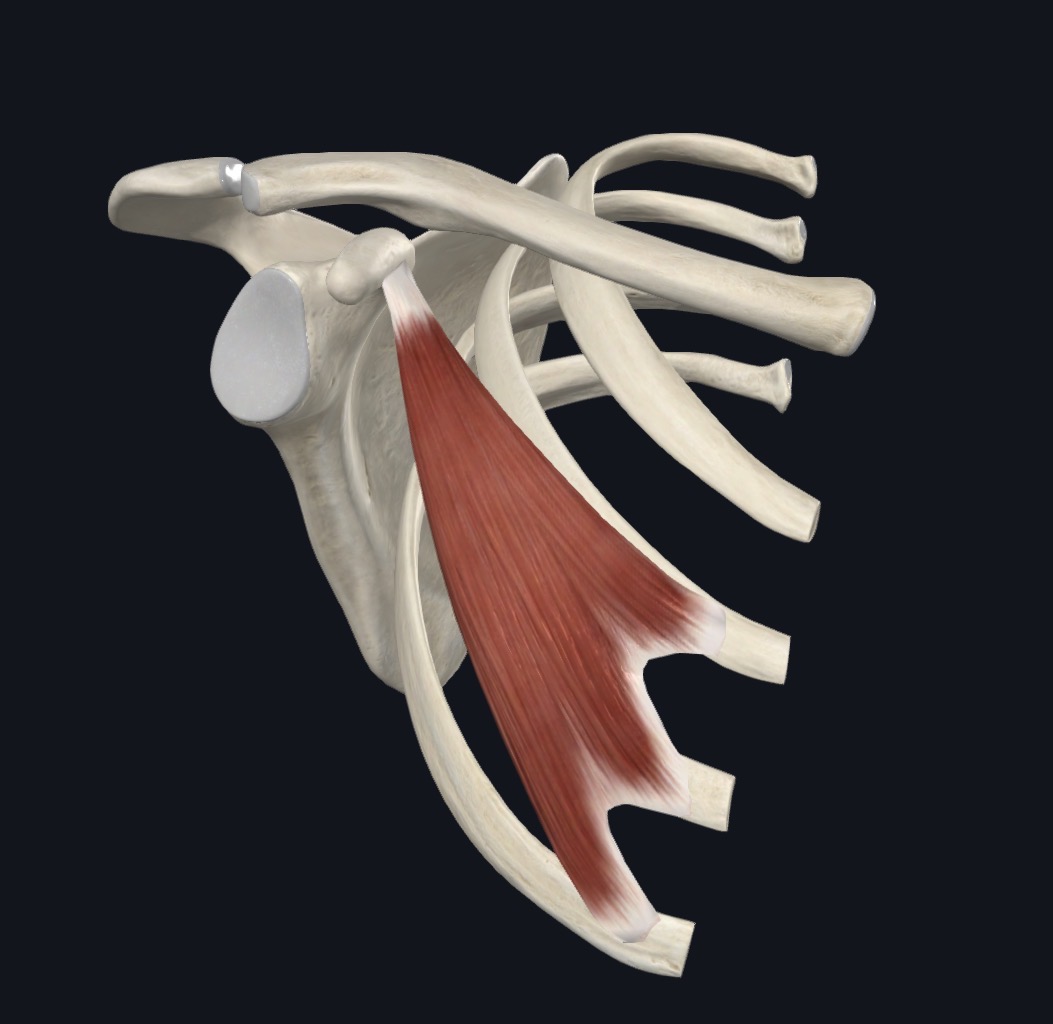
Pectoralis minor is a small, flat, triangular muscle that lies deep to the much larger pectoralis major, on the upper front of the rib cage. It runs from the upper ribs diagonally up and out to the coracoid process of the scapula, the small hook of bone just under the outer end of the clavicle.
Although it is a relatively small muscle, pectoralis minor has an outsized influence on scapular position and movement, and it sits directly over the neurovascular bundle that supplies the arm — making it one of the more clinically significant muscles in the anterior shoulder region.
For massage therapists, pectoralis minor is particularly important because chronic shortening of this muscle is strongly associated with rounded-shoulder, forward-head postures that are extremely common in clients who spend long hours at desks, on phones, or driving.
Section 02 of 20
Origin
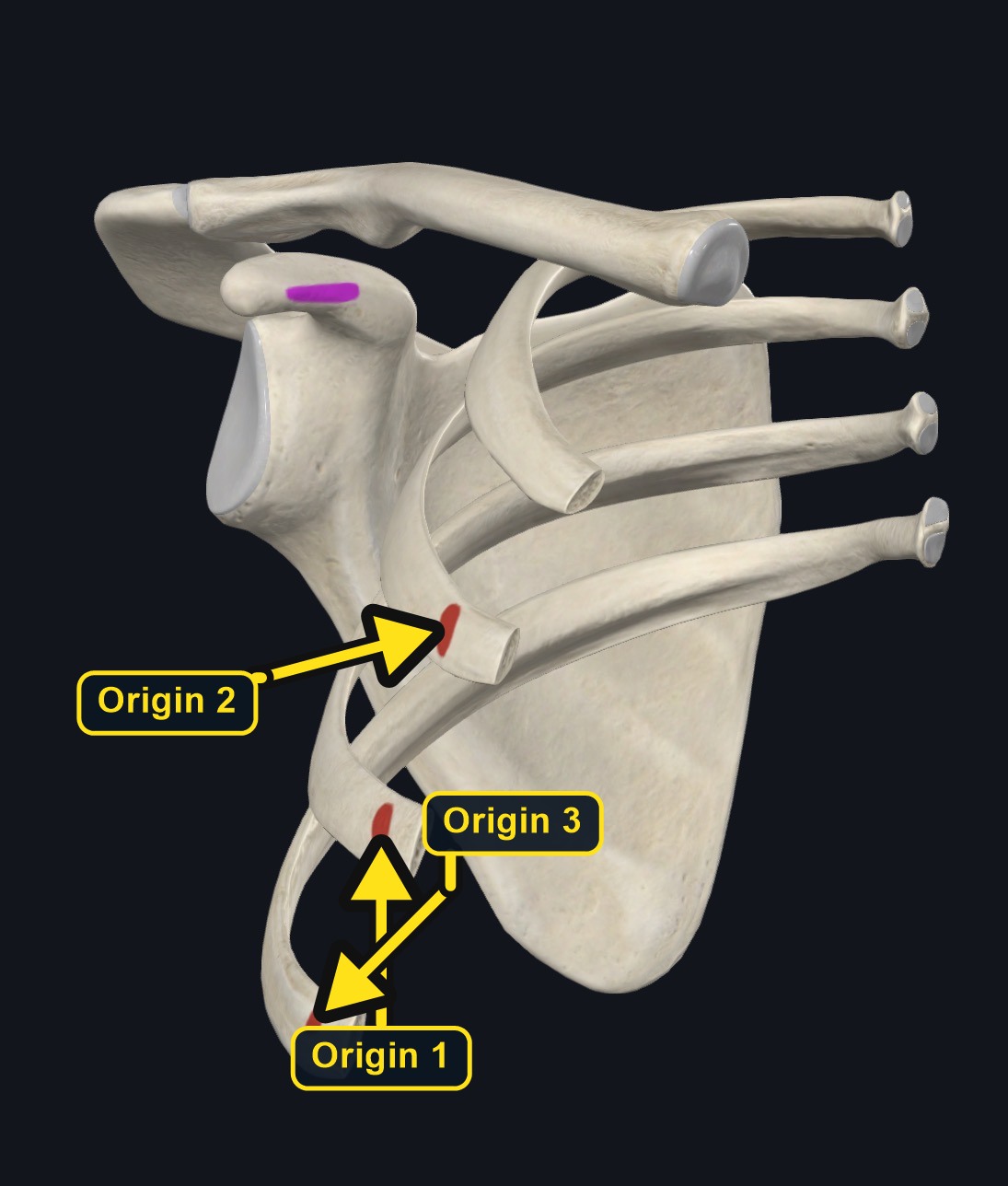
The origin is the fixed end from which the muscle pulls the scapula. Pectoralis minor originates from the outer surfaces of the third, fourth, and fifth ribs, near their costal cartilages.
| Origin | External surfaces of ribs 3, 4, and 5, near the costochondral junctions. |
|---|
Section 03 of 20
Insertion
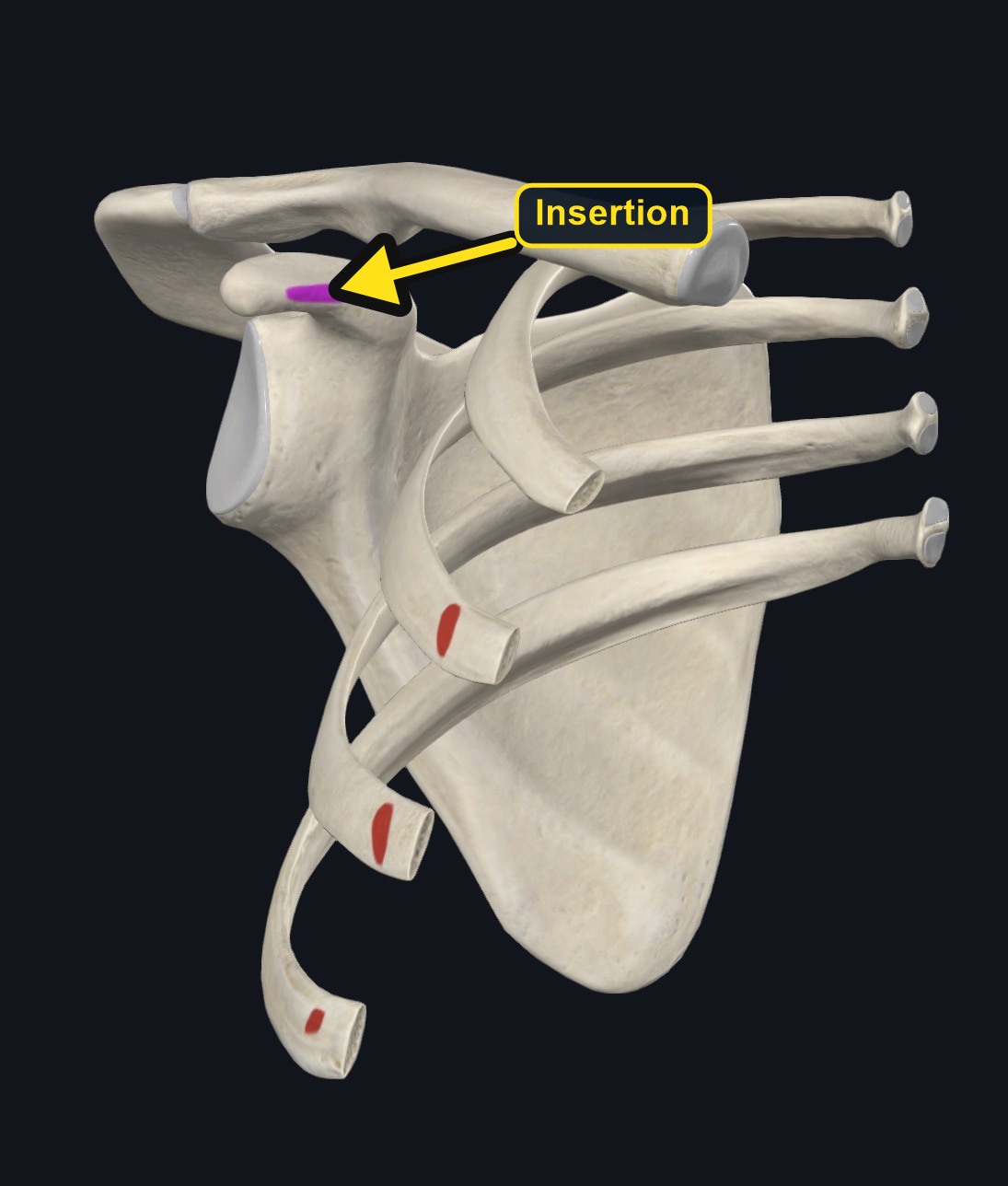
| Insertion | Medial border and superior surface of the coracoid process of the scapula. |
|---|
Section 04 of 20
Actions
| Primary action | Scapular depression and protraction (anterior tilt of the scapula). |
|---|---|
| Secondary actions | Assists forced inspiration by elevating ribs 3 to 5 when the scapula is fixed. |
| Movement at the joint | Scapulothoracic joint (scapular movement); ribs (with the scapula stable). |
| Heads / fiber groups | Single muscle belly; no separate heads. |
| Functional examples | Reaching forward; pushing; push-ups; sitting with rounded shoulders; deep inhalation. |
Primary actions
- Depresses and stabilizes the scapula by drawing the coracoid process down and forward (anterior tilt and downward rotation of the scapula).
- Protracts the scapula (draws it forward around the rib cage), working with serratus anterior in this respect.
Secondary / functional role
- Acts as an accessory muscle of respiration: when the scapula is fixed by other muscles, pectoralis minor can help elevate ribs 3-5 to assist forced inspiration.
- Contributes to anterior tilt of the scapula, which can influence overall shoulder mechanics and subacromial space during arm elevation.
Section 05 of 20
Nerve Innervation
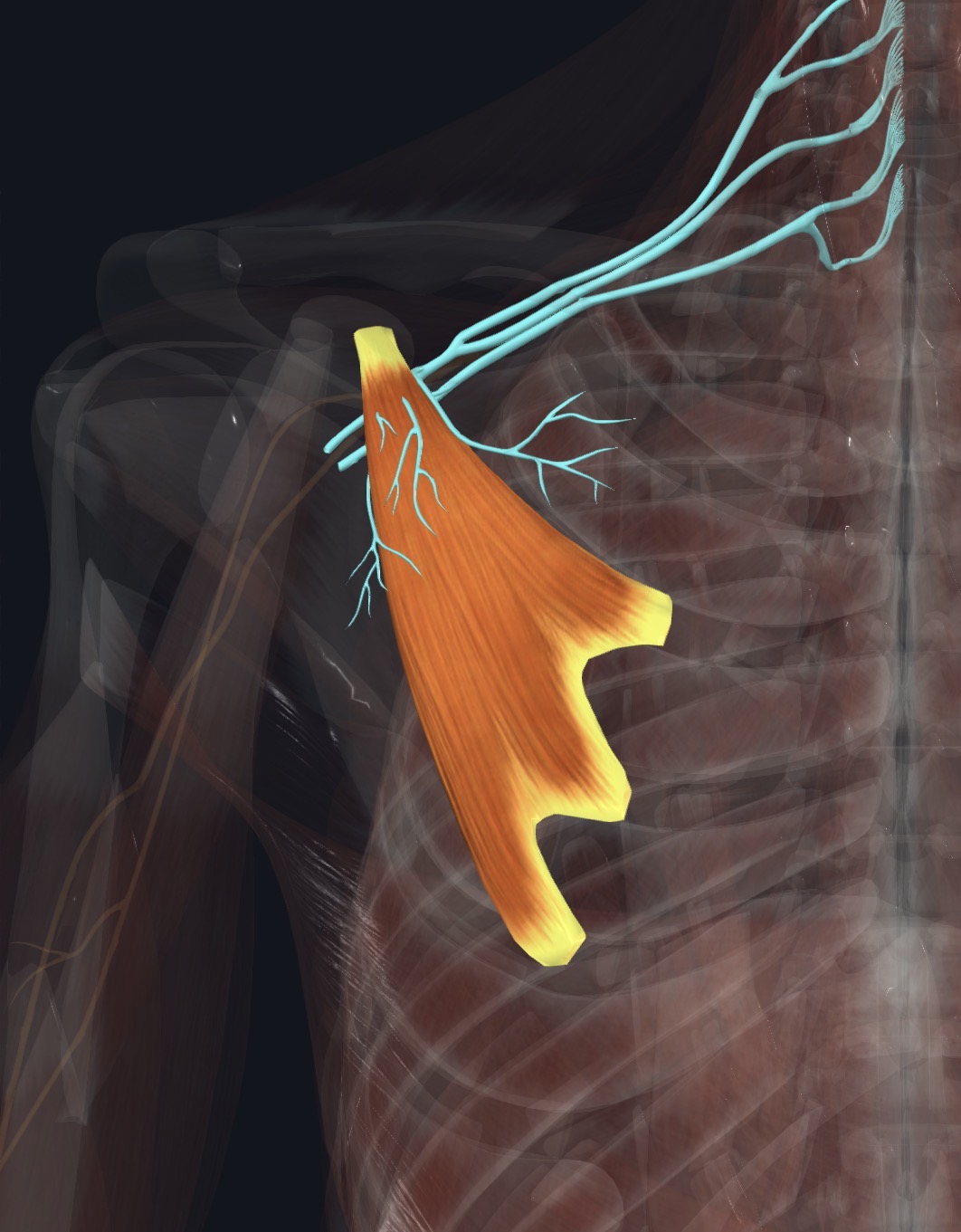
| Nerve | Medial pectoral nerve, with a documented contribution from the lateral pectoral nerve through the ansa pectoralis |
|---|---|
| Roots | Predominantly C8, T1 through the medial pectoral nerve; contributing fibers may vary with lateral-pectoral communications |
| Relationship | The medial pectoral nerve arises from the medial cord of the brachial plexus and characteristically pierces directly through the substance of pectoralis minor on its way to also supply the lower/lateral portion of pectoralis major. This is a distinctive anatomical relationship worth remembering: the medial pectoral nerve is named for its origin from the medial cord, not its final destination. |
Section 06 of 20
Blood Supply
Pectoralis minor is primarily supplied by the pectoral branch of the thoracoacromial artery (a branch of the axillary artery), with additional contribution from the lateral thoracic artery. The axillary artery and the brachial plexus cords lie directly deep to (posterior to) pectoralis minor as they pass toward the arm, which is clinically significant for the thoracic outlet relationship discussed below.
Section 07 of 20
Pictures and Visual Anatomy
Section 08 of 20
Functional Movement
Pectoralis minor pulls the scapula forward and down against the rib cage, which happens when reaching forward, pushing, and doing push-ups. It can also help lift the upper ribs during deep breathing when the shoulder blade is fixed.
Section 09 of 20
Synergists and Antagonists
Synergists
Serratus anterior (protraction); rhomboids can be functionally opposed depending on the specific scapular motion being discussed.
Antagonists
Trapezius (middle and lower fibers, which retract and help posteriorly tilt/upwardly rotate the scapula) and rhomboids (retraction) generally oppose pectoralis minor's protraction and anterior tilt actions.
Section 10 of 20
Palpation and Location
Client position
Client supine, arm relaxed at the side or slightly abducted and supported.
Landmarks and technique
- Locate the coracoid process just below the lateral third of the clavicle — pectoralis minor's insertion is here, though the coracoid itself is largely covered by the anterior deltoid and pectoralis major.
- To access pectoralis minor, the therapist typically works through the relaxed fibers of pectoralis major, gently sinking through the anterior chest wall between the third and fifth ribs, lateral to the sternum, angling toward the coracoid process.
- Asking the client to take a few relaxed breaths, and working during exhalation, can help the therapist ease through the more superficial tissue without forcing pressure.
- Because the axillary neurovascular bundle lies deep to this muscle, palpation should remain gentle, gradual, and guided by client feedback rather than sustained aggressive pressure — especially in the axillary region.
Section 11 of 20
Massage Therapy Relevance
Pectoralis minor is one of the most commonly shortened muscles in clients with a rounded-shoulder, forward-head posture — a pattern extremely common with prolonged sitting, computer work, phone use, and driving. A chronically short pectoralis minor pulls the scapula into anterior tilt and downward rotation, which can alter overall shoulder mechanics and contribute to a feeling of tightness across the chest and upper back.
Because the muscle lies directly over the neurovascular bundle supplying the arm, tightness here is also discussed in relation to thoracic outlet symptoms (see the Clinical Focus section below), making pectoralis minor an important muscle to assess in clients reporting arm heaviness, tingling, or fatigue, in addition to clients with primarily postural or chest-tightness complaints.
Repetitive reaching, carrying loads close to the chest, or occupations/sports involving sustained forward arm positions can also contribute to overuse-related tension in this muscle.
Section 12 of 20
Dysfunction: What Happens When Movement Goes Wrong
Changes in how a muscle works can change how a joint moves. The points below describe possibilities that may be associated with altered muscle function; they are not diagnoses, and one muscle is never assumed to be the sole cause of a problem.
When the muscle is weak
Weakness is less commonly discussed; reduced control may be associated with less scapular stability during pushing tasks.
When it is tight or shortened
Tightness may be associated with rounded shoulders, an anteriorly tilted scapula, and reduced overhead reach, and may narrow the space near the brachial plexus and axillary vessels.
When it is overused
Desk work, driving, and repetitive pushing may keep the muscle shortened and may contribute to chest and front-of-shoulder ache.
When it is strained
A strain may cause pain below the collarbone with reaching or deep breathing; chest pain can also have cardiac or lung causes and needs screening.
When it is inhibited or others compensate
Reduced activation may be associated with more work by pectoralis major and altered scapular position.
When it does not coordinate well with synergists and antagonists
Poor coordination with serratus anterior, the lower trapezius, and the rhomboids may alter scapular tilt and may be associated with shoulder symptoms.
Section 13 of 20
Conditions, Pathologies, and Pain Relationships
Postural shortening / rounded-shoulder pattern
What it is: Adaptive shortening of pectoralis minor associated with sustained forward-shoulder posture.
Why the muscle may be involved: Its line of pull directly produces anterior tilt and downward rotation of the scapula, the hallmark of this posture.
Typical symptoms: A sense of chest tightness, rounded shoulder appearance, and sometimes associated upper back or neck discomfort from compensatory muscle overuse.
Similar-presenting conditions: Tightness in other anterior chest and shoulder muscles (pectoralis major, anterior deltoid, short head of biceps/coracobrachialis) can contribute to a similar overall picture.
Refer when: Generally within massage scope to address; refer if pain is severe, persistent, or accompanied by neurological symptoms in the arm.
Pectoralis minor syndrome (a form of thoracic outlet syndrome)
What it is: Compression or irritation of the brachial plexus and/or axillary vessels as they pass beneath a tight or short pectoralis minor.
Why the muscle may be involved: The neurovascular bundle runs directly deep to this muscle; a shortened or hypertonic pectoralis minor can narrow this space.
Typical symptoms: Arm heaviness, aching, tingling, or numbness, sometimes worse with overhead arm positions.
Similar-presenting conditions: Cervical radiculopathy, other forms of thoracic outlet syndrome (cervical rib, scalene-related), peripheral nerve entrapments (e.g., at the elbow or wrist), and vascular conditions.
Refer when: Any true neurological or vascular symptom pattern (numbness, weakness, color/temperature change of the hand, pulse changes) should be referred for medical evaluation; massage therapists should not attempt to diagnose thoracic outlet syndrome.
Myofascial trigger points
What it is: Localized hyperirritable spots within the muscle that some massage-therapy sources associate with referred pain patterns.
Why the muscle may be involved: Sustained shortened positioning and overuse are commonly discussed contributing factors in myofascial trigger point literature.
Typical symptoms: Reported referred discomfort into the anterior chest and, in some descriptions, down the inner arm and into the hand, though this pattern is not universal and evidence quality varies across sources.
Similar-presenting conditions: Cardiac-related chest discomfort must always be considered and ruled out by appropriate medical evaluation before attributing chest symptoms to a muscular cause.
Refer when: Any new, unexplained, or exertion-related chest pain, pressure, or tightness — especially with shortness of breath, sweating, nausea, or pain radiating to the jaw or left arm — is a medical emergency, not a massage case. When in doubt, refer immediately.
Section 14 of 20
Example Clinical Relationship
What "thoracic outlet syndrome" means, and why it is not a simple diagnosis
The thoracic outlet is the region where the brachial plexus and subclavian/axillary vessels travel from the neck and chest into the arm. This pathway passes through several possible "tight spots," including the space between the scalene muscles, the costoclavicular space (between clavicle and first rib), and the space beneath pectoralis minor (sometimes called the retropectoralis minor space or the origin of "pectoralis minor syndrome").
Thoracic outlet syndrome is an umbrella term, and pectoralis minor is only one of several possible contributing structures. Anatomical variations (such as a cervical rib) and involvement of the scalene muscles are also well documented. Symptoms of nerve or vascular compression in this region — arm tingling, heaviness, weakness, or color/temperature changes — can also result from other causes including cervical spine pathology, peripheral nerve entrapment, or vascular disease.
Massage therapists should not diagnose thoracic outlet syndrome or claim that treating pectoralis minor will resolve it. Within scope, therapists can address soft tissue tension in the anterior chest that may be a contributing factor, while encouraging clients with true neurological or vascular symptoms to seek medical/diagnostic evaluation.
Section 15 of 20
Massage and Treatment Approaches
The following approaches may be considered for a generally healthy client with no contraindications present.
Broad warming strokes
Why: Prepares the anterior chest wall tissue and allows the therapist to gauge tone before working deeper.
Direction/location: Broad, gentle strokes across the upper chest, respecting breast tissue boundaries and draping/consent protocols.
Pressure: Light.
Positioning: Supine, arm relaxed.
Gentle sustained compression / positional release
Why: Because pectoralis minor lies deep to pectoralis major and directly over the neurovascular bundle, a slow, sustained, gentle compression approach (rather than aggressive stripping) is often more appropriate.
Direction/location: Gentle, gradual pressure through pectoralis major toward the rib origin and coracoid insertion, guided entirely by client feedback.
Pressure: Light to moderate at most; never forced.
Avoid: Deep, sustained pressure directly into the axilla or beneath the coracoid process where the neurovascular bundle is close to the surface.
Myofascial techniques
Why: May help address generalized fascial restriction contributing to a rounded-shoulder pattern.
Direction/location: Slow, broad contact across the anterior chest wall, following tissue response rather than forcing a release.
Pressure: Light, sustained.
Gentle stretching
Why: May help address adaptive shortening associated with rounded-shoulder posture.
Direction/location: Gentle horizontal shoulder extension/external rotation with scapular retraction (e.g., doorway-type stretch performed slowly and within comfortable range), or passive scapular retraction performed by the therapist.
Pressure: Gentle; avoid forcing end range, particularly in clients with any shoulder instability history.
Active/passive movement and postural education
Why: Since pectoralis minor tightness is strongly linked to sustained posture, pairing manual work with client education on posture and movement breaks can support longer-term comfort — this is education, not a medical treatment claim.
Section 16 of 20
Precautions and Contraindications
Use caution or avoid the area when any of the following are present
- Any new, unexplained, or exertional chest pain, pressure, or tightness — treat as a possible medical emergency and refer immediately rather than proceeding with massage.
- Acute injury, suspected rib fracture, or recent chest/shoulder trauma.
- Recent thoracic, breast, or shoulder surgery without medical clearance for massage.
- Unexplained swelling, lump, or skin changes in the chest wall.
- Signs of infection or acute inflammation.
- Active neurological or vascular symptoms in the arm (numbness, weakness, color or temperature change, pulse changes) without prior medical evaluation.
Vulnerable structures — avoid firm direct pressure
- The axilla and the space deep to pectoralis minor, where the brachial plexus and axillary artery/vein travel.
- Breast tissue — respect draping, consent, and professional boundaries at all times.
- Directly over rib cartilage if the client reports tenderness suggestive of costochondral irritation.
Section 17 of 20
Red Flags and When to Refer
Postpone massage and refer for medical evaluation if a client reports or shows:
- Chest pain, pressure, tightness, or discomfort — especially with shortness of breath, sweating, nausea, dizziness, or pain radiating to the jaw, neck, or arm. Treat as a possible cardiac emergency.
- New or progressive numbness, tingling, or weakness in the arm or hand.
- Color or temperature changes in the hand, or a noticeably weak/absent pulse.
- Unexplained lump, swelling, or skin changes in the breast or chest wall.
- Signs of infection (fever, redness, warmth) in the chest region.
- Recent significant trauma to the chest or shoulder.
Section 18 of 20
Study Summary
Ribs 3-5 (external surfaces, near costal cartilages).
Coracoid process of the scapula (medial border/superior surface).
Depresses/stabilizes and protracts the scapula; accessory muscle of respiration.
Predominantly medial pectoral nerve (C8, T1), with recognized lateral pectoral contribution through the ansa pectoralis.
Central to rounded-shoulder posture; overlies the brachial plexus/axillary vessels, relevant to thoracic outlet discussions.
Section 19 of 20
Instructor Narration
Open narration script (readable / for audio conversion)
Section 20 of 20