Section 01 of 20
Introduction
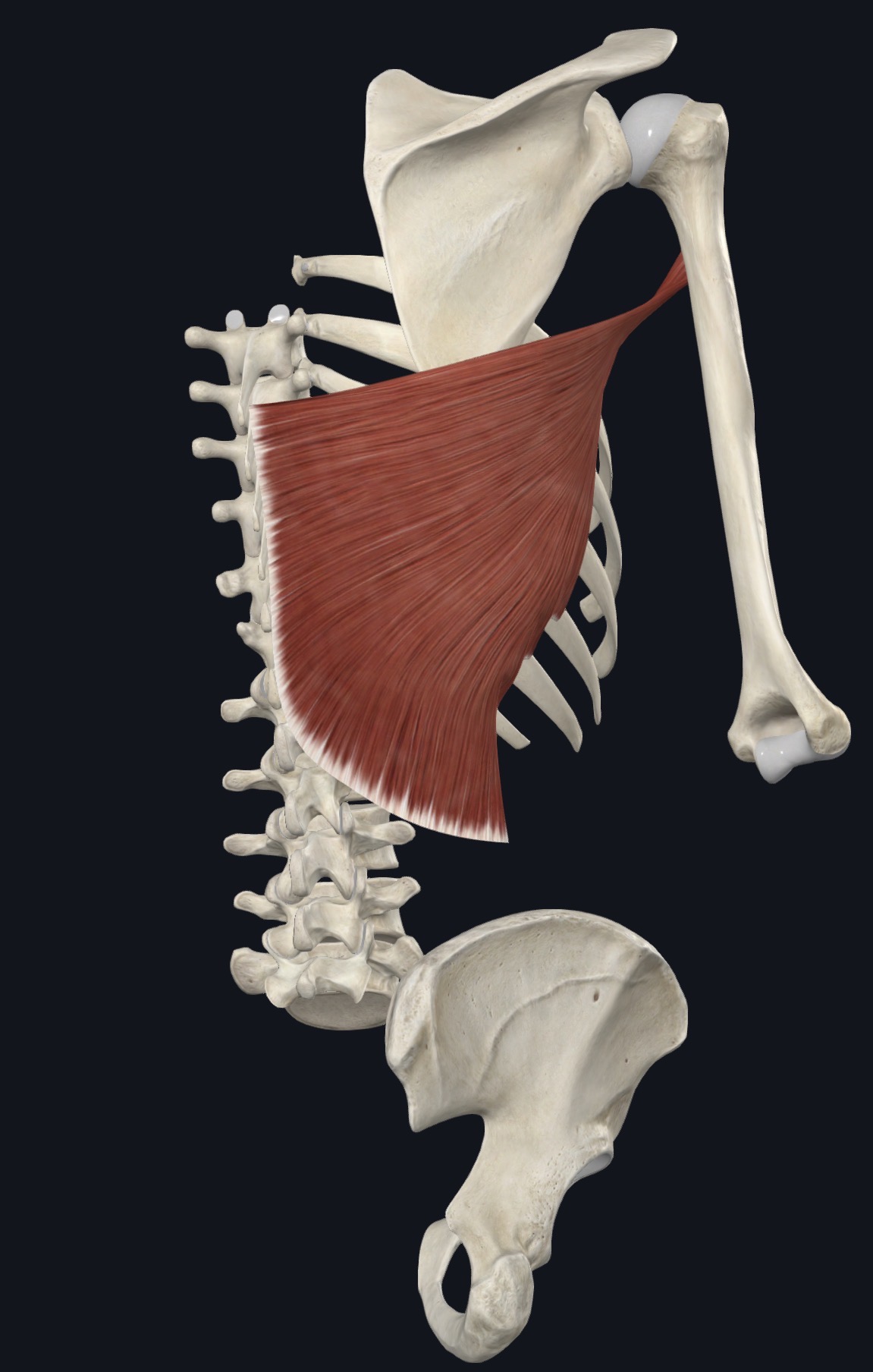
Latissimus dorsi is a wide, triangular muscle that covers the lower thoracic and lumbar back. Its fibers gather from the spine, pelvis, and lower ribs and converge into a flat tendon that twists as it passes the lower edge of teres major to reach the front of the upper arm bone.
Because it connects the trunk to the arm, it moves the arm when the trunk is steady and moves the trunk when the arm is fixed, as in pull-ups and climbing. Its lower edge forms the back wall of the armpit together with teres major.
Section 02 of 20
Origin
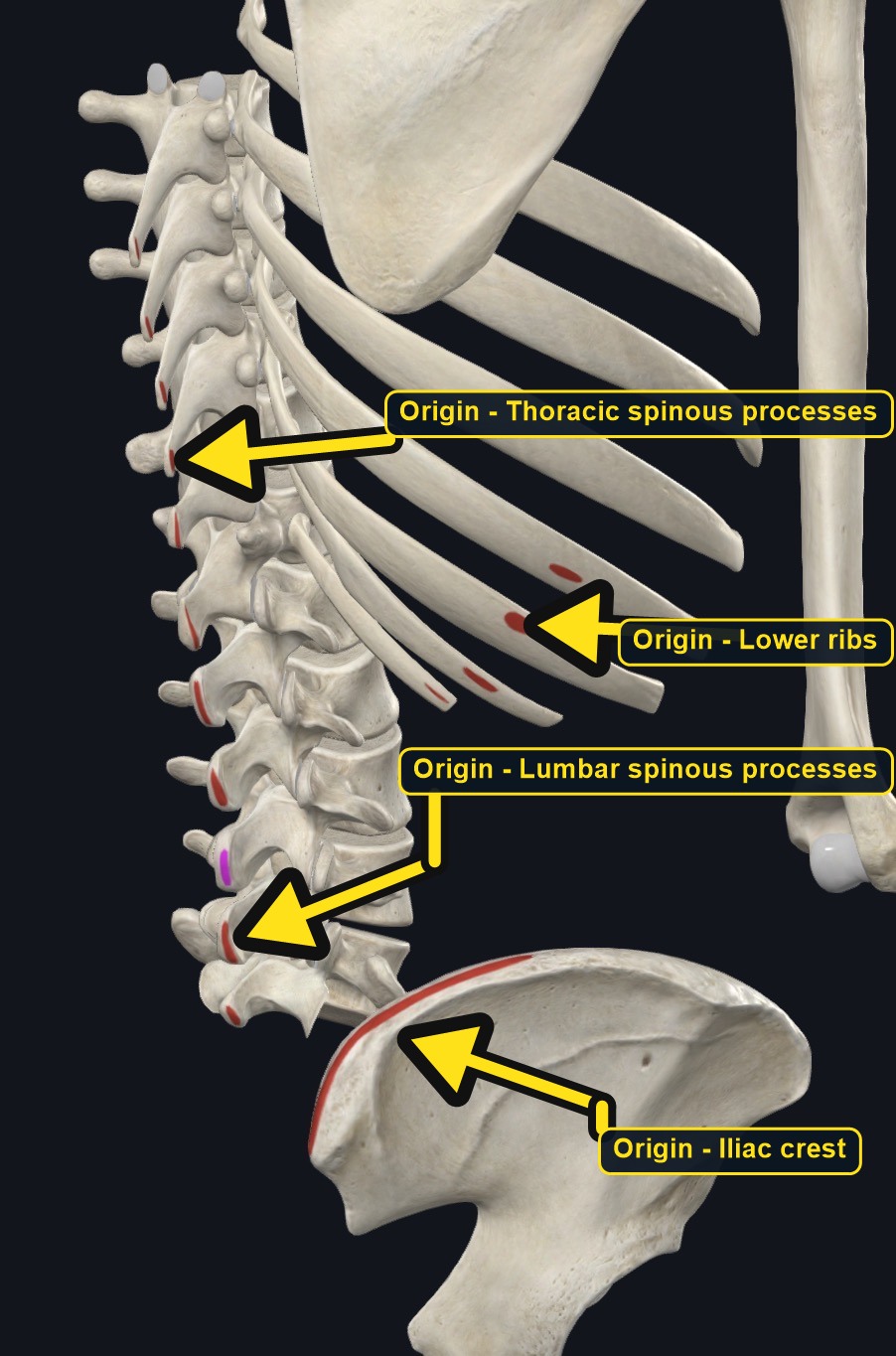
| Origin | Spinous processes of the lower six thoracic vertebrae (about T7–T12) and, through the thoracolumbar fascia, the lumbar and sacral spinous processes; the posterior part of the iliac crest; the lower three or four ribs; and often a small slip from the inferior angle of the scapula. |
|---|
Section 03 of 20
Insertion
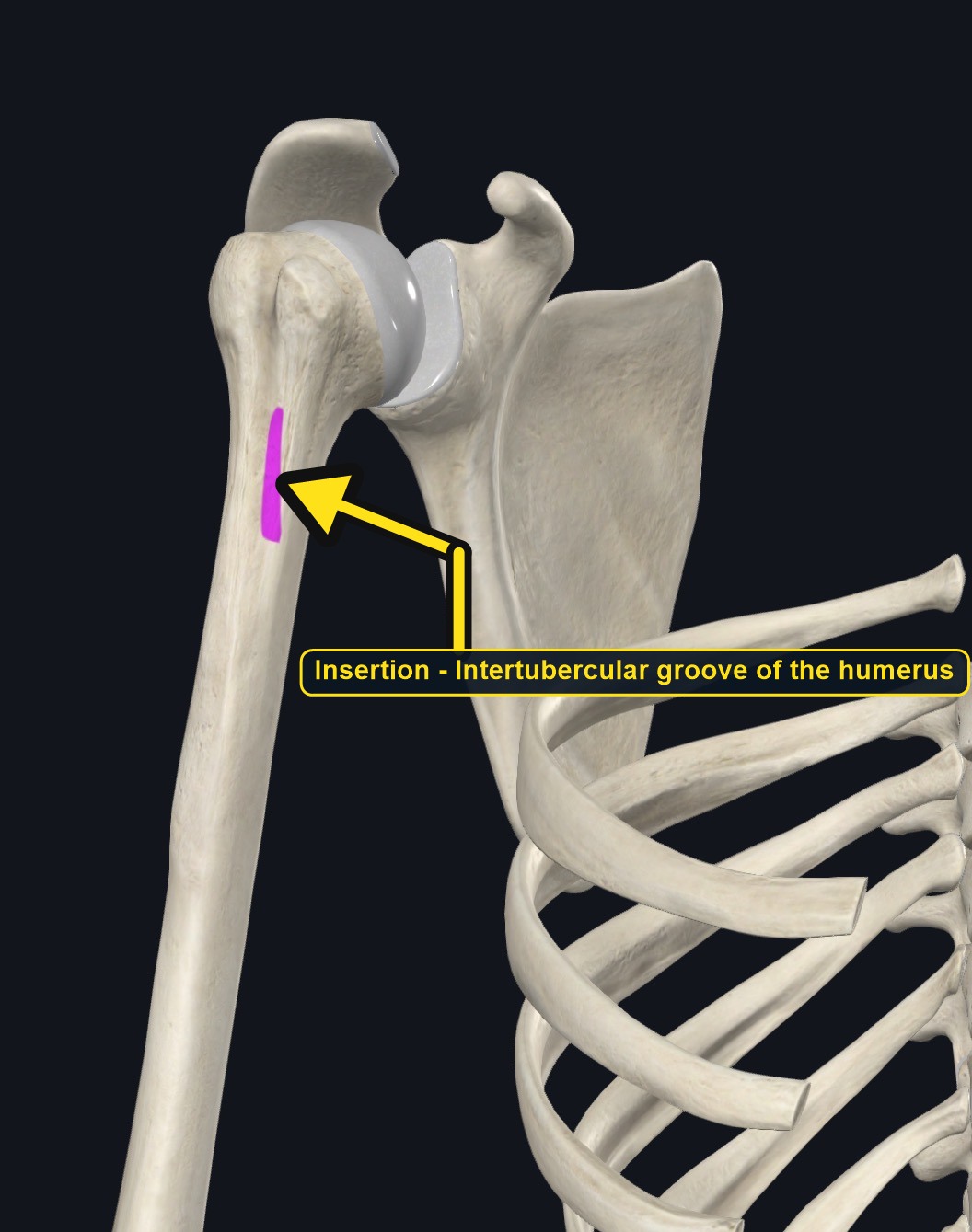
| Insertion | Floor of the intertubercular (bicipital) groove of the humerus, between the attachments of pectoralis major and teres major. |
|---|
Section 04 of 20
Actions
| Primary action | Shoulder extension and adduction. |
|---|---|
| Secondary actions | Medial rotation of the arm; with the arm fixed it lifts the trunk and assists forced expiration and coughing. |
| Movement at the joint | Glenohumeral (shoulder) joint. |
| Heads / fiber groups | Single broad muscle with vertebral, iliac, costal, and scapular fibers. |
| Functional examples | Climbing; rowing and swimming (pulling phase); pull-ups; pulling a door or rope toward the body. |
Shoulder extension
Draws the raised arm down and back, as in the downstroke of swimming or rowing.
Shoulder adduction
Pulls the arm toward the trunk.
Medial (internal) rotation
Turns the arm inward, as in placing the hand behind the back.
Trunk support
With the arm fixed, it lifts the trunk toward the arm (climbing, pull-ups), and assists forceful breathing out and coughing.
Section 05 of 20
Nerve Innervation
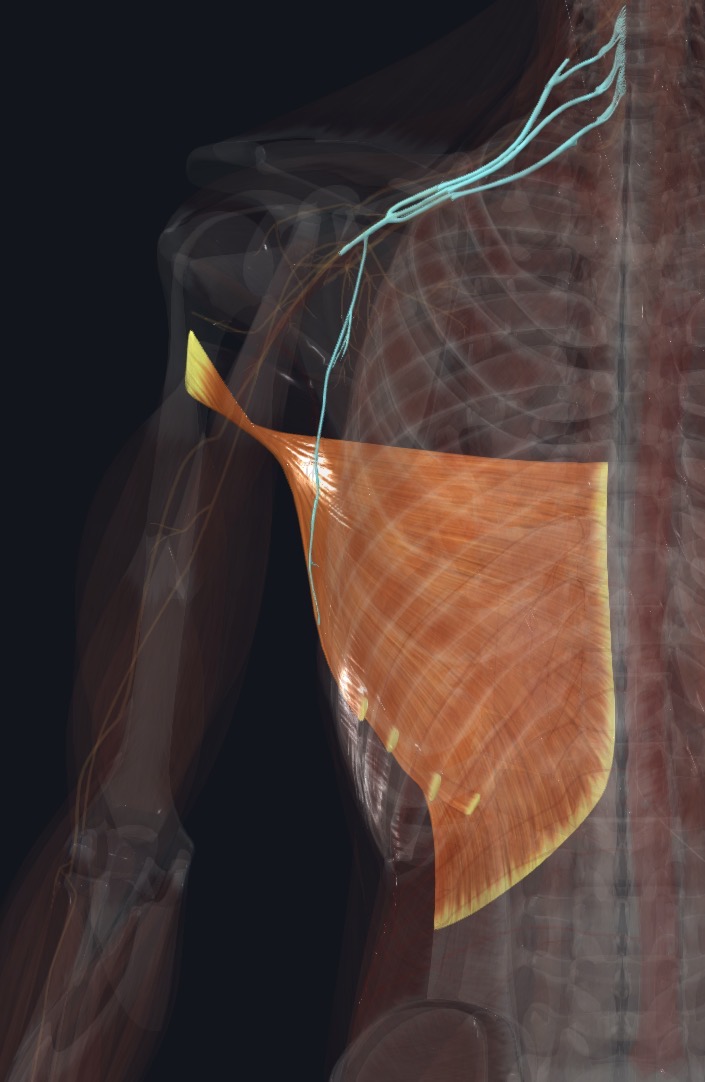
| Nerve | Thoracodorsal nerve (middle subscapular nerve), from the posterior cord of the brachial plexus, roots C6–C8. |
|---|
The thoracodorsal nerve and vessels enter the muscle near its upper lateral border. Surgery in the axilla can affect this nerve. Weak arm extension with normal neck and chest strength may point to a nerve problem, not only muscle tightness.
Section 06 of 20
Blood Supply
| Blood | Thoracodorsal artery (from the subscapular artery), with perforating branches from the posterior intercostal and lumbar arteries. |
|---|
Section 07 of 20
Pictures and Visual Anatomy
Section 08 of 20
Functional Movement
Latissimus dorsi powers pulling movements such as climbing, rowing, swimming, pull-ups, and pulling a door or rope toward the body. It also helps stabilize the low back during lifting and swinging through the thoracolumbar fascia.
Section 09 of 20
Synergists and Antagonists
Synergists: teres major, posterior deltoid, the long head of triceps, and the sternocostal fibers of pectoralis major (extension and adduction of the arm). Antagonists: the anterior and middle deltoid, the clavicular head of pectoralis major, and supraspinatus (shoulder flexion and abduction).
Section 10 of 20
Palpation and Location
Client position and technique
Position the client prone with the arm alongside the body, or side-lying with the arm supported. Locate the posterior axillary fold, then follow the muscle across the mid and lower back. Ask the client to gently extend or press the arm down against light resistance to feel the muscle tighten. The thick lower fibers can be followed toward the thoracolumbar fascia and iliac crest.
Protect nearby structures
Avoid deep pressure in the armpit, where the brachial plexus, axillary vessels, and lymph nodes are close. Use broad, moderate pressure over the ribs and stop if the client reports tingling, numbness, or sharp pain.
Section 11 of 20
Massage Therapy Relevance
Latissimus dorsi is commonly involved in mid and low back tension, limited overhead reach, and rounded-shoulder posture. Because it crosses the thoracolumbar fascia and the shoulder, it can influence both back and shoulder complaints, although many other structures cause similar symptoms.
Section 12 of 20
Dysfunction: What Happens When Movement Goes Wrong
Changes in how a muscle works can change how a joint moves. The points below describe possibilities that may be associated with altered muscle function; they are not diagnoses, and one muscle is never assumed to be the sole cause of a problem.
When the muscle is weak
Weakness may reduce pulling strength and may be associated with more work by teres major, the posterior deltoid, and the trunk during pulling.
When it is tight or shortened
Tightness may be associated with limited overhead reach, a rounded or forward-shifted shoulder, and increased arching of the low back with arm elevation.
When it is overused
Repeated pulling and overhead activity may overload the muscle and may contribute to back, armpit, or shoulder blade ache.
When it is strained
A strain may cause pain in the back or near the arm with resisted pulling; rotator cuff, rib, and spine problems can look similar.
When it is inhibited or others compensate
Reduced activation may be associated with poor control of the arm during pulling and more load on the low back and shoulder.
When it does not coordinate well with synergists and antagonists
Poor coordination with teres major, the lower trapezius, and the core may alter shoulder movement and may be associated with shoulder or back symptoms.
Section 13 of 20
Conditions, Pathologies, and Pain Relationships
Latissimus strain
Sudden pulling in rowing, climbing, gymnastics, and throwing can strain the muscle or its tendon near the arm, causing back or armpit pain.
Tightness and limited overhead reach
A shortened muscle may be associated with restricted shoulder flexion and elevation and increased low back arching when reaching overhead.
Trigger point referral
Trigger points may refer pain to the lower shoulder blade, back of the arm, and side of the trunk, but heart, lung, and spine problems can look the same.
Differential considerations
Rotator cuff and teres major problems, rib and thoracic spine dysfunction, thoracic outlet syndrome, cervical radiculopathy, and visceral pain can all cause pain in this area.
Section 14 of 20
Example Clinical Relationship
A rock climber reports tightness across the mid back and a pulling ache near the armpit after long sessions. Latissimus dorsi may be involved, and the pattern may be associated with overuse or a mild strain, but rotator cuff, rib, and spine problems can look similar. Gentle broad work along the muscle may support comfort, while chest pain, fever, or new arm weakness needs referral.
Section 15 of 20
Massage and Treatment Approaches
For healthy, non-acute tissue, position the client prone or side-lying. Begin with broad effleurage from the iliac crest toward the armpit, then use kneading, compression, and gentle longitudinal strokes along the fibers, adding comfortable arm movement when appropriate.
| Movement | Use gentle active or assisted shoulder flexion and abduction within comfort to lengthen the muscle; do not force range. |
|---|---|
| Regional work | Consider teres major, the thoracolumbar fascia, quadratus lumborum, serratus posterior inferior, and rhomboids when assessment supports it. |
| Avoid | Deep pressure in the axilla, over an acute strain, or at any point that reproduces arm tingling. |
Section 16 of 20
Precautions and Contraindications
Precautions and contraindications
- Acute strain, rib fracture, or recent trauma or surgery in the back or axilla.
- Use caution with severe osteoporosis, anticoagulant use, or easy bruising.
- Avoid open wounds, infection, rashes, and unexplained swelling.
- Stop if pressure causes sharp pain, or arm numbness or tingling.
Section 17 of 20
Red Flags and When to Refer
Red flags and referral
- Chest pain, shortness of breath, or pain that spreads to the jaw or left arm.
- Back pain with fever, unexplained weight loss, or night pain.
- New arm weakness, numbness, or loss of coordination.
- Bladder or bowel changes, or numbness in the saddle area with back pain.
Section 18 of 20
Study Summary
Attachments
Origin: T7–L5 spinous processes and thoracolumbar fascia, iliac crest, lower ribs. Insertion: floor of the intertubercular groove.
Actions
Shoulder extension, adduction, and medial rotation.
Supply
Thoracodorsal nerve (C6–C8); thoracodorsal artery.
Section 19 of 20
Instructor Narration
Open narration transcript
Latissimus dorsi is the broad muscle of the mid and lower back. It runs from the spine, pelvis, and lower ribs to the humerus.
It arises from the spinous processes of the lower thoracic vertebrae and, through the thoracolumbar fascia, from the lumbar and sacral spinous processes, the iliac crest, and the lower ribs. It inserts in the intertubercular groove of the humerus.
It extends, adducts, and medially rotates the arm, and with the arm fixed it lifts the trunk, as in climbing. Teres major and the posterior deltoid help it, and the anterior deltoid and the clavicular head of pectoralis major oppose it.
The thoracodorsal nerve supplies it, from C6 to C8, and the thoracodorsal artery provides its blood.
Palpate with the client prone or side-lying, follow the posterior axillary fold, and ask for gentle arm extension. Avoid deep pressure in the armpit.
Strain, tightness that limits overhead reach, and trigger points are common, and rotator cuff, rib, spine, and visceral problems can overlap. Refer chest pain, back pain with fever or weight loss, new arm weakness, or bladder or bowel changes.
Remember: spine, pelvis, and lower ribs to the intertubercular groove; extension, adduction, and medial rotation; thoracodorsal nerve.
Section 20 of 20