Section 01 of 20
Introduction
Internal oblique is the middle of the three flat muscles on the side of the abdominal wall. It lies deep to external oblique and superficial to transversus abdominis, and its fibers run upward and toward the midline, at right angles to those of external oblique.
Working with the opposite external oblique it creates a rotational force on the trunk, and both sides together brace the abdomen.
Section 02 of 20
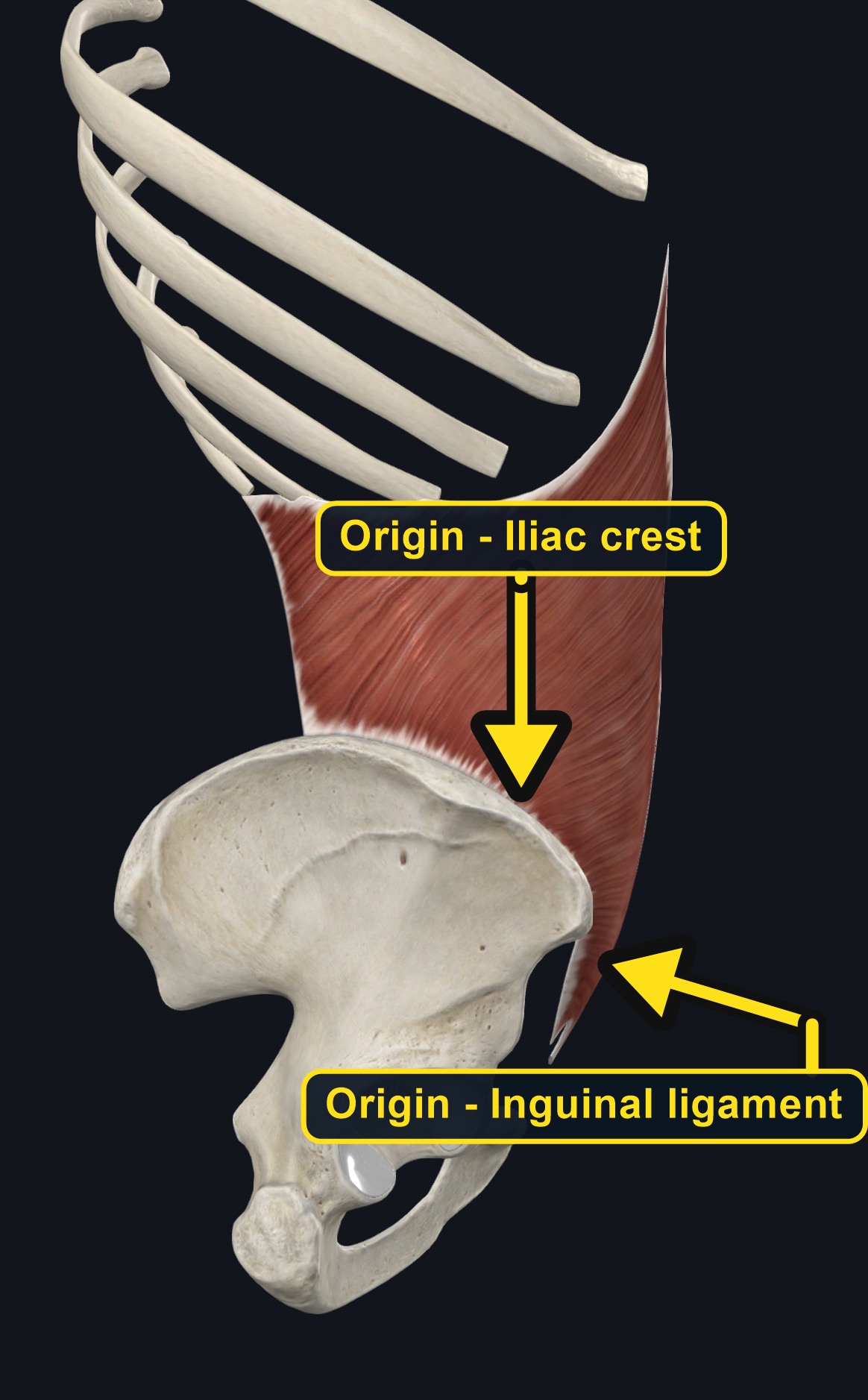
Origin
| Origin | Thoracolumbar fascia, the anterior two-thirds of the iliac crest, and the lateral two-thirds of the inguinal ligament. |
|---|
Section 03 of 20
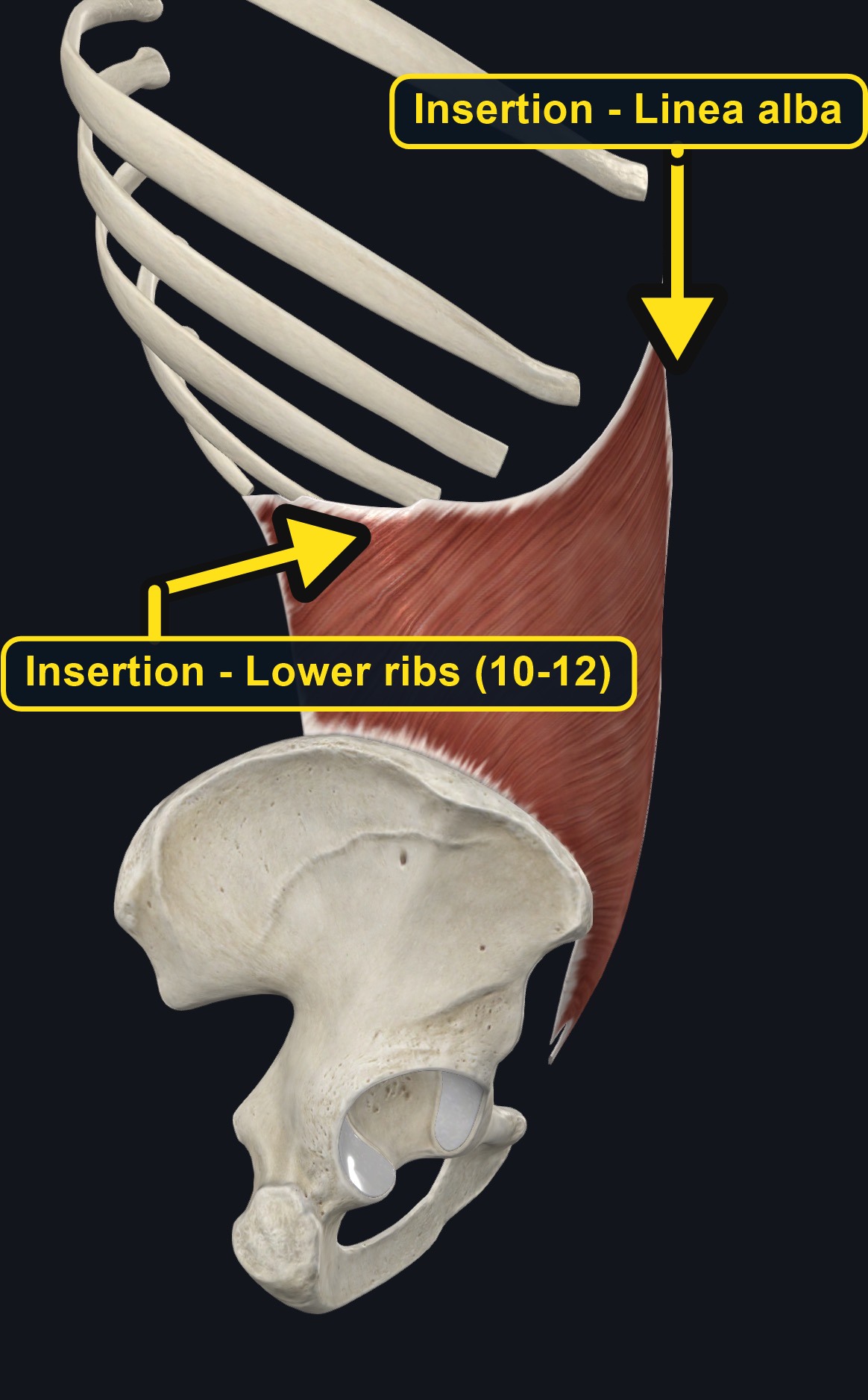
Insertion
| Insertion | Inferior borders of the cartilages of ribs 10–12, the linea alba through the rectus sheath, and the pubic crest and pectineal line by the conjoint tendon. |
|---|
Section 04 of 20
Actions
No dedicated action video is currently available. This movement is explained below and video will be added when verified source media becomes available.
| Primary action | Rotation of the trunk to the same side. |
|---|---|
| Secondary actions | Trunk flexion, lateral flexion, and abdominal compression. |
| Movement at the joint | Lumbar and lower thoracic spine (intervertebral joints) and the abdominal wall. |
| Heads / fiber groups | Single sheet of fibers; the lower fibers form the conjoint tendon with transversus abdominis. |
| Functional examples | Twisting, throwing, swinging a bat or club, side-bending, forced exhalation, coughing, and lifting. |
Trunk rotation
Rotates the trunk to the same side as the contracting muscle, working with the opposite external oblique.
Trunk flexion and lateral flexion
Both sides flex the trunk; one side bends it to that side.
Abdominal compression and stability
Compresses the abdominal contents and supports coughing, exhaling, and core stability.
Section 05 of 20
Nerve Innervation
| Nerve | Lower intercostal nerves (T7–T11), subcostal nerve (T12), iliohypogastric and ilioinguinal nerves (L1). |
|---|
The iliohypogastric and ilioinguinal nerves run between internal oblique and transversus abdominis. Burning, numbness, or shooting pain in the lower abdomen or groin may reflect nerve irritation, not only muscle tightness.
Section 06 of 20
Blood Supply
| Blood | Deep circumflex iliac artery, superior and inferior epigastric arteries, lower posterior intercostal arteries, and lumbar arteries. |
|---|
Section 07 of 20
Pictures and Visual Anatomy
The pictures for this muscle are shown with the Origin, Insertion, Nerve Innervation, and other sections where they teach best.
Section 08 of 20
Functional Movement
Internal oblique is active in twisting, throwing, swinging a bat or club, bending sideways, forced exhalation, coughing, and lifting, where it stabilizes the trunk.
Section 09 of 20
Synergists and Antagonists
Synergists: external oblique on the opposite side (rotation), rectus abdominis (flexion), transversus abdominis (compression), and quadratus lumborum (lateral flexion). Antagonists: the erector spinae and multifidus (trunk extension), and the opposite-side internal oblique (rotation).
Section 10 of 20
Palpation and Location
Client position and technique
Position the client supine with the knees bent or side-lying. Locate the iliac crest and the lower ribs, then feel the lateral abdominal wall between them. Ask the client to gently rotate the shoulder toward the side being palpated (a small curl-twist) to feel the muscle tighten beneath the external oblique.
Protect nearby structures
Use slow, flat-hand pressure and stay away from the inguinal region, ribs 10–12, and any hernia site. Avoid the area in pregnancy, after recent abdominal surgery, or with acute abdominal pain, and stop if the client reports sharp pain or nausea.
Section 11 of 20
Massage Therapy Relevance
Internal oblique is part of core stability and trunk rotation, so it is commonly involved in low back tension, rotational sport injuries, and postural asymmetry. Because it lies over the abdominal organs, safe technique and clear consent matter.
Section 12 of 20
Dysfunction: What Happens When Movement Goes Wrong
Changes in how a muscle works can change how a joint moves. The points below describe possibilities that may be associated with altered muscle function; they are not diagnoses, and one muscle is never assumed to be the sole cause of a problem.
When the muscle is weak
Weakness may reduce trunk rotation strength and abdominal support and may be associated with more load on the low back.
When it is tight or shortened
Tightness may be associated with limited trunk rotation and side-bending and with a pulled-down feeling in the rib cage.
When it is overused
Repeated twisting in golf, tennis, and throwing may overload the muscle and may contribute to side or lower abdominal pain.
When it is strained
A strain may cause side or lower abdominal pain with twisting or coughing; hernia and visceral causes can look similar.
When it is inhibited or others compensate
Reduced activation may be associated with poor core control and more work by the erector spinae and hip flexors.
When it does not coordinate well with synergists and antagonists
Poor coordination with external oblique, transversus abdominis, and the back muscles may alter trunk control and may be associated with low back or abdominal symptoms.
Section 13 of 20
Conditions, Pathologies, and Pain Relationships
Oblique strain
Twisting sports like golf, baseball, and tennis can strain the muscle and cause side or lower abdominal pain, worse with twisting or coughing.
Low back pain and core imbalance
Reduced control of the trunk muscles may be associated with low back tension, but the spine, discs, and organs can cause similar pain.
Nerve entrapment
Irritation of the iliohypogastric or ilioinguinal nerves may cause burning lower abdominal or groin pain and needs assessment.
Differential considerations
Hernia, appendicitis, kidney stones, gynecologic and bowel conditions, and lumbar referral can all cause abdominal wall and flank pain.
Section 14 of 20
Example Clinical Relationship
A golfer reports a pulling pain along the side of the lower abdomen with each twisting swing. The oblique muscles may be involved, and the pattern may be associated with an oblique strain, but a hernia, a nerve problem, and internal organ conditions can look similar. Gentle, consented work on the flank may support comfort, while severe pain, a new bulge, or fever needs referral.
Section 15 of 20
Massage and Treatment Approaches
For healthy, non-acute tissue, position the client supine or side-lying with the trunk supported. Begin with light effleurage and gentle kneading of the lateral abdominal wall and flank, working with the client's breathing and within comfort, and consider gentle trunk rotation and side-bend mobility.
| Movement | Use gentle active rotation and side-bending; do not force stretch a painful side. |
|---|---|
| Regional work | Consider external oblique, rectus abdominis, quadratus lumborum, erector spinae, and the diaphragm when assessment supports it. |
| Avoid | Deep pressure on the abdomen, over the ribs 10–12, or near any hernia, scar, or tender area. |
Section 16 of 20
Precautions and Contraindications
Precautions and contraindications
- Pregnancy, recent abdominal surgery, or hernia: avoid direct abdominal work.
- Use caution with inflammatory bowel disease, abdominal pain of unknown cause, or after a full meal.
- Use caution with anticoagulant use or easy bruising.
- Always obtain explicit consent and use secure draping.
Section 17 of 20
Red Flags and When to Refer
Red flags and referral
- Severe or worsening abdominal pain, fever, vomiting, or a rigid abdomen.
- A new bulge in the groin or abdominal wall, especially painful or not reducible.
- Blood in the urine or stool, or unexplained weight loss.
- Chest pain, shortness of breath, or pain that spreads to the shoulder or jaw.
Section 18 of 20
Study Summary
Attachments
Origin: thoracolumbar fascia, iliac crest, inguinal ligament. Insertion: ribs 10–12, linea alba, pubic crest.
Actions
Trunk rotation to the same side, trunk flexion, and abdominal compression.
Supply
Lower intercostal, subcostal, iliohypogastric, and ilioinguinal nerves; epigastric, circumflex iliac, and lumbar arteries.
Section 19 of 20
Instructor Narration
Open narration transcript
Internal oblique is the middle layer of the lateral abdominal wall. It lies between external oblique and transversus abdominis, with fibers running upward and toward the midline.
It arises from the thoracolumbar fascia, the anterior iliac crest, and the inguinal ligament, and inserts on the cartilages of ribs 10 to 12, the linea alba, and the pubic crest.
It rotates the trunk to the same side, flexes and side-bends the trunk, and compresses the abdomen. The opposite external oblique and rectus abdominis work with it, and the erector spinae oppose it.
The lower intercostal, subcostal, iliohypogastric, and ilioinguinal nerves supply it, and the epigastric, circumflex iliac, and lumbar arteries provide its blood.
With the client supine, locate the iliac crest and lower ribs and ask for a gentle twist to feel the muscle. Use slow, flat-hand pressure, avoid the groin, ribs, and any hernia, and obtain consent.
Oblique strain, low back pain, nerve entrapment, hernia, and organ conditions can overlap. Refer severe abdominal pain, a new bulge, blood in the urine or stool, or chest pain.
Remember: iliac crest and inguinal ligament to ribs 10 to 12 and the linea alba, same-side rotation, lower intercostal, iliohypogastric, and ilioinguinal nerves.
Section 20 of 20