Section 01 of 20
Introduction
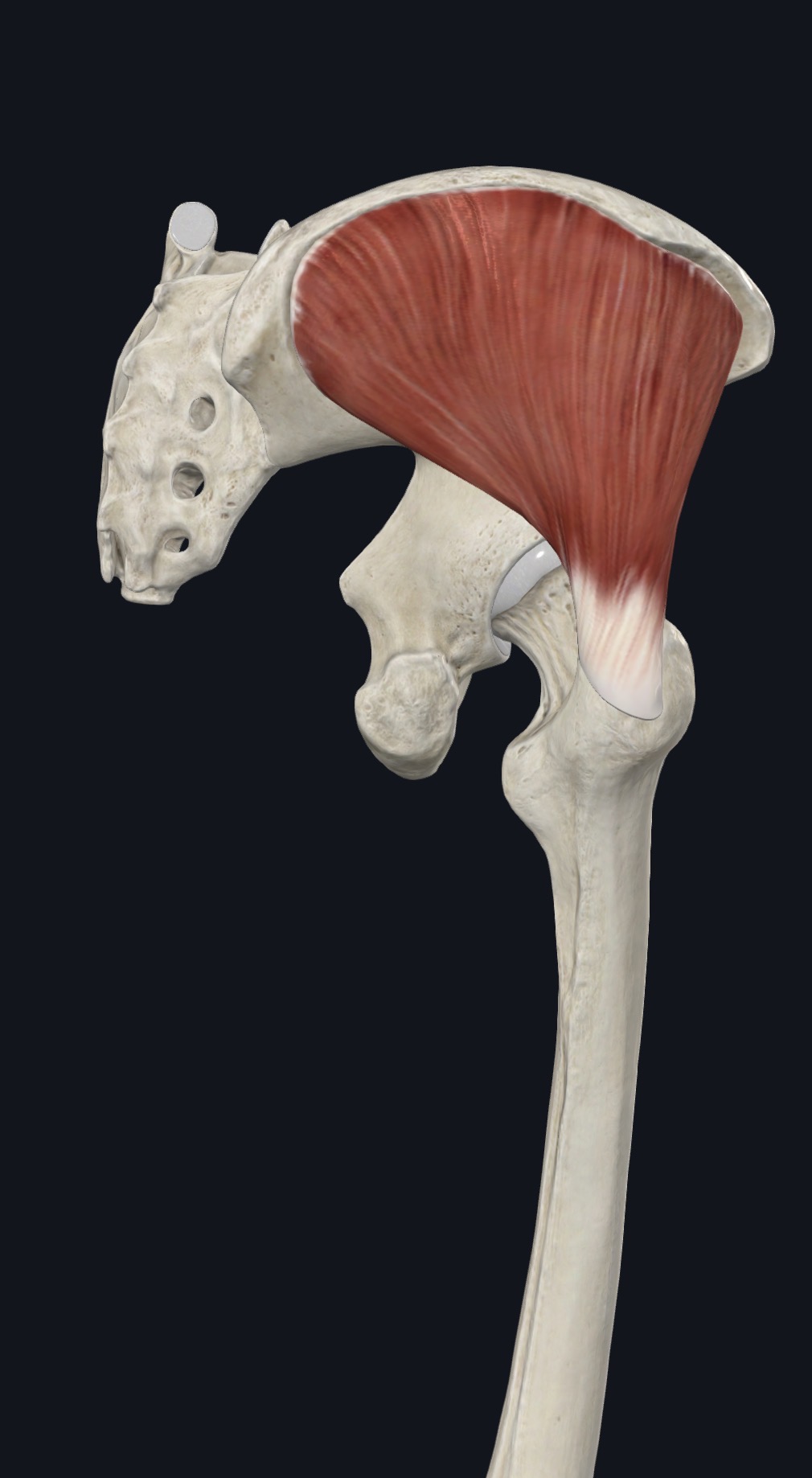
Gluteus medius is a broad, fan-shaped muscle located on the outer surface of the pelvis, partly covered by gluteus maximus posteriorly but palpable directly beneath the skin over much of the lateral hip. Its primary job is hip abduction, but its more critical, less obvious role is pelvic stabilization — keeping the pelvis level during single-leg stance, such as each step of walking or running.
Gluteus medius works constantly during gait, contracting on the stance leg's side to prevent the opposite side of the pelvis from dropping. This stabilizing role makes it one of the most functionally important muscles for normal walking mechanics, and dysfunction here can have effects that are felt well beyond the hip itself.
For massage therapists, gluteus medius is especially significant because it — along with its underlying tendon — is now recognized as a very common source of lateral hip pain that is frequently, and often incorrectly, assumed to be hip joint arthritis.
Section 02 of 20
Origin
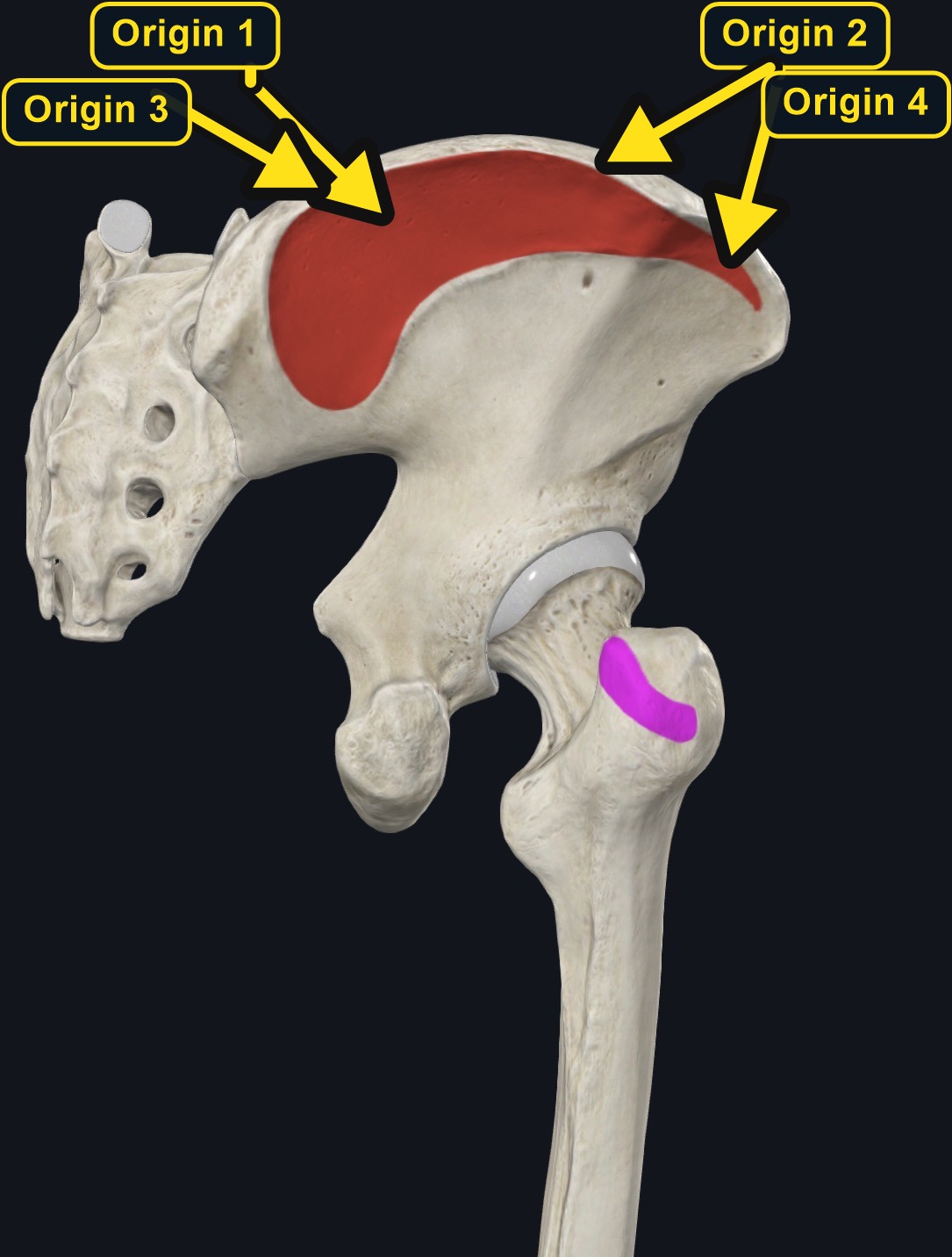
| Origin | External surface of the ilium, between the posterior and anterior gluteal lines (deep to gluteus maximus posteriorly, more superficial anteriorly and laterally). |
|---|
Section 03 of 20
Insertion
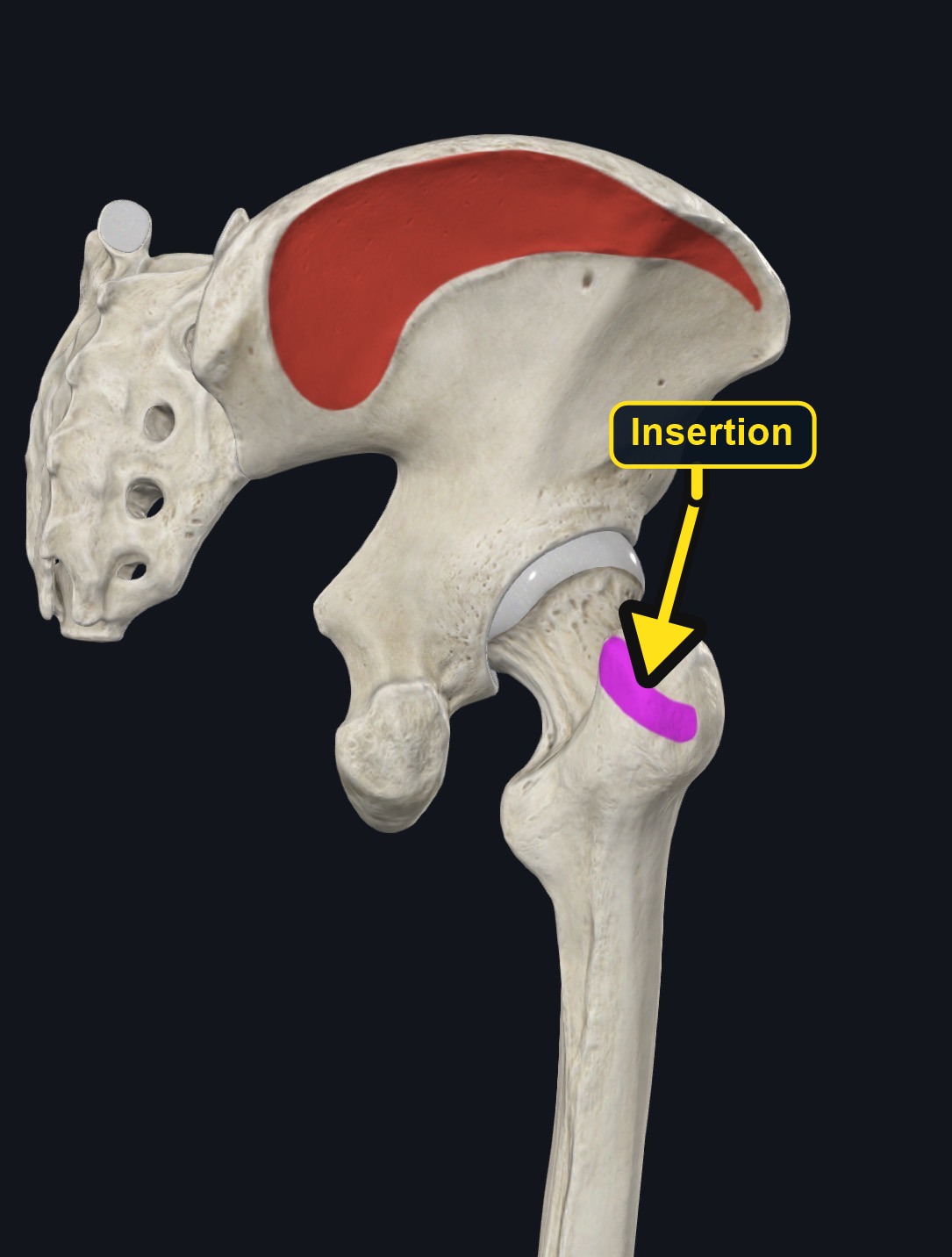
| Insertion | Lateral surface of the greater trochanter of the femur. |
|---|
Section 04 of 20
Actions
| Primary action | Hip abduction. |
|---|---|
| Secondary actions | Anterior fibers: internal rotation and flexion. Posterior fibers: external rotation and extension. All fibers stabilize the pelvis during single-leg stance. |
| Movement at the joint | Hip joint. |
| Heads / fiber groups | Anterior, middle, and posterior fiber groups. |
| Functional examples | Keeping the pelvis level in walking; side-stepping; standing on one leg; climbing stairs. |
Primary actions
- Abduction of the hip (all fibers).
- Pelvic stabilization during single-leg stance — contracting on the weight-bearing side to prevent the opposite (unsupported) side of the pelvis from dropping during walking, running, and stair climbing.
Fiber-specific secondary actions
- Anterior fibers assist hip flexion and internal rotation.
- Posterior fibers assist hip extension and external rotation.
Section 05 of 20
Nerve Innervation
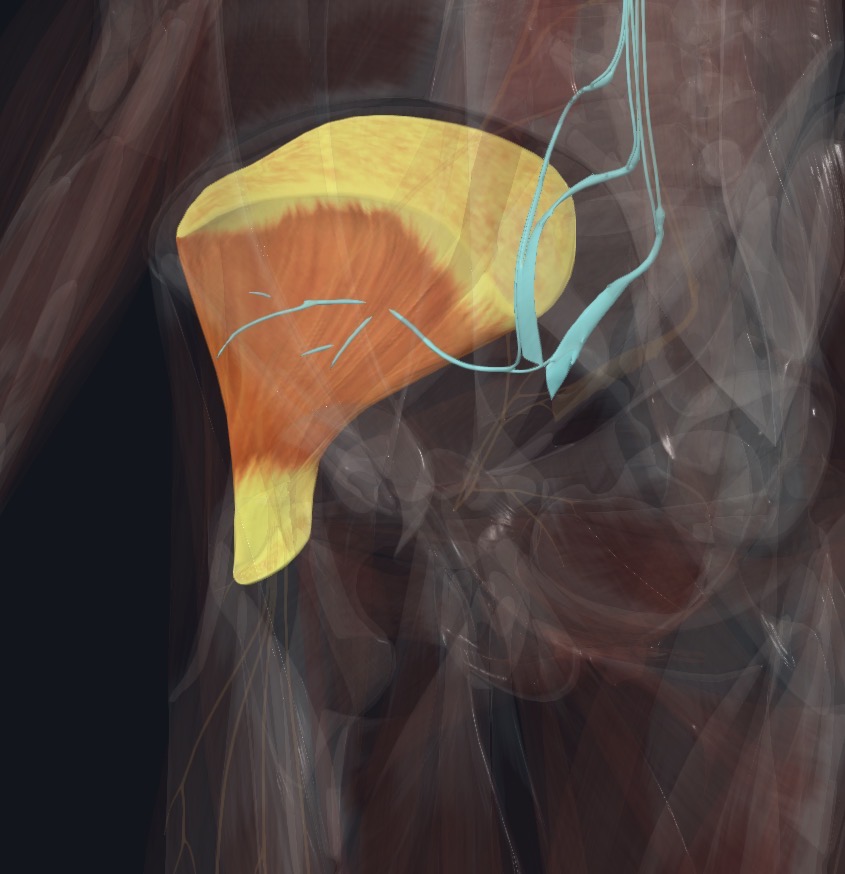
| Nerve | Superior gluteal nerve |
|---|---|
| Roots | L4, L5, S1 |
| Relationship | The superior gluteal nerve arises from the sacral plexus, exits the pelvis through the greater sciatic foramen above the piriformis (distinguishing its exit point from the inferior gluteal nerve and the sciatic nerve, which exit below piriformis), and supplies gluteus medius, gluteus minimus, and tensor fasciae latae. |
Section 06 of 20
Blood Supply
Gluteus medius is supplied primarily by the superior gluteal artery, a branch of the internal iliac artery, which travels alongside the superior gluteal nerve.
Section 07 of 20
Pictures and Visual Anatomy
Section 08 of 20
Functional Movement
Gluteus medius keeps the pelvis level when you stand on one leg, which happens with every step of walking or running. It also controls the hip during side steps, stair climbing, and standing on one leg, and it helps rotate the thigh.
Section 09 of 20
Synergists and Antagonists
Synergists
Gluteus minimus (abduction, works almost identically); tensor fasciae latae (abduction, flexion, internal rotation assistance).
Antagonists
Adductor group (adduction is the opposing motion to abduction).
Section 10 of 20
Palpation and Location
Client position
Client side-lying (uppermost leg being assessed) or prone.
Landmarks and technique
- Locate the iliac crest and the greater trochanter of the femur; gluteus medius fills much of the space between these landmarks on the lateral hip, fanning out from the outer pelvis down to the top of the trochanter.
- A portion of gluteus medius is covered by gluteus maximus posteriorly, but a substantial anterior/lateral portion is directly palpable just beneath the skin, often described as feeling firm and fan-shaped under the fingers.
- Asking the client to gently abduct the leg (lifting it sideways, side-lying position, against light resistance) will help the therapist feel the muscle contract and distinguish it from tensor fasciae latae, which lies just anterior to it.
- The insertion tendon area near the greater trochanter is a common site of tenderness (see Conditions) — palpate this area gently and take note of any sharp, localized tenderness distinct from general muscle tightness.
Section 11 of 20
Massage Therapy Relevance
Gluteus medius is extremely relevant to massage therapy because of how frequently it is involved in lateral hip pain, a very common client complaint, especially in middle-aged and older clients, runners, and people who stand for long periods. Because this muscle contracts with every single step to stabilize the pelvis, it accumulates significant cumulative load over a lifetime of walking.
Weakness or poor control of gluteus medius is also commonly discussed in relation to altered gait patterns and compensatory strain elsewhere in the lower back, hip, or knee, making it a muscle worth considering even when a client's primary complaint is located elsewhere in the lower kinetic chain.
Because true hip joint pathology (such as osteoarthritis) can present with similar lateral or groin hip pain, and because the two conditions may sometimes coexist, therapists should avoid assuming that all lateral hip pain is muscular in origin, and should encourage appropriate medical evaluation when symptoms are persistent or unclear.
Section 12 of 20
Dysfunction: What Happens When Movement Goes Wrong
Changes in how a muscle works can change how a joint moves. The points below describe possibilities that may be associated with altered muscle function; they are not diagnoses, and one muscle is never assumed to be the sole cause of a problem.
When the muscle is weak
Weakness may cause the pelvis to drop on the opposite side in single-leg stance (Trendelenburg pattern) and may be associated with a side-to-side gait and increased load on the hip and low back.
When it is tight or shortened
Tightness may be associated with lateral hip ache and limited hip adduction and may add tension near the greater trochanter.
When it is overused
Running, long standing, and repeated single-leg loading may overload the muscle and its tendon and may contribute to lateral hip pain.
When it is strained
A strain or tendon irritation may cause pain over the outer hip with side-lying or single-leg stance; hip joint disease and lumbar referral can look similar.
When it is inhibited or others compensate
Reduced activation may be associated with knee collapse inward during squatting or landing and compensation from the tensor fasciae latae and the low back.
When it does not coordinate well with synergists and antagonists
Poor coordination with gluteus maximus, tensor fasciae latae, and the adductors may alter pelvic and knee control and may be associated with lateral hip or knee symptoms.
Section 13 of 20
Conditions, Pathologies, and Pain Relationships
Gluteus medius tendinopathy
What it is: Degenerative or irritative change of the gluteus medius tendon near its insertion on the greater trochanter.
Why the muscle may be involved: Cumulative loading from walking, running, and single-leg activities over time, sometimes combined with biomechanical factors.
Typical symptoms: Lateral hip pain, often worse with walking, climbing stairs, lying on the affected side, or after prolonged standing.
Similar-presenting conditions: Trochanteric bursitis, hip joint osteoarthritis, lumbar referral, IT band-related lateral hip/thigh discomfort.
Refer when: Persistent or worsening pain, or any signs suggesting joint-level pathology, warrant medical evaluation and possible imaging.
Greater trochanteric pain syndrome (GTPS)
What it is: A broader clinical term encompassing gluteus medius/minimus tendinopathy, trochanteric bursitis, and related lateral hip soft-tissue pain, now understood to be more commonly tendon-related than purely bursa-related in many cases.
Why the muscle may be involved: Gluteus medius (and minimus) tendon insertion is the anatomical focus of this syndrome.
Typical symptoms: Lateral hip pain that can radiate down the outer thigh, tenderness directly over the greater trochanter, worse with side-lying, walking, or stairs.
Similar-presenting conditions: Hip osteoarthritis, lumbar radiculopathy, IT band syndrome.
Refer when: Diagnosis and management of GTPS is a medical determination; massage therapists should not diagnose this condition, though gentle supportive soft tissue work may be appropriate within scope for clients who have been evaluated and cleared for massage.
Trendelenburg gait pattern (informational)
What it is: A gait pattern in which the pelvis drops on the side of the unsupported leg during walking, classically associated with gluteus medius weakness or dysfunction on the standing-leg side.
Why the muscle may be involved: Gluteus medius's stabilizing role during single-leg stance is directly responsible for preventing this pelvic drop.
Typical symptoms: A visible waddling or dropping gait pattern, sometimes with associated hip or low back discomfort over time from altered mechanics.
Similar-presenting conditions: Hip joint pathology, neurological conditions affecting the superior gluteal nerve, leg length discrepancy.
Refer when: This is a clinical observation, not a massage therapy diagnosis; if observed, it is reasonable to mention the observation and suggest a professional movement/medical assessment.
Section 14 of 20
Example Clinical Relationship
Why lateral hip pain is not automatically arthritis
Many clients who report "hip pain" are describing lateral hip discomfort over the greater trochanter region, which is very often related to the gluteus medius/minimus tendons and greater trochanteric pain syndrome rather than the hip joint itself. True hip joint pathology, such as osteoarthritis, more typically produces groin-predominant pain, though presentations can overlap and both conditions can coexist in the same client, particularly in older adults.
This distinction matters for massage therapists because the two conditions may respond differently to soft tissue work and because true joint pathology often benefits from a broader medical/orthopedic management plan. Massage therapists should avoid telling a client they either "have arthritis" or "don't have arthritis" — this is a diagnostic determination outside massage therapy scope — but can reasonably note the location and behavior of the pain, offer appropriate soft-tissue techniques for muscular/tendon-related tenderness, and suggest medical evaluation for persistent, worsening, or unclear hip pain, especially when there is joint stiffness, swelling, or significant loss of hip range of motion.
Section 15 of 20
Massage and Treatment Approaches
The following approaches may be considered for a generally healthy client with no contraindications present.
Broad warming strokes
Why: Prepares the lateral hip tissue and allows general tone assessment.
Direction/location: Broad strokes across the lateral hip, from the iliac crest down toward the greater trochanter.
Pressure: Light to moderate.
Positioning: Side-lying (working the uppermost hip) or prone.
Compression and kneading
Why: Addresses general muscle tightness through the fan-shaped belly.
Direction/location: Through the muscle belly, avoiding direct sustained pressure right on the trochanteric insertion if it is acutely tender.
Pressure: Moderate, adjusted to client tolerance and any reported trochanteric tenderness.
Stripping
Why: Can address fiber-direction tension.
Direction/location: Along fiber direction from the iliac crest toward the greater trochanter.
Pressure: Light to moderate; reduce pressure directly over a tender insertion point.
Gentle stretching
Why: May help address general tightness, particularly in clients with reduced hip adduction range.
Direction/location: Gentle hip adduction across the body (side-lying or supine), performed slowly and within comfortable range.
Pressure: Gentle; avoid aggressive stretching directly over an irritable tendon.
Active movement
Why: Light active hip abduction can help the therapist assess muscle activation and general strength/tolerance, within general massage-therapy scope of active/passive assessment.
Section 16 of 20
Precautions and Contraindications
Use caution or avoid the area when any of the following are present
- Acute injury or suspected muscle/tendon tear.
- Acutely inflamed or highly irritable trochanteric bursitis/tendinopathy — very light work or avoidance of direct pressure over the trochanter may be more appropriate in an acute flare, guided by client feedback.
- Recent hip surgery (including joint replacement) without medical clearance for massage.
- Unexplained swelling, warmth, or significant asymmetry around the hip.
- Signs of acute inflammation or infection.
- Suspected fracture, especially in older adults after a fall.
Vulnerable structures — general awareness
- The greater trochanter itself, which may be acutely tender in trochanteric pain syndrome — reduce pressure and follow client feedback closely in this area.
Section 17 of 20
Red Flags and When to Refer
Postpone massage and refer for medical evaluation if a client reports or shows:
- Sudden inability to bear weight on the leg, or suspected fracture (especially after a fall in an older adult).
- Significant, unexplained, or progressively worsening hip or leg weakness.
- Numbness, tingling, or other neurological symptoms in the leg.
- Signs of infection (fever, redness, warmth, swelling) around the hip.
- Unexplained, severe, or worsening pain not clearly related to a specific movement or activity, especially with joint swelling or significant loss of motion.
- Recent significant trauma to the hip or pelvis.
Section 18 of 20
Study Summary
External surface of the ilium, between the posterior and anterior gluteal lines.
Lateral surface of the greater trochanter of the femur.
Hip abduction; critical pelvic stabilizer during single-leg stance (prevents contralateral pelvic drop).
Superior gluteal nerve (L4, L5, S1).
Very common source of lateral hip pain (tendinopathy/greater trochanteric pain syndrome), frequently confused with hip joint arthritis; essential to normal gait.
Section 19 of 20
Instructor Narration
Open narration script (readable / for audio conversion)
Section 20 of 20