Section 01 of 20
Introduction
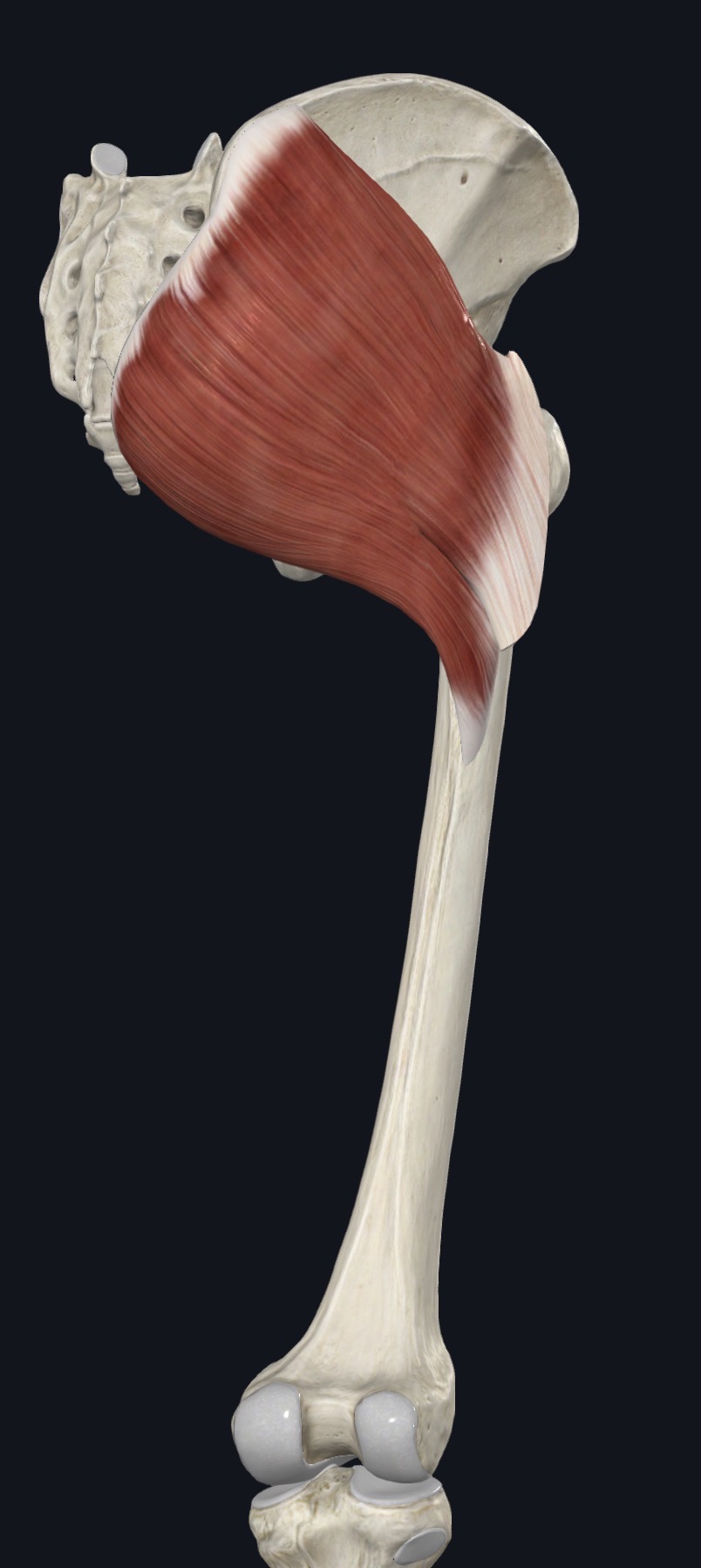
Gluteus maximus is the largest and heaviest muscle in the human body, forming the bulk of the buttock. It is a thick, coarse-fibered muscle running diagonally from the back of the pelvis to the upper thigh, and it is the primary muscle responsible for powerful hip extension — the movement that drives you up out of a chair, up a flight of stairs, or forward during running and sprinting.
Unlike many postural muscles that are active nearly all the time, gluteus maximus is relatively quiet during easy standing and walking, and becomes strongly active mainly during more demanding movements requiring force — climbing, running, jumping, or rising from a deep flexed hip position. This activation pattern is directly relevant to why the muscle so often becomes underused (sometimes informally called "glute amnesia") in people with predominantly sedentary lifestyles.
For massage therapists, gluteus maximus is significant both as a very large, generally well-tolerated muscle for broad manual work, and because of its role in overall pelvic and lower back mechanics.
Section 02 of 20
Origin
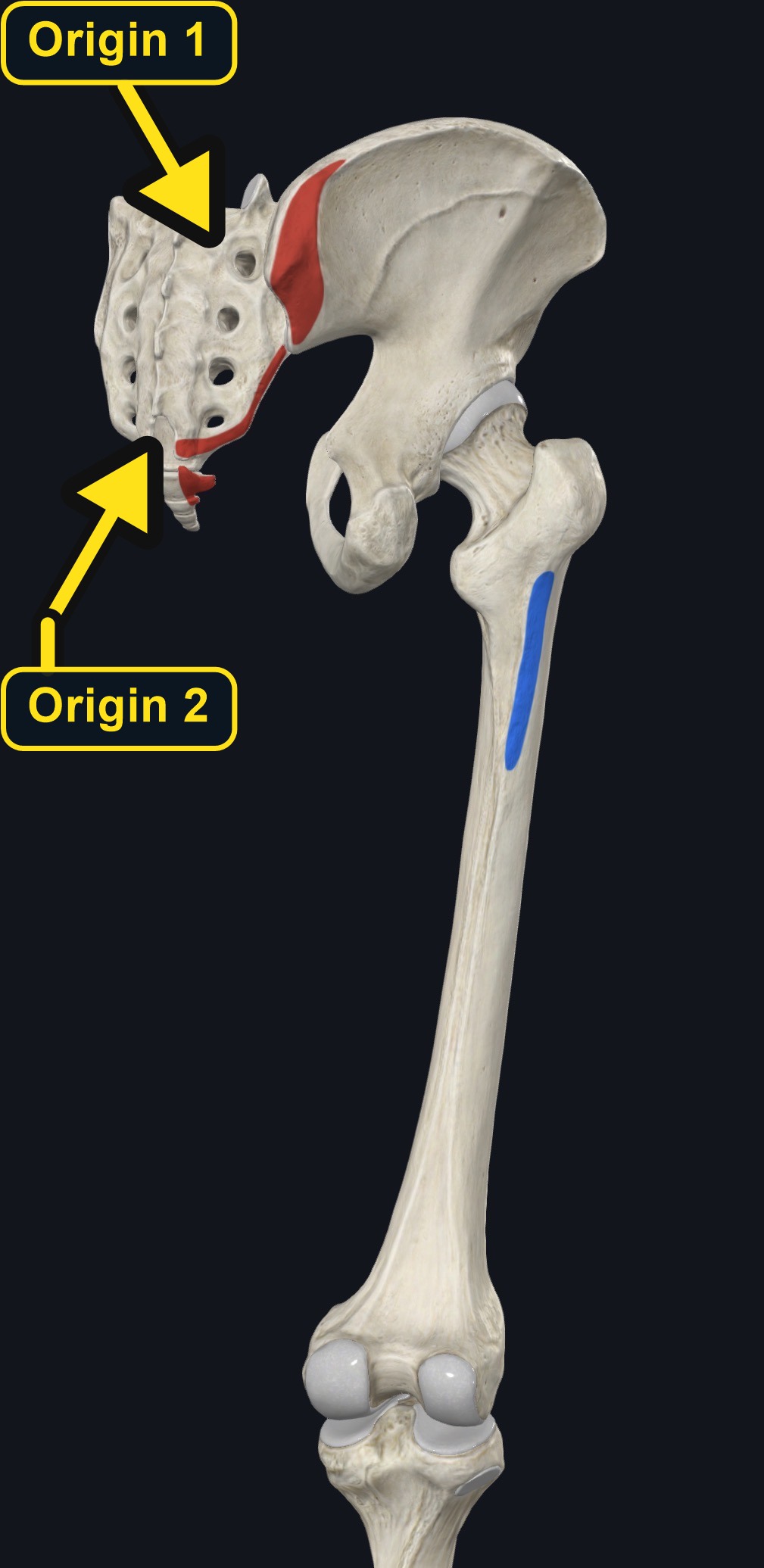
| Origin | Posterior gluteal line of the ilium and the bone above and behind it, the posterior surface of the sacrum and coccyx, the sacrotuberous ligament, and the thoracolumbar fascia (the broad fascial sheet of the low back). |
|---|
Section 03 of 20
Insertion
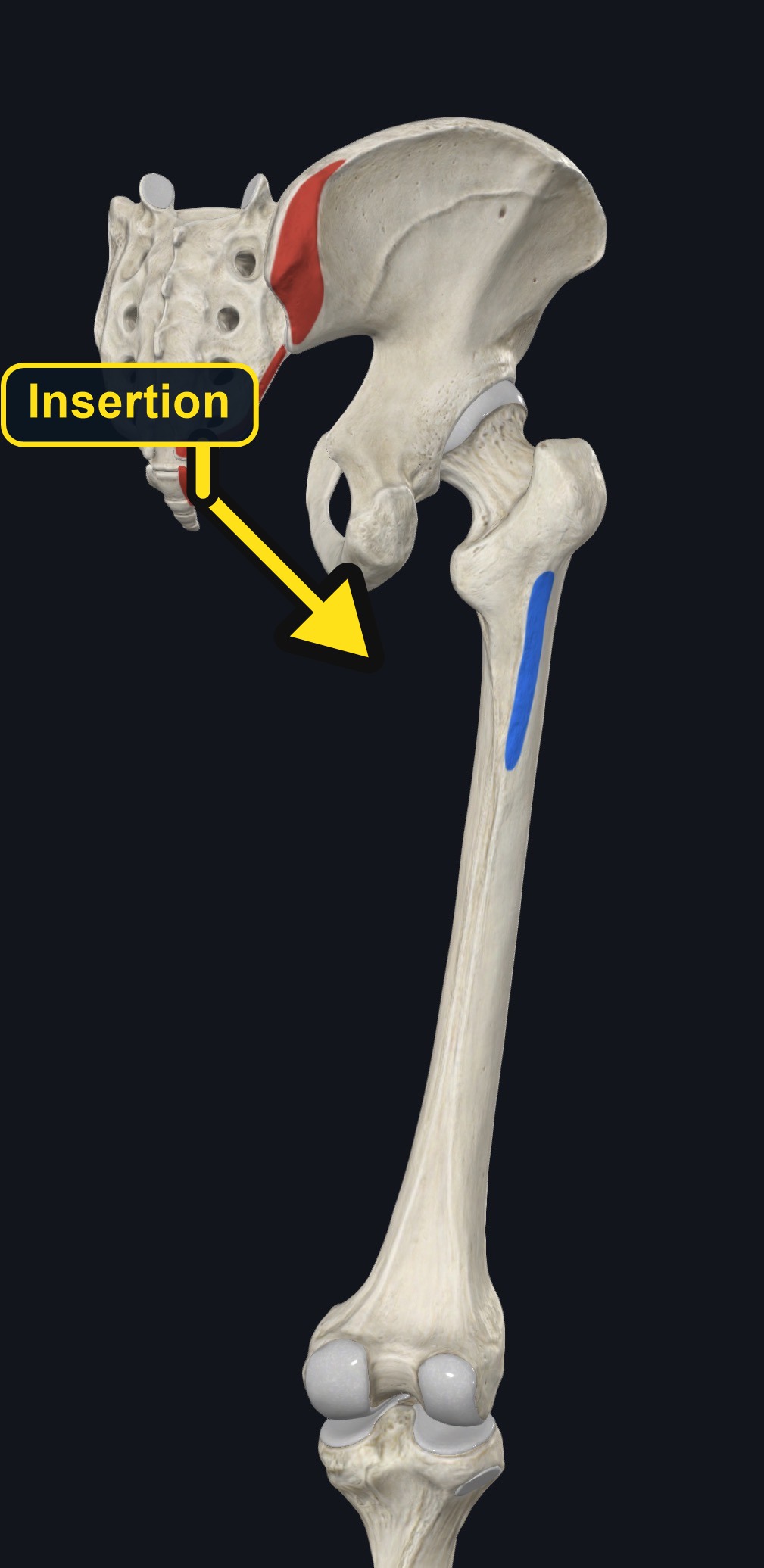
| Insertion | The majority of fibers (roughly the upper three-quarters) insert into the iliotibial (IT) tract/band; the remaining deeper fibers insert directly onto the gluteal tuberosity of the femur. |
|---|
Section 04 of 20
Actions
| Primary action | Hip extension (especially against resistance). |
|---|---|
| Secondary actions | External rotation of the hip; abduction (upper fibers) and adduction (lower fibers); stabilization of the pelvis and knee through the iliotibial tract. |
| Movement at the joint | Hip joint; knee stability through the iliotibial tract. |
| Heads / fiber groups | Upper fibers (abduction, external rotation) and lower fibers (extension, adduction). |
| Functional examples | Standing up from a chair; climbing stairs; running uphill; lifting from the floor; jumping. |
Primary actions
- Powerful extension of the hip, particularly from a flexed position (e.g., rising from sitting, climbing stairs, the drive phase of running/sprinting).
- External (lateral) rotation of the hip.
Secondary actions
- Upper fibers assist hip abduction; lower fibers assist hip adduction (this division of action is a commonly taught but somewhat debated point in the literature).
- Via its attachment into the iliotibial tract, gluteus maximus contributes to lateral stabilization of the knee during standing and gait.
- Assists in maintaining an upright trunk position by controlling anterior pelvic tilt during activities like standing up from a bend.
Section 05 of 20
Nerve Innervation
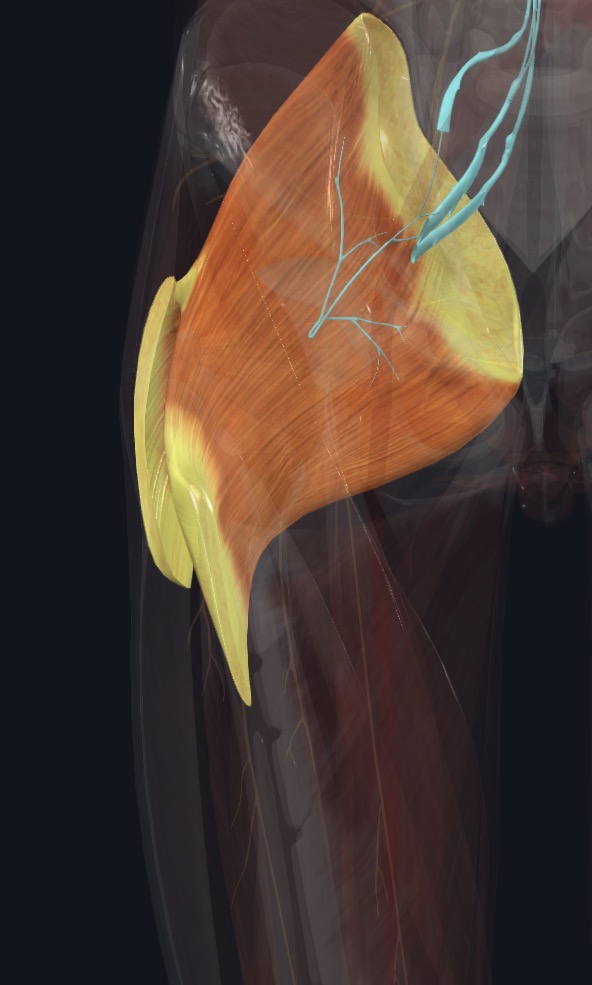
| Nerve | Inferior gluteal nerve |
|---|---|
| Roots | L5, S1, S2 |
| Relationship | The inferior gluteal nerve arises from the sacral plexus and exits the pelvis through the greater sciatic foramen, below the piriformis, to supply gluteus maximus exclusively (it does not continue on to supply other structures, unlike some neighboring nerves). |
Section 06 of 20
Blood Supply
Gluteus maximus is supplied primarily by the superior and inferior gluteal arteries, both branches of the internal iliac artery, which pass through the greater sciatic foramen along with their corresponding nerves.
Section 07 of 20
Pictures and Visual Anatomy
Section 08 of 20
Functional Movement
Gluteus maximus is the main hip extensor for powerful movements: standing up from a chair, climbing stairs, running uphill, jumping, and lifting from the floor. It also controls the trunk on the pelvis and helps keep the knee stable through the iliotibial tract.
Section 09 of 20
Synergists and Antagonists
Synergists
Hamstrings (hip extension); deep lateral rotators including piriformis (external rotation).
Antagonists
Iliopsoas and rectus femoris (hip flexion); adductor group and gluteus medius/minimus contribute opposing actions depending on the specific motion.
Section 10 of 20
Palpation and Location
Client position
Client prone, arms relaxed, with appropriate draping.
Landmarks and technique
- Gluteus maximus is large, superficial, and generally easy to identify — it forms the bulk of the visible buttock contour, running diagonally from the sacrum/coccyx region down and out toward the upper thigh and IT band.
- Asking the client to gently extend the hip (lifting the thigh slightly off the table) or squeeze the buttocks will help the therapist feel the muscle contract and distinguish its borders from surrounding tissue.
- The muscle is generally well tolerated with broader, more generous pressure than the smaller, deeper muscles beneath it (such as piriformis), because of its size and superficial position — but pressure should still be guided by client feedback and comfort with this sensitive body region.
- Because gluteus maximus lies directly over the sciatic nerve and the other deep gluteal structures, deep or narrow-contact pressure applied through this muscle can still affect those deeper structures — see Precautions below.
Section 11 of 20
Massage Therapy Relevance
Gluteus maximus is highly relevant to massage therapy clients across a wide range of activity levels. In sedentary clients, prolonged sitting can be associated with underactivity and general deconditioning of this muscle, sometimes discussed informally as contributing to compensatory overuse of other structures (such as the hamstrings or low back) during hip extension tasks. In highly active clients — runners, cyclists, weightlifters, and athletes in general — gluteus maximus is heavily loaded and can develop overuse-related tightness or soreness.
Because gluteus maximus is part of the broader pelvic and lumbar movement system, general tension or dysfunction here is often considered alongside the low back, hip flexors, hamstrings, and the deeper hip rotators (including piriformis) rather than in isolation.
As the largest muscle in the body, gluteus maximus is also a common area for general relaxation-focused massage work, given its size, superficial position, and generally good tolerance for broader techniques.
Section 12 of 20
Dysfunction: What Happens When Movement Goes Wrong
Changes in how a muscle works can change how a joint moves. The points below describe possibilities that may be associated with altered muscle function; they are not diagnoses, and one muscle is never assumed to be the sole cause of a problem.
When the muscle is weak
Weakness may reduce hip extension power and may be associated with more work by the hamstrings and the low back during lifting, stairs, and running.
When it is tight or shortened
Tightness may be associated with limited hip flexion and internal rotation and may add tension to the iliotibial tract.
When it is overused
Repetitive hill running, stair climbing, or squatting may load the muscle and may contribute to buttock ache.
When it is strained
A strain may cause buttock pain with hip extension or rising from a chair; deep buttock pain has hip, spine, and sciatic nerve causes as well.
When it is inhibited or others compensate
Prolonged sitting and pain may be associated with reduced gluteal activation (sometimes called gluteal amnesia) and more use of the hamstrings and lumbar extensors.
When it does not coordinate well with synergists and antagonists
Poor coordination with the hamstrings, gluteus medius, and abdominal muscles may alter pelvic control and may be associated with low back, hip, or knee symptoms.
Section 13 of 20
Conditions, Pathologies, and Pain Relationships
Gluteal muscle strain
What it is: Overstretching or partial tearing of muscle fibers, generally from a sudden powerful contraction (e.g., sprinting, heavy lifting) or unaccustomed loading.
Why the muscle may be involved: High force production during hip extension activities.
Typical symptoms: Localized buttock pain, possible swelling or bruising, pain with resisted hip extension.
Similar-presenting conditions: Deep hip rotator strain, hamstring strain (proximal), ischial bursitis.
Refer when: Significant swelling, bruising, or loss of function is present, or symptoms do not improve as expected.
Ischial (sit bone) bursitis
What it is: Inflammation of the bursa near the ischial tuberosity, sometimes discussed in relation to prolonged sitting or direct trauma.
Why the muscle may be involved: Gluteus maximus and the hamstring origin are both in close proximity to this region.
Typical symptoms: Localized tenderness directly over the sit bone, worse with sitting.
Similar-presenting conditions: Proximal hamstring tendinopathy, referred pain from the low back.
Refer when: Symptoms are persistent or significantly limit sitting tolerance/function.
Underactivity / relative weakness pattern ("glute amnesia")
What it is: An informally used term describing reduced voluntary activation or relative weakness of gluteus maximus, often discussed in the context of prolonged sitting and sedentary lifestyles.
Why the muscle may be involved: Reduced regular loading of the hip extensors.
Typical symptoms: No direct pain from the muscle itself necessarily, but may be discussed alongside compensatory overuse patterns in the low back or hamstrings.
Similar-presenting conditions: This is a functional/activation pattern rather than a diagnosed pathology, and should be described to clients accordingly.
Refer when: Not a red-flag condition on its own; general movement/exercise guidance is outside massage therapy's typical scope unless the therapist holds additional relevant qualifications.
Section 14 of 20
Example Clinical Relationship
Why gluteus maximus tension can be felt at the knee
Because the majority of gluteus maximus fibers insert into the iliotibial (IT) tract rather than directly onto the femur, tension generated by this muscle is transmitted down the outside of the thigh via the IT band toward the knee. This means gluteal tension and IT band tightness are anatomically connected, and clients with lateral knee discomfort (sometimes associated with IT band syndrome) may benefit from an assessment that includes gluteus maximus and the broader hip region, not only the knee itself.
This is a useful anatomical relationship for treatment planning, but it is not a guarantee that gluteal work will resolve knee symptoms, which can also arise from the knee joint itself, other surrounding structures, training load, or biomechanical factors outside massage therapy's scope to assess. Persistent or worsening knee symptoms should be evaluated by an appropriate healthcare provider.
Section 15 of 20
Massage and Treatment Approaches
The following approaches may be considered for a generally healthy client with no contraindications present.
Broad warming strokes
Why: Prepares the large muscle mass and allows general tone assessment.
Direction/location: Broad strokes across the entire buttock, generally following the diagonal fiber direction from sacrum toward the greater trochanter/IT band.
Pressure: Light to moderate to start.
Compression and kneading
Why: This large, superficial muscle generally tolerates broader compression and kneading well.
Direction/location: Through the full muscle belly.
Pressure: Moderate to firm, as tolerated and guided by client feedback.
Avoid: Overly narrow, sustained, deep pressure directly over the sciatic nerve's known path or the piriformis/deep rotator region without appropriate caution (see the Piriformis lesson for details on this specific area).
Stripping
Why: Can address fiber-direction tension across this large muscle.
Direction/location: Along the diagonal fiber direction, from the sacral/coccygeal origin toward the IT band/femoral insertion.
Pressure: Moderate, adjusted to tolerance.
Gentle stretching and passive movement
Why: May help address general tightness.
Direction/location: Hip flexion with slight adduction (e.g., knee-to-opposite-shoulder style stretch performed gently), staying within comfortable range.
Pressure: Gentle; avoid forcing end range.
Active movement / postural education
Why: Encouraging regular movement and activity, in addition to manual work, may support general comfort in sedentary clients — general educational guidance, not a prescribed exercise program outside scope.
Section 16 of 20
Precautions and Contraindications
Use caution or avoid the area when any of the following are present
- Acute injury or suspected muscle tear in the gluteal region.
- Any active radiating, shooting, electric, numb, or tingling sensation down the leg during assessment or treatment — ease off immediately (see the Piriformis lesson for the sciatic nerve relationship in this region).
- Recent hip, pelvic, or lower back surgery without medical clearance for massage.
- Unexplained swelling, bruising, or significant asymmetry.
- Signs of acute inflammation or infection, including pressure sores in clients with reduced mobility.
Vulnerable structures — general awareness
- The sciatic nerve's path through the deep gluteal region, beneath gluteus maximus — avoid sustained, narrow, aggressive pressure directly along this path.
- The ischial tuberosity (sit bone) region if tender or if bursitis is suspected.
Section 17 of 20
Red Flags and When to Refer
Postpone massage and refer for medical evaluation if a client reports or shows:
- Numbness, tingling, or weakness in the leg or foot, especially if progressive or new.
- Loss of bladder or bowel control, or saddle-area numbness — treat as a possible medical emergency.
- Significant, unexplained, or progressively worsening leg weakness.
- Signs of infection (fever, redness, warmth, swelling).
- Unexplained, severe, or worsening pain not clearly related to a specific movement or activity.
- Recent significant trauma to the pelvis, hip, or low back.
Section 18 of 20
Study Summary
Posterior ilium, sacrum, coccyx, sacrotuberous ligament, thoracolumbar fascia.
Iliotibial tract (majority of fibers) and gluteal tuberosity of the femur.
Powerful hip extension and external rotation; contributes to knee stabilization via the IT band.
Inferior gluteal nerve (L5, S1, S2).
Largest muscle in the body; generally tolerates broad, generous technique well; connected to knee mechanics via the IT band; overlies the sciatic nerve and deep hip rotators.
Section 19 of 20
Instructor Narration
Open narration script (readable / for audio conversion)
Section 20 of 20