Section 01 of 20
Introduction
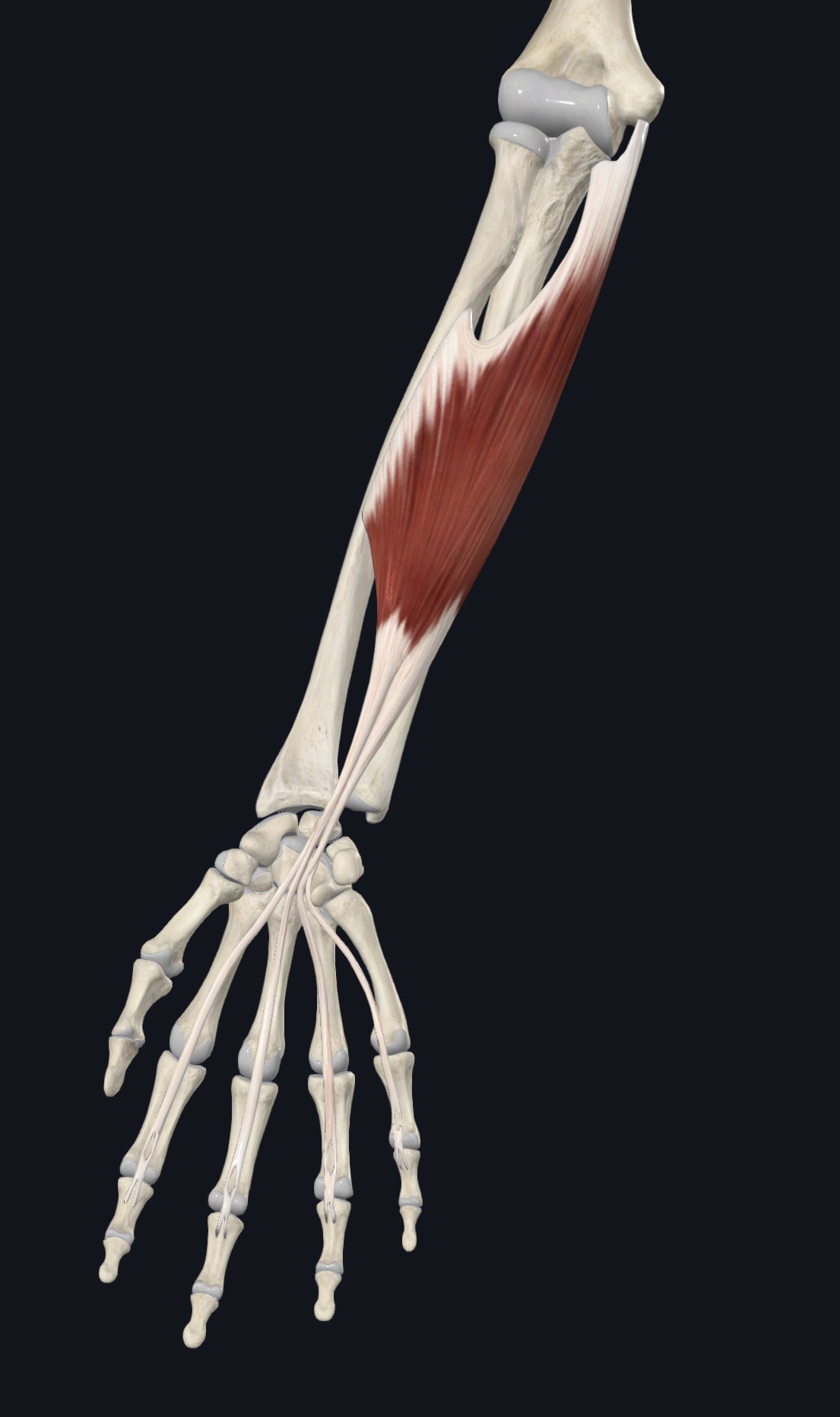
Flexor digitorum profundus (FDP) is a thick, deep muscle of the anterior forearm that lies on the ulna and interosseous membrane. Its belly divides into four tendons that cross the wrist through the carpal tunnel.
In each finger its tendon passes through a split in the flexor digitorum superficialis tendon to reach the fingertip, which is why FDP is the only muscle that can bend the distal interphalangeal (fingertip) joint.
Section 02 of 20
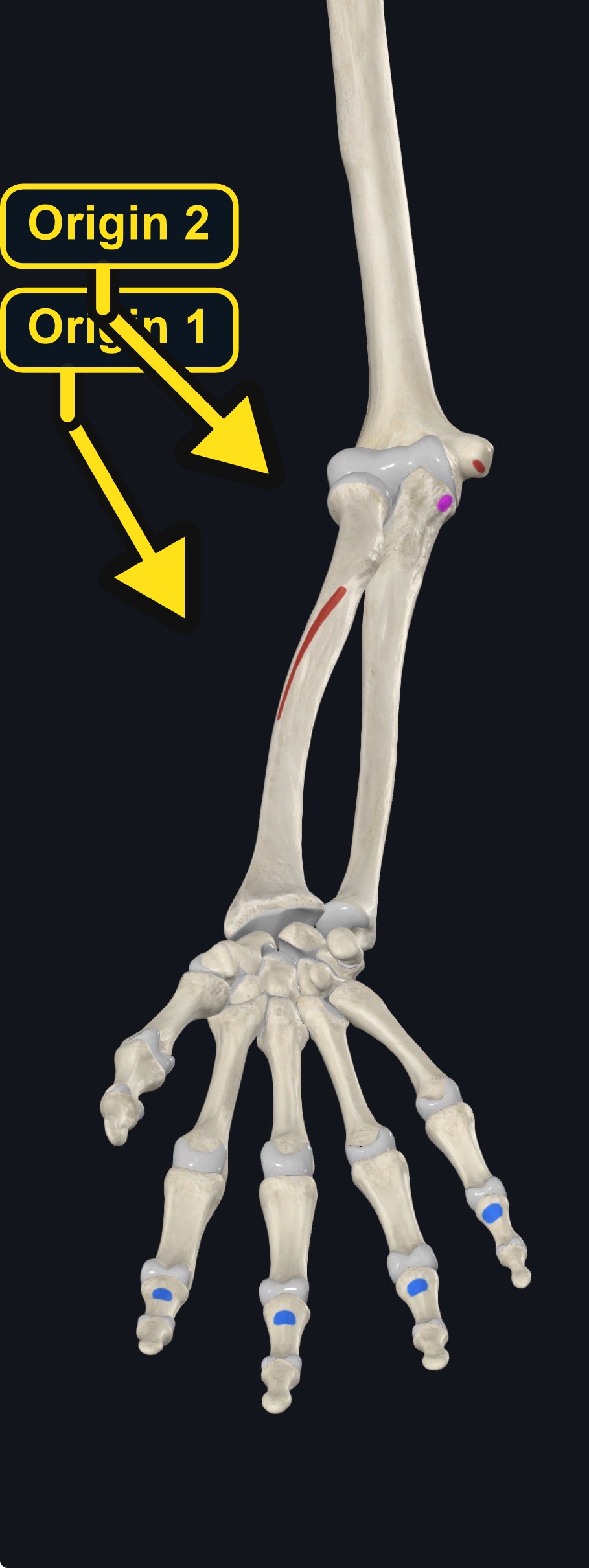
Origin
| Origin | Proximal three-quarters of the anterior and medial surfaces of the ulna, the adjacent interosseous membrane, and the coronoid process. |
|---|
Section 03 of 20
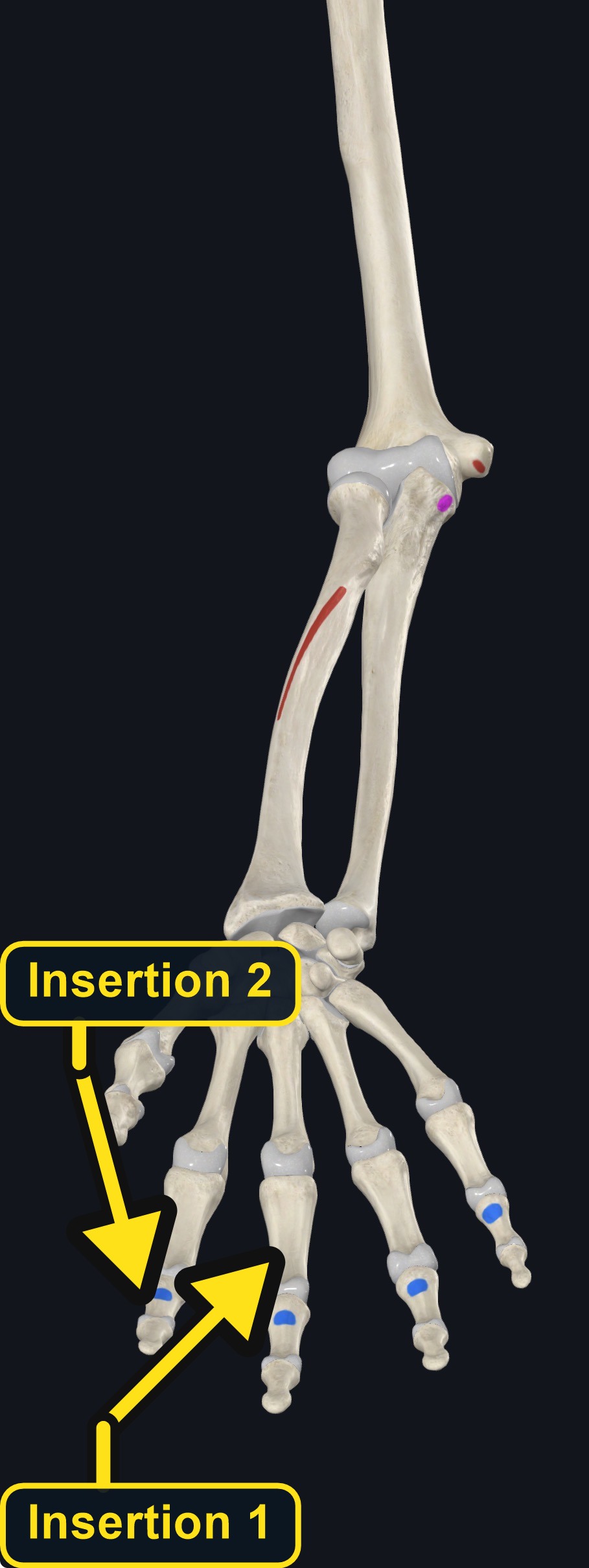
Insertion
| Insertion | Palmar bases of the distal phalanges of the index, middle, ring, and little fingers, each through a tendon that passes through the split flexor digitorum superficialis tendon. |
|---|
Section 04 of 20
Actions
| Primary action | Flexion of the distal interphalangeal joints of the fingers (the only muscle that does this). |
|---|---|
| Secondary actions | Assists flexion at the proximal interphalangeal and metacarpophalangeal joints and weakly assists wrist flexion. |
| Movement at the joint | Distal and proximal interphalangeal, metacarpophalangeal, and wrist joints. |
| Heads / fiber groups | Single muscle belly that divides into four tendons; the medial part is supplied by the ulnar nerve and the lateral part by the anterior interosseous branch of the median nerve. |
| Functional examples | Gripping a bar or rope; pulling; climbing; picking up small objects with the fingertips. |
Distal interphalangeal flexion
Flexes the fingertip joint, the movement no other muscle can perform.
Proximal interphalangeal and metacarpophalangeal flexion
Assists flexion of the middle and base joints of the fingers.
Wrist flexion
Weakly assists flexion of the wrist.
Section 05 of 20
Nerve Innervation
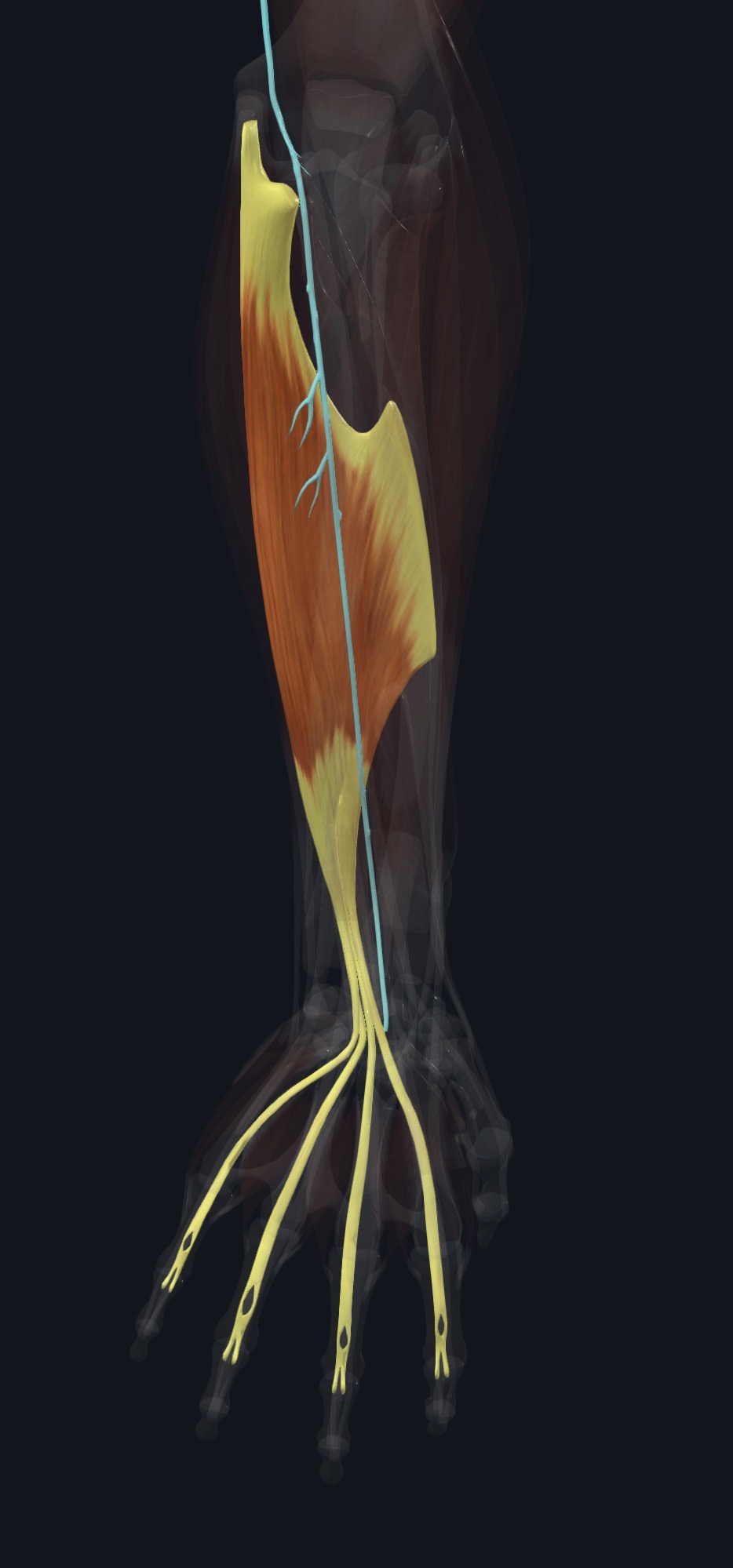
| Nerve | Medial part (ring and little finger tendons): ulnar nerve. Lateral part (index and middle finger tendons): anterior interosseous nerve, a branch of the median nerve. Roots C8–T1. |
|---|
The dual supply means that median and ulnar nerve problems can each weaken different fingers. Trouble bending the fingertips of the index and thumb (the OK sign) points to anterior interosseous nerve involvement.
Section 06 of 20
Blood Supply
| Blood | Anterior interosseous artery and muscular branches of the ulnar artery. |
|---|
Section 07 of 20
Pictures and Visual Anatomy
Section 08 of 20
Functional Movement
FDP provides the strength of a firm grip, especially for pulling, climbing, lifting, and holding tools. Fingertip flexion also allows precise pinching and picking.
Section 09 of 20
Synergists and Antagonists
Synergists: flexor digitorum superficialis (for the middle joints), lumbricals and interossei (for the base joints), and the wrist flexors. Antagonists: extensor digitorum, extensor indicis, and extensor digiti minimi, which extend the fingers.
Section 10 of 20
Palpation and Location
Client position and technique
Position the client seated with the forearm supported, palm up. Ask them to curl the fingertips (bend the distal joint) while you hold the middle joint straight. Feel deeply along the ulnar side of the mid-forearm, beneath the superficial flexors, for the muscle belly contracting.
Protect nearby structures
The muscle is deep and lies close to the ulnar nerve and artery and the anterior interosseous neurovascular bundle. Use slow, moderate pressure, avoid pinching, and stop if tingling or numbness spreads into the hand. Keep pressure light over the carpal tunnel at the wrist.
Section 11 of 20
Massage Therapy Relevance
FDP is heavily used in gripping and finger work. Forearm and hand fatigue is common in therapists, climbers, and manual workers, but finger and hand symptoms often have nerve or tendon sources.
Section 12 of 20
Dysfunction: What Happens When Movement Goes Wrong
Changes in how a muscle works can change how a joint moves. The points below describe possibilities that may be associated with altered muscle function; they are not diagnoses, and one muscle is never assumed to be the sole cause of a problem.
When the muscle is weak
Weakness may reduce fingertip flexion and grip strength and may be associated with median or ulnar nerve problems depending on which fingers are affected.
When it is tight or shortened
Tightness may be associated with limited finger extension and forearm tension along the ulnar side.
When it is overused
Repetitive gripping and climbing may overload the muscle and may contribute to deep forearm ache.
When it is strained
A strain or tendon injury may cause pain with resisted fingertip flexion; a sudden loss of fingertip flexion after a forceful pull needs urgent assessment.
When it is inhibited or others compensate
Reduced activation may be associated with a weaker fingertip grip and compensation from flexor digitorum superficialis.
When it does not coordinate well with synergists and antagonists
Poor coordination with flexor digitorum superficialis, the lumbricals, and the finger extensors may alter grip control and may load the tendon sheaths.
Section 13 of 20
Conditions, Pathologies, and Pain Relationships
Forearm flexor overuse
Aching and tightness in the deep forearm after gripping or manual work. It is usually non-acute and responds to gentle work and rest.
Trigger finger and flexor tenosynovitis
Catching or locking of a finger, pain at the base of the finger, or swelling along the tendon sheath. Hot swelling with fever needs urgent assessment.
Avulsion of the FDP tendon (jersey finger)
A sudden loss of fingertip flexion after a forceful pull is an injury that needs urgent medical care.
Nerve involvement
Carpal tunnel syndrome, cubital tunnel syndrome, and anterior interosseous nerve syndrome can all affect finger flexion or sensation.
Section 14 of 20
Example Clinical Relationship
A rock climber reports deep forearm tightness and catching in a finger. Flexor digitorum profundus may be overloaded, and the pattern may be associated with tendon sheath irritation or trigger finger, but nerve entrapment and tendon injury can look similar. Sudden loss of fingertip flexion, a hot swollen finger, or progressive numbness needs referral.
Section 15 of 20
Massage and Treatment Approaches
For healthy, non-acute tissue, support the forearm palm up and begin with broad effleurage and kneading on the anterior forearm. Progress to slow, comfortable compression and gentle longitudinal strokes along the ulnar side of the forearm.
| Movement | Use gentle active finger curling and opening within comfort. |
|---|---|
| Regional work | Consider the superficial flexors, pronator teres, extensors, and neck and shoulder posture when history supports it. |
| Avoid | Deep pressure over the carpal tunnel, the ulnar nerve at the elbow, or an acutely inflamed tendon sheath. |
Section 16 of 20
Precautions and Contraindications
Precautions and contraindications
- Acute finger, hand, or forearm injury, or recent surgery.
- Use caution with carpal tunnel or cubital tunnel symptoms, inflammatory arthritis, or reduced sensation.
- Avoid open wounds, infection, and marked swelling.
- Ask about anticoagulant use and easy bruising.
Section 17 of 20
Red Flags and When to Refer
Red flags and referral
- Sudden inability to bend a fingertip after a forceful pull (possible tendon avulsion).
- Hot, red, swollen finger, hand, or forearm, especially with fever or severe pain with passive finger extension.
- Progressive numbness, weakness, clawing, or thenar wasting.
- Neck pain with spreading arm weakness, or chest pain and shortness of breath.
Section 18 of 20
Study Summary
Attachments
Origin: proximal ulna and interosseous membrane. Insertion: palmar bases of the distal phalanges 2-5.
Actions
Flexes the fingertip joint and assists finger and wrist flexion.
Supply
Ulnar nerve (medial part) and anterior interosseous nerve (lateral part), C8-T1.
Section 19 of 20
Instructor Narration
Open narration transcript
Flexor digitorum profundus is the deep finger flexor of the forearm. It lies on the ulna and interosseous membrane and divides into four tendons that pass through the carpal tunnel.
It arises from the proximal three-quarters of the anterior and medial ulna and the interosseous membrane, and its tendons pass through the split flexor digitorum superficialis tendons to insert on the bases of the distal phalanges of the index, middle, ring, and little fingers.
It is the only muscle that flexes the fingertip joint, and it also assists flexion of the other finger joints and the wrist. Flexor digitorum superficialis helps flex the middle joints, and the finger extensors oppose it.
It has a dual nerve supply: the ulnar nerve for the ring and little finger tendons, and the anterior interosseous branch of the median nerve for the index and middle finger tendons, from C8 to T1. Blood comes from the anterior interosseous and ulnar arteries.
To palpate, ask the client to curl the fingertips while you hold the middle joints straight, and feel deeply along the ulnar side of the mid-forearm. Use slow, moderate pressure, and stop if tingling spreads into the hand.
Trigger finger, tendon avulsion, carpal tunnel syndrome, cubital tunnel syndrome, and anterior interosseous nerve syndrome can all affect finger flexion. Refer sudden loss of fingertip flexion after a forceful pull, a hot swollen finger or hand, progressive numbness or weakness, or neck pain with arm weakness.
Remember: ulna and membrane to the distal phalanges 2 to 5, the only fingertip flexor, and dual innervation.
Section 20 of 20