Section 01 of 20
Introduction
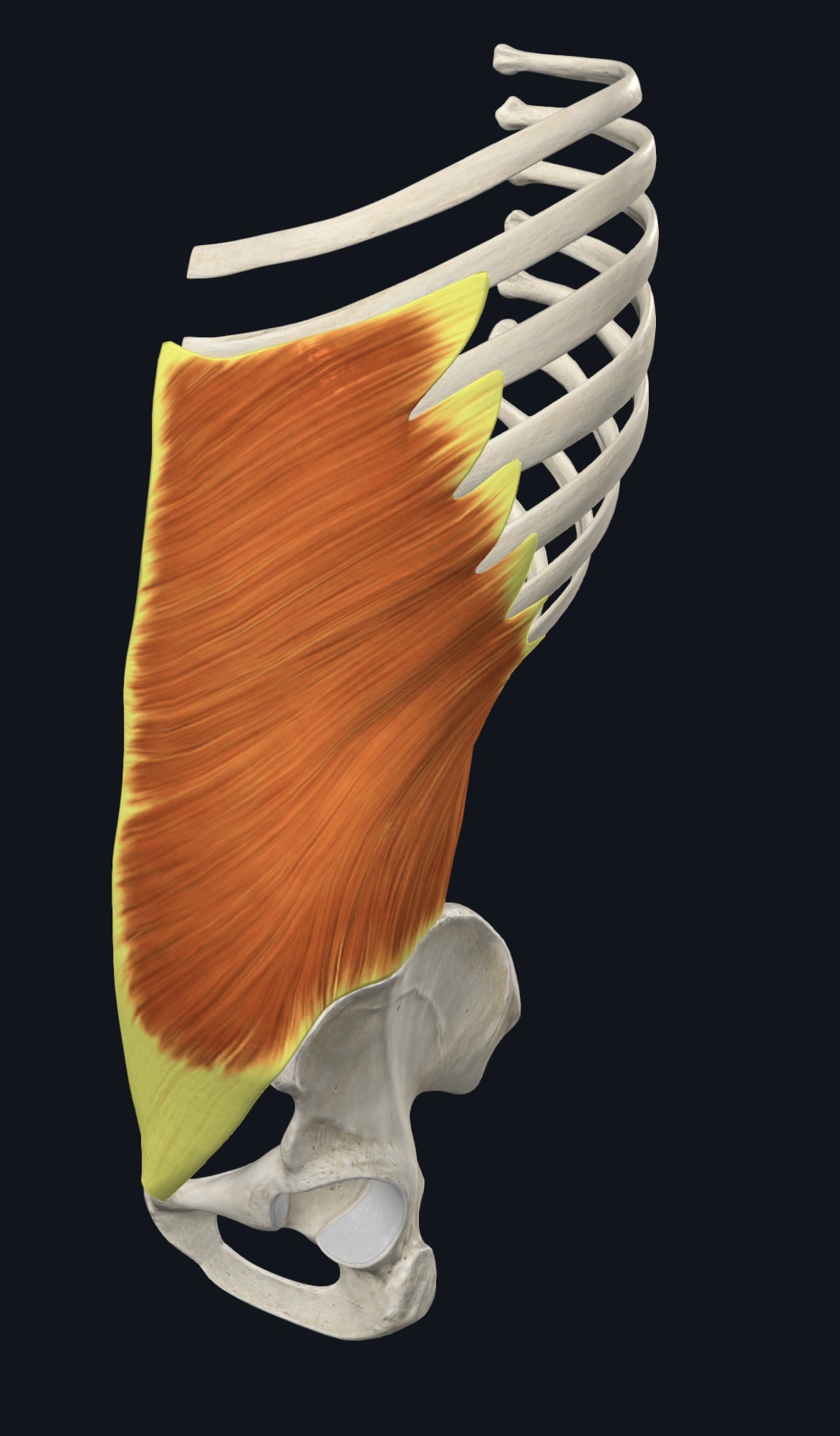
External oblique is the largest and most superficial flat abdominal muscle. Its fibers run from the lower ribs inferomedially toward a broad aponeurosis, iliac crest, and pubic region. The inferior aponeurotic border contributes to the inguinal ligament.
Section 02 of 20
Origin
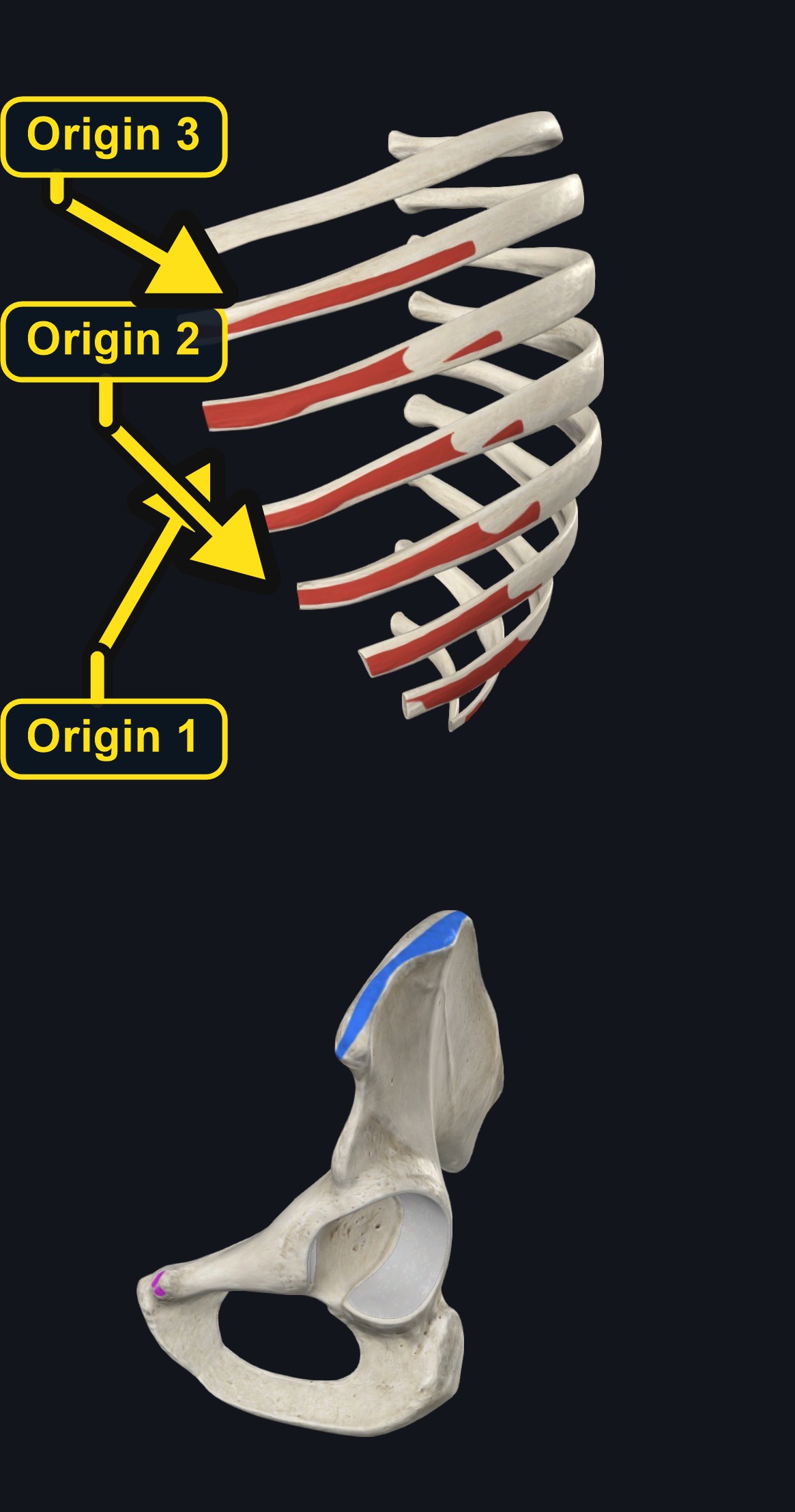
| Origin | External surfaces of ribs 5–12 in interdigitations with serratus anterior and latissimus dorsi. |
|---|
Section 03 of 20
Insertion
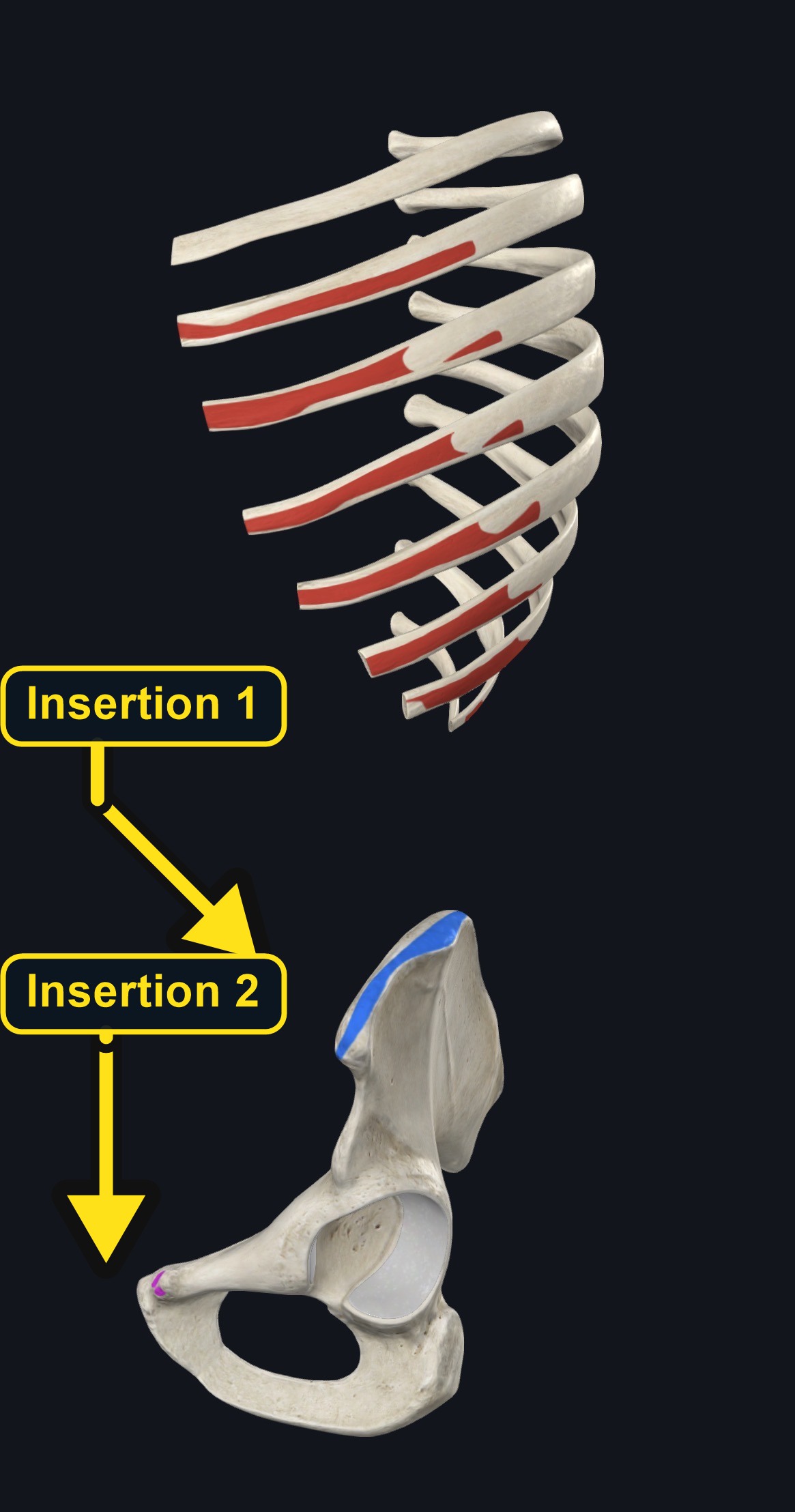
| Insertion | Anterior half of iliac crest, linea alba through its aponeurosis, and pubic tubercle/crest region; the inferior aponeurosis forms the inguinal ligament. |
|---|
Section 04 of 20
Actions
No dedicated action video is currently available. This movement is explained below and video will be added when verified source media becomes available.
| Primary action | Trunk rotation to the opposite side (one side working) and trunk flexion (both sides working). |
|---|---|
| Secondary actions | Lateral flexion to the same side; compression of the abdomen; assists forced expiration and pelvic stability. |
| Movement at the joint | Lumbar and lower thoracic spine (intervertebral joints) and the rib cage. |
| Heads / fiber groups | Single flat muscle with fibers running inferomedially (the 'hands-in-pockets' direction). |
| Functional examples | Twisting the trunk; throwing; coughing and forced breathing; sit-ups; stabilizing the pelvis while lifting. |
- Bilateral trunk flexion and abdominal compression.
- Unilateral same-side lateral flexion.
- Rotation of the trunk to the opposite side.
- Assists forced expiration and lumbopelvic stabilization.
Section 05 of 20
Nerve Innervation
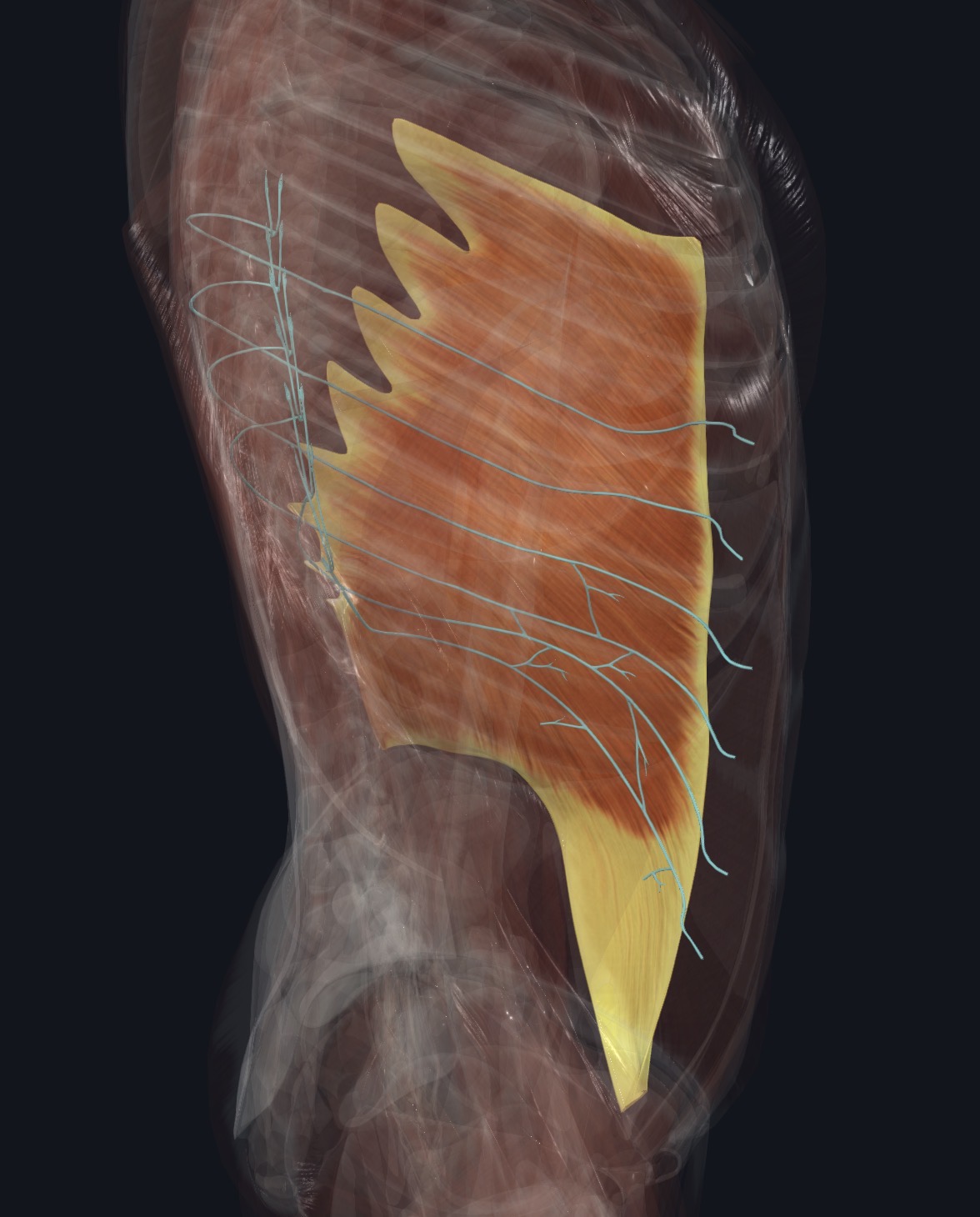
| Nerves | Thoracoabdominal nerves T7-T11 and subcostal nerve T12. |
|---|
Section 06 of 20
Blood Supply
| Blood supply | Lower posterior intercostal and subcostal arteries, musculophrenic and superior/inferior epigastric anastomoses, with deep circumflex iliac contribution inferiorly. |
|---|
Section 07 of 20
Pictures and Visual Anatomy
Section 08 of 20
Functional Movement
External oblique works in rotation and bending of the trunk, forced breathing, coughing, and lifting. Everyday examples include twisting to look behind you, throwing, swinging a golf club, sit-ups, and stabilizing the trunk when carrying loads.
Section 09 of 20
Synergists and Antagonists
Synergists: contralateral internal oblique for rotation; rectus abdominis for flexion; transversus abdominis for compression. Antagonists: spinal extensors oppose flexion, while the opposite external oblique opposes rotation direction.
Section 10 of 20
Palpation and Location
Use supine or side-lying positioning with informed consent and appropriate draping. Ask for a small curl or rotation toward the opposite side to identify the superficial fibers. Palpate lateral to rectus abdominis and above the iliac crest, avoiding deep abdominal compression and sensitive rib margins.
Section 11 of 20
Massage Therapy Relevance
External oblique may fatigue with coughing, sport rotation, lifting, or unfamiliar abdominal exercise. Abdominal or flank pain can also reflect rib, spine, hernia, gastrointestinal, urinary, reproductive, vascular, or other medical causes; muscle tone is not diagnostic.
Section 12 of 20
Dysfunction: What Happens When Movement Goes Wrong
Changes in how a muscle works can change how a joint moves. The points below describe possibilities that may be associated with altered muscle function; they are not diagnoses, and one muscle is never assumed to be the sole cause of a problem.
When the muscle is weak
Weakness may reduce rotation and trunk control and may be associated with a greater load on the low back and hip flexors.
When it is tight or shortened
Tightness may be associated with a lower rib-cage position, restricted rib movement, and limited trunk extension.
When it is overused
Repetitive twisting or forceful coughing may load the muscle and may contribute to a side or flank ache.
When it is strained
A strain may cause pain in the flank or abdomen with twisting, coughing, or lifting; abdominal pain has many causes, including organ problems.
When it is inhibited or others compensate
Reduced activation may be associated with less control of the ribs and pelvis and more use of the back extensors.
When it does not coordinate well with synergists and antagonists
Poor coordination with the internal oblique, transversus abdominis, and hip muscles may alter trunk rotation and pelvic control.
Section 13 of 20
Conditions, Pathologies, and Pain Relationships
Strain
May follow forceful rotation, coughing, throwing, or lifting. Acute bruising, swelling, or severe pain warrants evaluation.
Hernia relationship
The aponeurosis helps form the abdominal wall and inguinal region. A new bulge or pain with straining requires medical assessment, not direct massage.
Visceral differential
Unexplained abdominal pain, guarding, fever, vomiting, bowel changes, or pulsation should not be treated as a tight oblique.
Section 14 of 20
Example Clinical Relationship
A golfer reports a pulling pain in the side of the abdomen after a round. External oblique may be strained, and the pattern may be associated with rotation overload, but flank or abdominal pain can also come from ribs, hernia, kidneys, bowel, or other organs. Severe pain, fever, vomiting, a new bulge, or bleeding needs referral.
Section 15 of 20
Massage and Treatment Approaches
Obtain explicit consent, use secure draping, and begin with broad light contact. Coordinate with breathing and never use painful deep pressure. Avoid recent surgical sites, suspected hernia, pregnancy-related contraindications, or unexplained abdominal symptoms without appropriate guidance.
- Broad superficial warming along inferomedial fibers.
- Gentle side-lying compression and fascial contact.
- Breathing-based relaxation and comfortable trunk positioning.
- Slow supported side-bending or rotation only when pain-free.
Section 16 of 20
Precautions and Contraindications
Avoid local treatment with suspected hernia, acute abdominal illness, unexplained mass, recent surgery without clearance, infection, acute trauma, pregnancy complications, abdominal aortic aneurysm concern, or client discomfort with abdominal work.
Section 17 of 20
Red Flags and When to Refer
Refer severe or worsening abdominal pain, rigid guarding, fever, repeated vomiting, blood in stool or urine, new painful bulge, faintness, pulsating abdominal mass, breathing difficulty, major trauma, or pain with unexplained systemic symptoms.
Section 18 of 20
Study Summary
Origin: ribs 5–12. Insertion: linea alba, iliac crest, pubic region. Actions: flexion, same-side lateral flexion, opposite-side rotation, compression. Innervation: T7-T12. Clinical key: abdominal symptoms require careful consent and red-flag screening.
Section 19 of 20
Instructor Narration
Open complete narration
Section 20 of 20