Section 01 of 20
Introduction
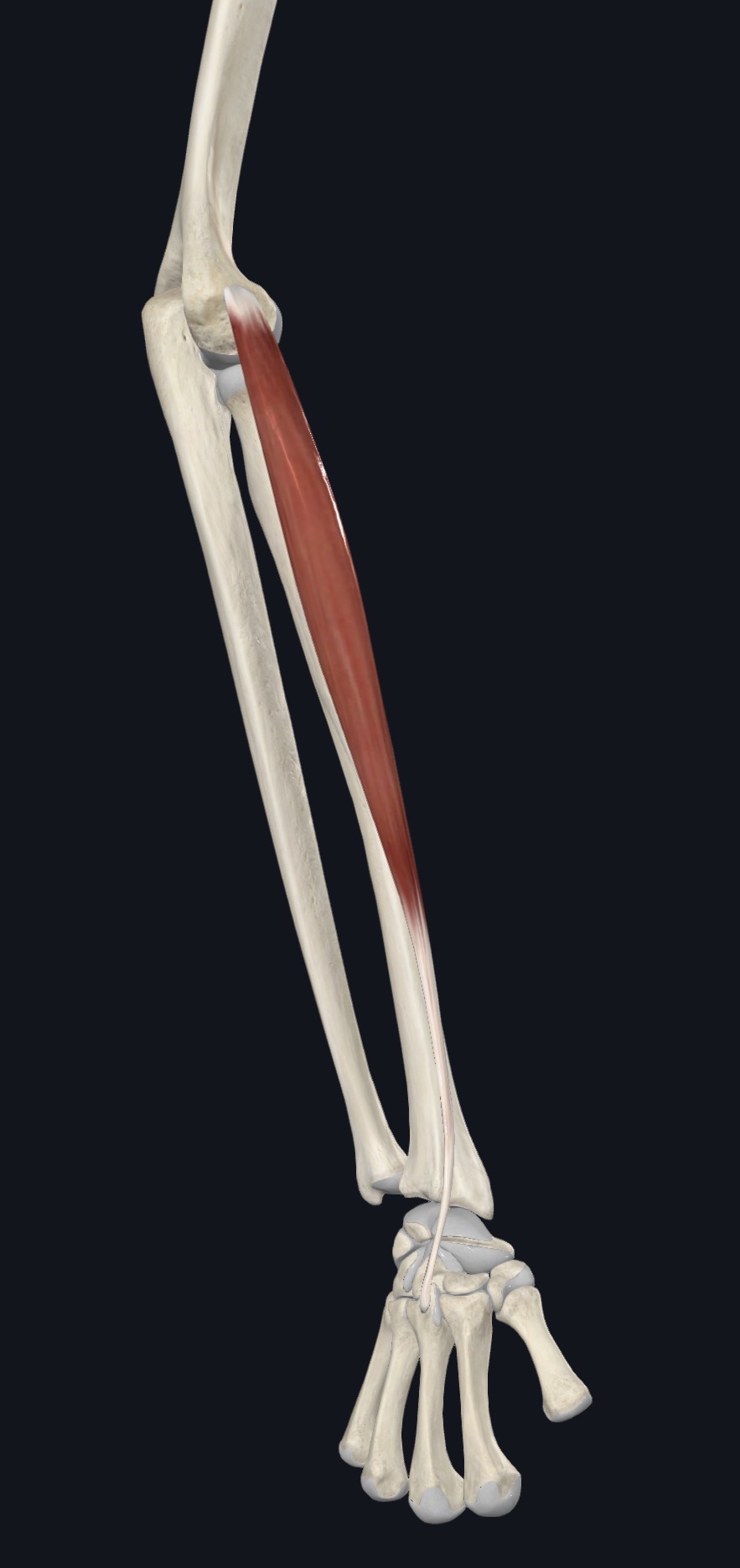
ECRL belongs to the mobile wad on the lateral forearm with brachioradialis and extensor carpi radialis brevis. Its muscle belly is proximal and superficial; its tendon crosses the dorsal wrist beneath the extensor retinaculum. It is distinct from ECRB, which inserts on the third metacarpal and is innervated by the deep radial branch.
Section 02 of 20
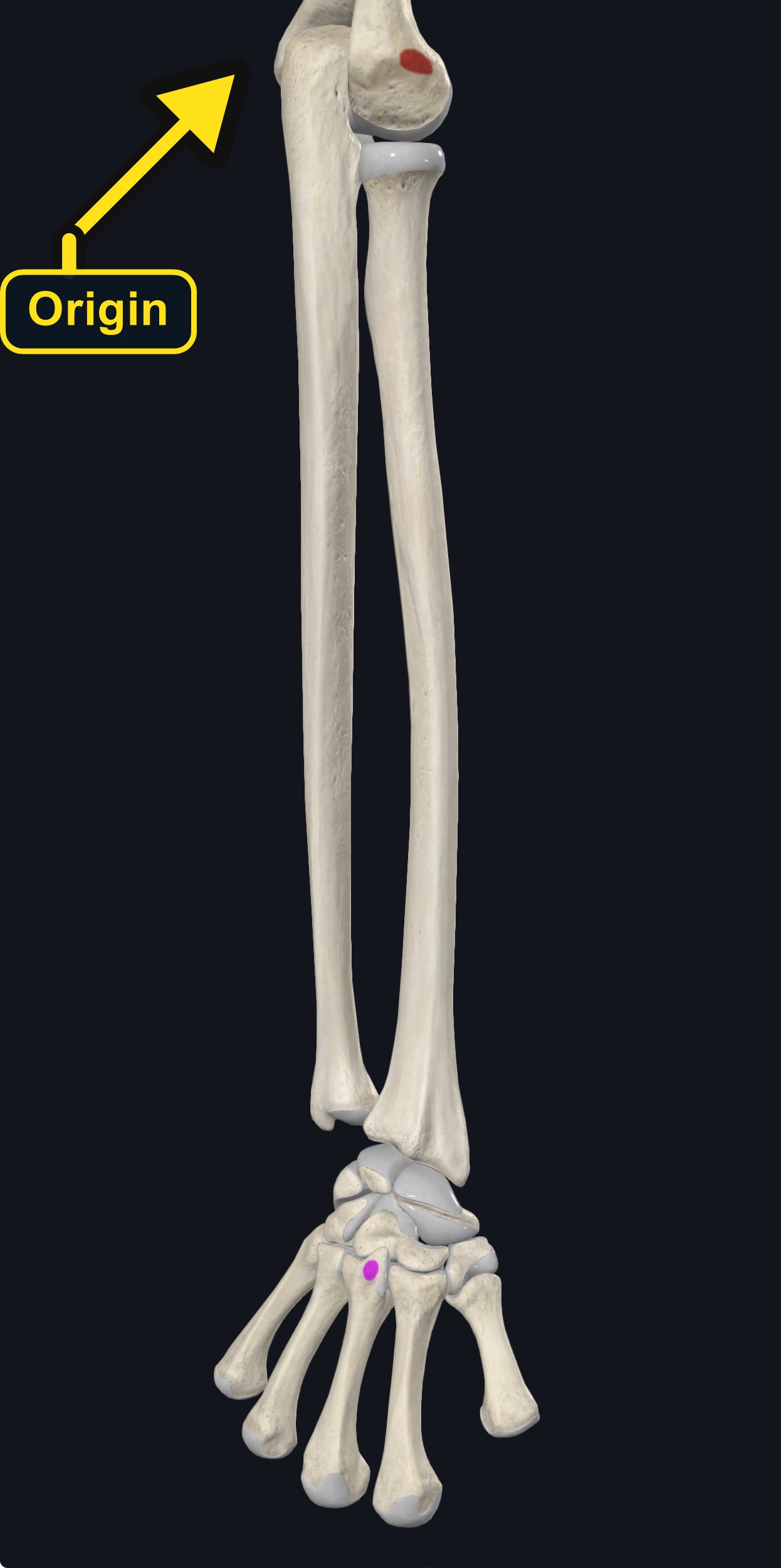
Origin
| Origin | Distal lateral supracondylar ridge of the humerus and lateral intermuscular septum. |
|---|
Section 03 of 20
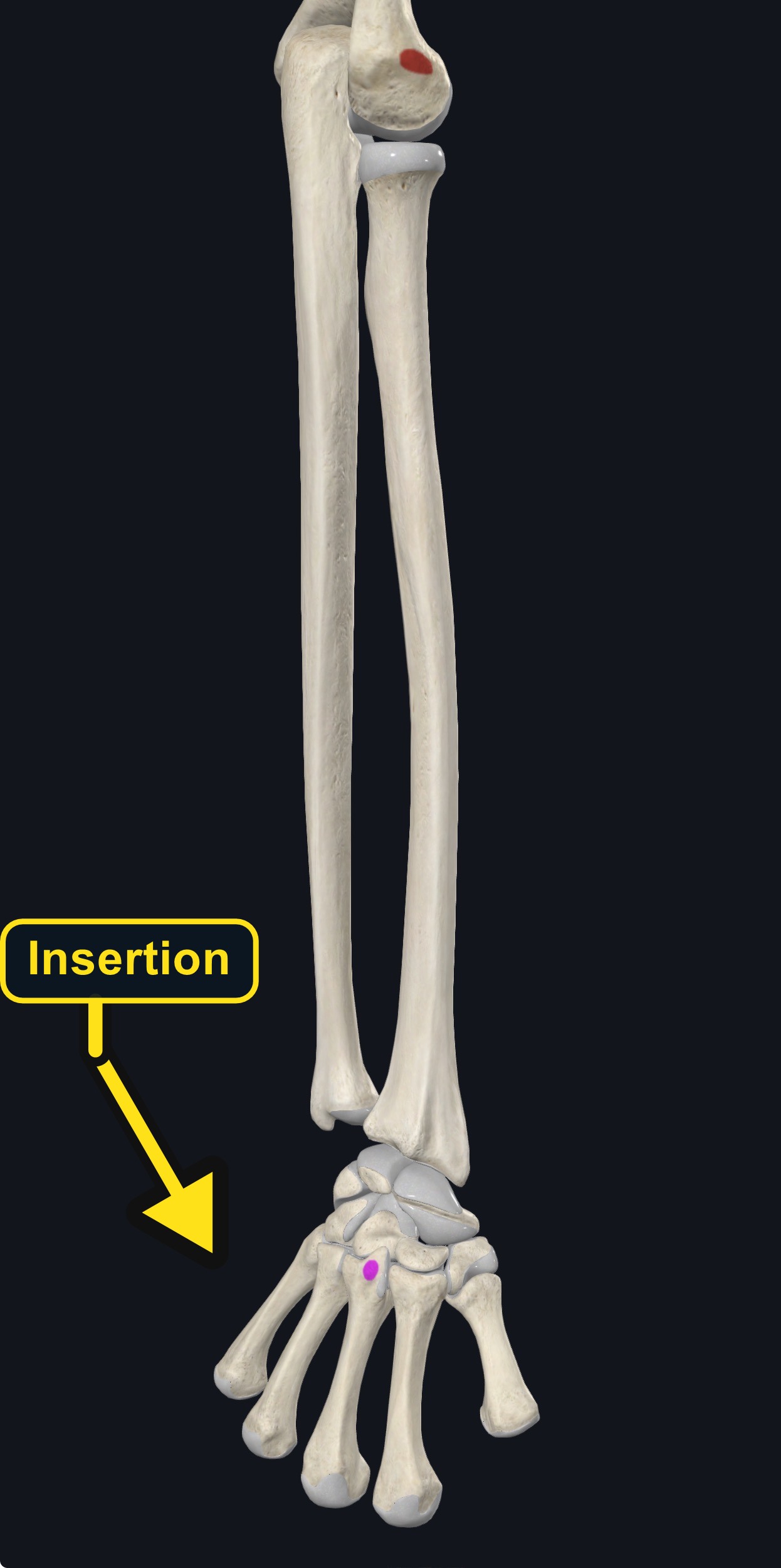
Insertion
| Insertion | Dorsal base of the second metacarpal, on its radial side. |
|---|
Section 04 of 20
Actions
| Primary action | Wrist extension. |
|---|---|
| Secondary actions | Radial deviation of the wrist (toward the thumb); helps stabilize the wrist during gripping. |
| Movement at the joint | Wrist (radiocarpal and midcarpal) joints. |
| Heads / fiber groups | Single muscle belly; no separate heads. |
| Functional examples | Positioning the wrist for a strong grip; hammering; lifting a cup; using a computer mouse. |
- Extends the wrist.
- Abducts, or radially deviates, the wrist.
- Works with wrist flexors to hold the wrist near neutral during gripping.
Section 05 of 20
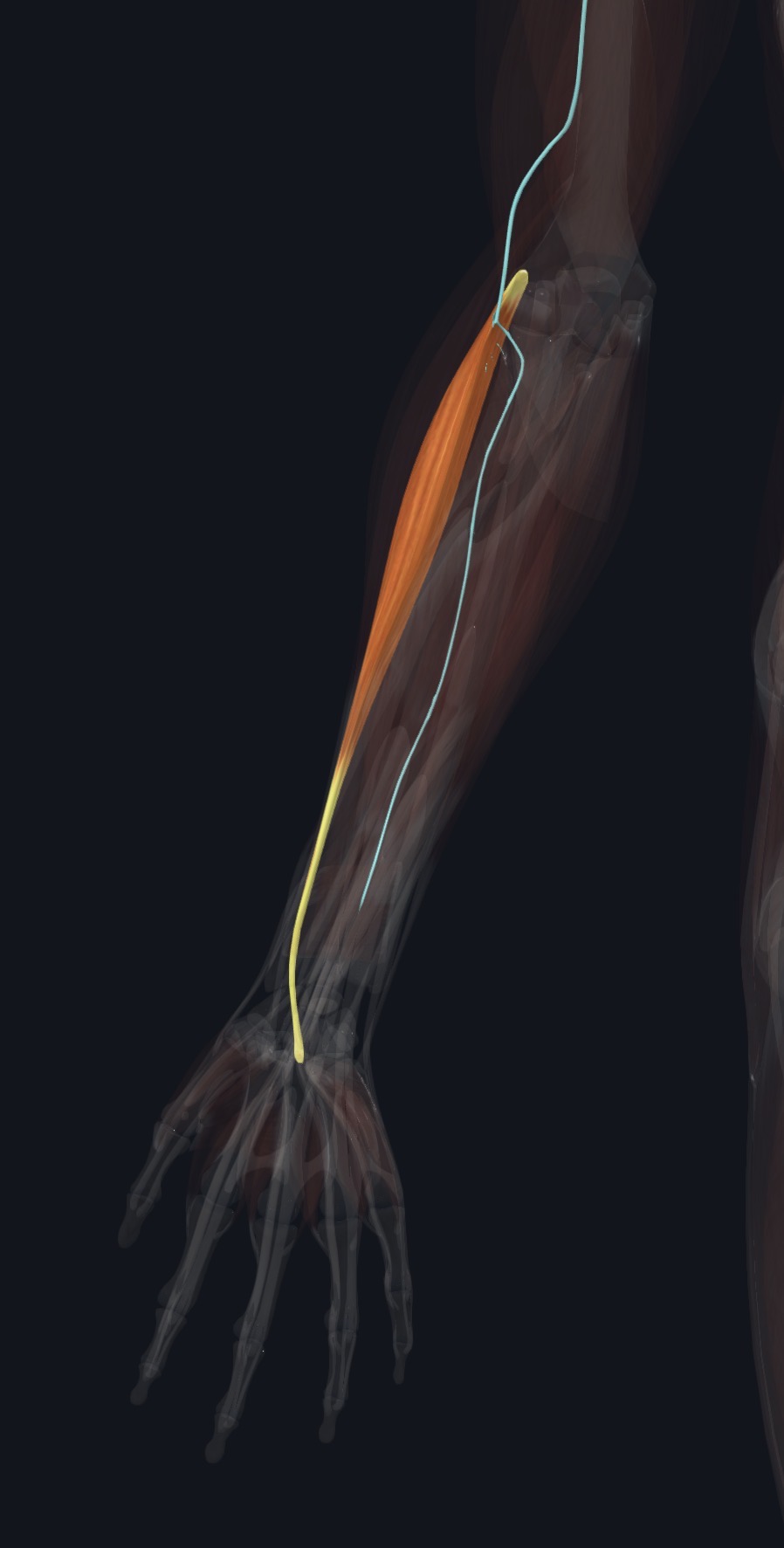
Nerve Innervation
| Nerve | Radial nerve proper, before its division into superficial and deep branches. |
|---|---|
| Roots | C6-C7. |
Section 06 of 20
Blood Supply
| Blood supply | Primarily radial recurrent and radial artery branches, with regional collateral contributions. |
|---|
Section 07 of 20
Pictures and Visual Anatomy
Section 08 of 20
Functional Movement
Functional examples include positioning the wrist for a strong grasp, using a hammer, lifting a cup, and stabilizing the wrist during racquet or tool use.
Section 09 of 20
Synergists and Antagonists
Synergists: ECRB for extension/radial deviation; extensor carpi ulnaris for balanced extension; flexor carpi radialis for radial deviation. Antagonists: wrist flexors oppose extension, while ECU and FCU oppose radial deviation.
Section 10 of 20
Palpation and Location
Seat the client with the forearm pronated and supported. Locate the lateral supracondylar ridge, then ask for gentle wrist extension combined with radial deviation. Palpate the contracting muscle just distal to brachioradialis and follow its tendon toward the dorsal base of the second metacarpal. Keep resistance light and distinguish ECRL from the more central extensor mass.
Section 11 of 20
Massage Therapy Relevance
ECRL can be overloaded by repetitive gripping, wrist extension, computer-mouse use, racquet sports, and tool handling. Local tone may coexist with lateral elbow or dorsal-radial forearm pain, but pain in this region can also arise from tendon, joint, radial nerve, or cervical sources and should not be diagnosed by massage therapists.
Section 12 of 20
Dysfunction: What Happens When Movement Goes Wrong
Changes in how a muscle works can change how a joint moves. The points below describe possibilities that may be associated with altered muscle function; they are not diagnoses, and one muscle is never assumed to be the sole cause of a problem.
When the muscle is weak
Weakness may reduce grip strength and wrist extension and may be associated with radial nerve problems.
When it is tight or shortened
Tightness may be associated with discomfort when flexing the wrist with the fingers bent and may add tension near the lateral elbow.
When it is overused
Repetitive gripping, mouse use, or racquet sports may load the lateral forearm and may contribute to aching near the elbow.
When it is strained
A strain may cause pain with resisted wrist extension; lateral elbow pain also has tendon, joint, and nerve causes.
When it is inhibited or others compensate
Reduced activation may be associated with a weaker grip and more work by the finger extensors and forearm flexors.
When it does not coordinate well with synergists and antagonists
Imbalance with extensor carpi radialis brevis and the wrist flexors may alter wrist position during gripping and may increase load on the lateral elbow.
Section 13 of 20
Conditions, Pathologies, and Pain Relationships
Overuse and strain
May cause localized ache or fatigue with resisted wrist extension and gripping. Acute swelling, bruising, or loss of function warrants evaluation.
Lateral elbow pain
ECRL may contribute to extensor loading, although ECRB is more classically implicated in lateral epicondylalgia. Radial tunnel irritation and cervical referral can overlap.
Radial nerve dysfunction
Weak wrist or finger extension, sensory change, or wrist drop is not a simple muscle-tightness presentation and requires medical assessment.
Section 14 of 20
Example Clinical Relationship
A client who uses a mouse and racquet reports aching on the outer forearm and elbow. ECRL may be loaded and may be associated with lateral elbow symptoms, although extensor carpi radialis brevis is more classically involved and radial nerve irritation can look similar. Wrist drop or persistent numbness needs referral.
Section 15 of 20
Massage and Treatment Approaches
Work broadly through the lateral forearm before using specific longitudinal strokes. Avoid compressing the radial nerve near the lateral elbow or applying painful friction to an acutely irritated tendon. Reassess grip and gentle active motion rather than promising correction of a named disorder.
- Broad warming and compressions to the extensor compartment.
- Gentle stripping along the ECRL belly and tendon within tolerance.
- Slow wrist-flexion and ulnar-deviation positioning to lengthen ECRL without forcing end range.
- Client supine, seated, or prone with the forearm fully supported.
Section 16 of 20
Precautions and Contraindications
Avoid local massage with acute trauma, suspected fracture, infection, marked swelling, recent surgery without clearance, or acute inflammatory flare. Use caution around superficial veins, irritated tendons, and nerve-sensitive symptoms. Anticoagulation, fragile skin, or unexplained bruising requires modified pressure or medical guidance.
Section 17 of 20
Red Flags and When to Refer
Refer for sudden wrist drop, progressive weakness, persistent numbness, major trauma, deformity, severe night pain, fever/redness, rapidly increasing swelling, or symptoms that fail to improve appropriately.
Section 18 of 20
Study Summary
Origin: lateral supracondylar ridge. Insertion: dorsal base of second metacarpal. Actions: wrist extension and radial deviation. Innervation: radial nerve, C6-C7. Clinical key: assess the whole lateral elbow–forearm–wrist chain and screen neurologic weakness.
Section 19 of 20
Instructor Narration
Open complete narration
Section 20 of 20