Section 01 of 20
Introduction
Erector spinae is not one single muscle. It is a paired group running vertically on either side of the spine, superficial to the transversospinalis group. From lateral to medial, its columns are iliocostalis, longissimus, and spinalis.
Section 02 of 20
Origin
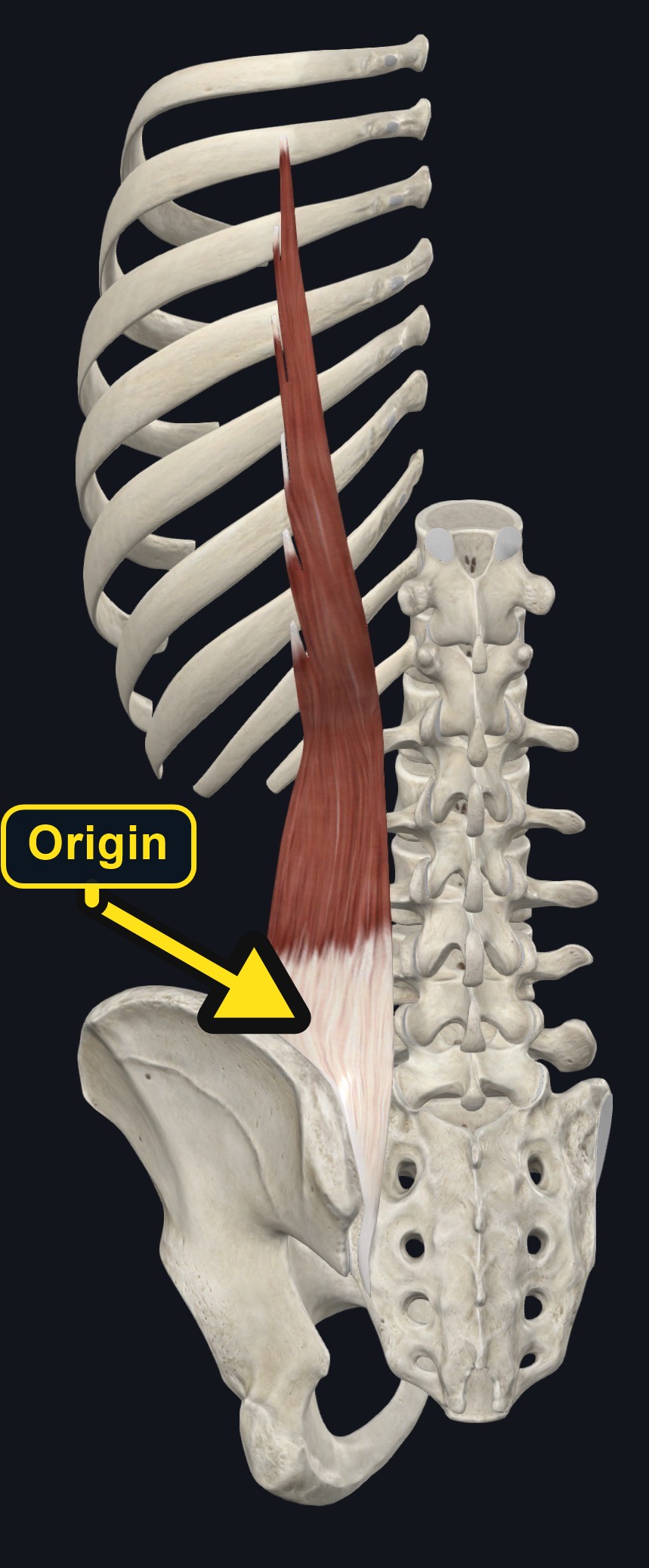
Because this is a long segmented group, attachments are best learned as a pattern rather than one short pair.
| Common inferior attachment | Broad tendon associated with the posterior iliac crest, posterior sacrum, sacroiliac ligaments, sacral and lower lumbar spinous processes, and supraspinous ligament. |
|---|
Section 03 of 20
Insertion
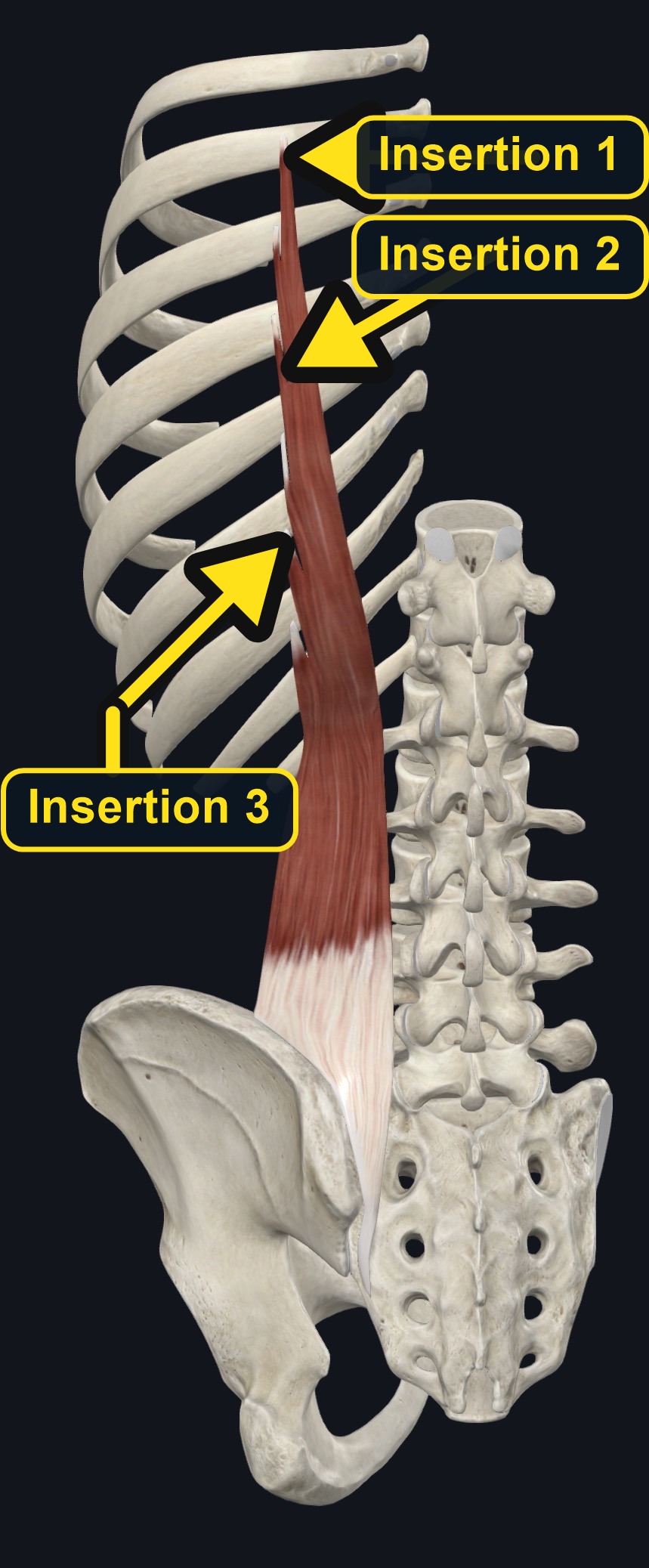
| Iliocostalis | Ascends to rib angles and lower cervical transverse processes. |
|---|---|
| Longissimus | Ascends to ribs, thoracic and cervical transverse processes, and the mastoid process through longissimus capitis. |
| Spinalis | Primarily connects spinous processes across thoracic and cervical levels. |
Section 04 of 20
Actions
No dedicated action video is currently available. This movement is explained below and video will be added when verified source media becomes available.
| Primary action | Extension of the vertebral column and head (both sides working together). |
|---|---|
| Secondary actions | Lateral flexion of the trunk to the same side (one side working); postural stabilization and eccentric control of forward bending. |
| Movement at the joint | Intervertebral joints of the lumbar, thoracic, and cervical spine. |
| Heads / fiber groups | Three columns from lateral to medial: iliocostalis, longissimus, and spinalis, each with regional parts. |
| Functional examples | Standing upright; rising from bending forward; lifting; walking; holding the trunk steady while the arms work. |
- Bilateral contraction extends the vertebral column and head.
- Unilateral contraction laterally flexes the trunk or neck to the same side.
- Provides postural endurance and eccentric control during forward bending.
- Helps stabilize spinal segments during lifting, walking, and upper- or lower-limb movement.
Section 05 of 20
Nerve Innervation
| Nerves | Segmental posterior (dorsal) rami of spinal nerves. |
|---|---|
| Roots | No single root pair applies; innervation is segmental across the spinal levels occupied by the group. |
Section 06 of 20
Blood Supply
| Blood supply | Segmental dorsal branches from posterior intercostal and lumbar arteries, with cervical contributions including deep cervical and occipital-region vessels. |
|---|
Section 07 of 20
Pictures and Visual Anatomy
The pictures for this muscle are shown with the Origin, Insertion, Nerve Innervation, and other sections where they teach best.
Section 08 of 20
Functional Movement
The erector spinae work in almost every upright activity: they hold the trunk upright in standing and sitting, control forward bending (eccentric work), extend the trunk when returning upright, and stabilize the spine during lifting, walking, and reaching. Examples include picking up an object from the floor, sitting at a desk for long periods, gardening, and carrying a bag on one side.
Section 09 of 20
Synergists and Antagonists
Synergists: multifidus and other transversospinalis muscles, quadratus lumborum, semispinalis, splenius muscles, and gluteus maximus during trunk/hip extension tasks. Antagonists: rectus abdominis and obliques during trunk flexion, although co-contraction often provides stability.
Section 10 of 20
Palpation and Location
Position the client prone with bolsters for comfort, or seated when prone is unsuitable. Palpate the longitudinal muscle columns lateral to the spinous processes; ask for a very small trunk extension to confirm contraction, then relax. In the lumbar region, distinguish the broad erector mass from quadratus lumborum farther lateral and multifidus deeper and closer to the spinous processes. Do not press directly onto spinous processes or force extension.
Section 11 of 20
Massage Therapy Relevance
Erector spinae commonly develops protective tone or fatigue with prolonged sitting, sustained posture, repetitive lifting, deconditioning, or unfamiliar activity. Increased tone can be a response to pain rather than its cause. Low-back or thoracic pain may also arise from joints, discs, ribs, viscera, inflammatory disease, fracture, infection, or nerve-root involvement.
Section 12 of 20
Dysfunction: What Happens When Movement Goes Wrong
Changes in how a muscle works can change how a joint moves. The points below describe possibilities that may be associated with altered muscle function; they are not diagnoses, and one muscle is never assumed to be the sole cause of a problem.
When the muscle is weak
Weakness may reduce trunk extension endurance and may be associated with a rounded posture and greater load on the spinal joints and ligaments.
When it is tight or shortened
Tightness may be associated with a stiff, braced trunk, limited forward bending, and an increased lumbar curve.
When it is overused
Prolonged sitting, standing, or repetitive lifting may fatigue the muscles and may contribute to a dull, spreading ache in the back.
When it is strained
A strain may cause sudden, localized back pain with movement, often with spasm; severe pain, leg symptoms, or trauma needs assessment.
When it is inhibited or others compensate
Reduced activation may occur with pain and may be associated with a stiff, protective movement pattern and more use of the hips and shoulders.
When it does not coordinate well with synergists and antagonists
Poor coordination with the abdominal muscles, multifidus, and gluteals may alter spinal control and may be associated with recurring low back symptoms.
Section 13 of 20
Conditions, Pathologies, and Pain Relationships
Muscle strain and delayed soreness
Acute bruising, severe limitation, or trauma warrants evaluation.
Nonspecific back pain
Erector guarding can accompany many presentations. Massage may support short-term comfort and movement but should not be presented as correcting a presumed spinal lesion.
Radicular symptoms
Radiating pain, numbness, weakness, or reflex change can reflect nerve-root involvement; local muscle work is not a substitute for evaluation.
Postural endurance
Fatigue during sustained positions may involve workload, ergonomics, sleep, stress, conditioning, and broader movement patterns—not merely a “tight” back.
Section 14 of 20
Example Clinical Relationship
A client who sits at a desk all day reports aching along both sides of the low back that eases with movement. The erector spinae may be fatigued, and the pattern may be associated with sustained postures, but low back pain can also come from discs, joints, nerves, or organs. Leg weakness, numbness in the saddle area, bladder or bowel changes, fever, or pain after trauma needs urgent referral.
Section 15 of 20
Massage and Treatment Approaches
Use broad contact and gradual pressure while monitoring breathing and guarding. Work beside, not directly on, spinous processes. Avoid assuming asymmetry equals pathology. Coordinate with rehabilitation plans and encourage comfortable movement within scope. Abdominal aortic aneurysm, renal or visceral pain, fracture, infection, cancer, and neurologic emergencies are differential concerns that massage cannot diagnose.
- Broad effleurage and compressions parallel to the columns.
- Slow longitudinal or cross-fiber work to tolerated superficial tissues.
- Gentle rocking, breathing, and pain-free trunk movement.
- Prone, side-lying, or seated positioning with lumbar and cervical support.
- Reduce pressure when guarding increases; depth is not the goal.
Section 16 of 20
Precautions and Contraindications
Avoid local work with acute fracture or trauma, infection, open wounds, unstable spinal condition, unexplained swelling, acute inflammatory flare, or recent surgery without clearance. Modify for osteoporosis, anticoagulation, pregnancy positioning, severe pain, skin fragility, and known spinal stenosis or disc symptoms. Do not apply deep abdominally directed pressure in the lumbar region.
Section 17 of 20
Red Flags and When to Refer
Urgent referral is appropriate for new bowel or bladder dysfunction, saddle numbness, progressive leg weakness, major trauma, fever with back pain, unexplained weight loss, known cancer with new pain, pulsating abdominal/back pain, severe unremitting night pain, or symptoms suggesting cauda equina syndrome. New thoracic pain with chest symptoms or breathing difficulty also requires evaluation.
Section 18 of 20
Study Summary
Parts: iliocostalis, longissimus, spinalis. Attachments: broad common lower tendon ascending to ribs, transverse and spinous processes, and the mastoid depending on column. Actions: spinal extension, same-side lateral flexion, postural control. Innervation: segmental dorsal rami. Clinical key: back-muscle tone is nonspecific; screen red flags and avoid diagnosing from palpation.
Section 19 of 20
Instructor Narration
Open complete narration
Section 20 of 20