Section 01 of 20
Introduction
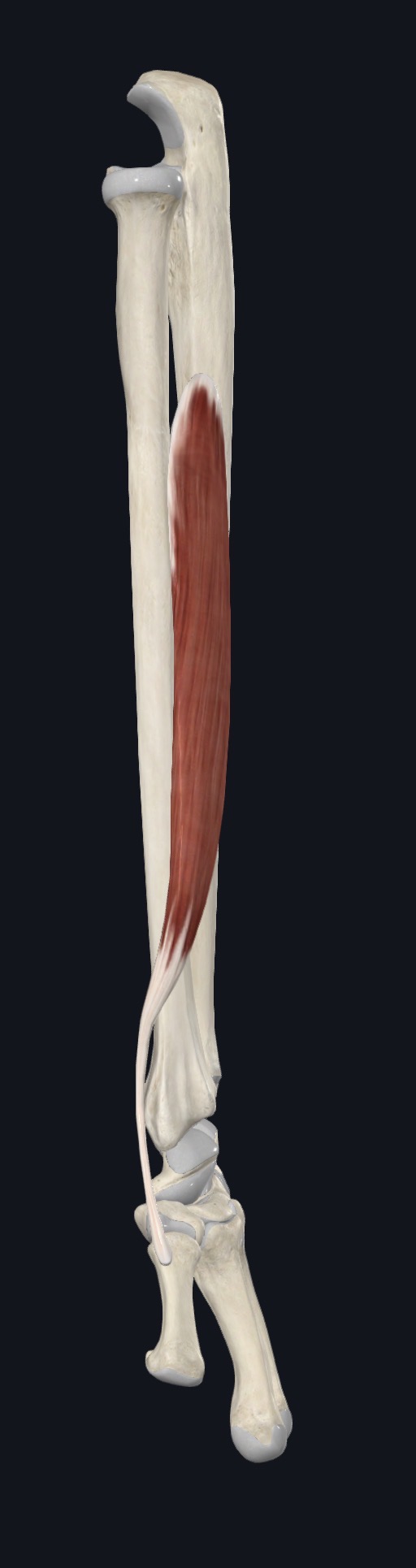
Abductor pollicis longus is a deep muscle of the posterior forearm. Its belly emerges from beneath the extensor digitorum and extensor carpi radialis muscles on the radial side of the distal forearm, and its tendon crosses the wrist to the base of the thumb metacarpal.
Its tendon runs in the first dorsal compartment with extensor pollicis brevis, forming the lateral (radial) border of the anatomical snuffbox.
Section 02 of 20
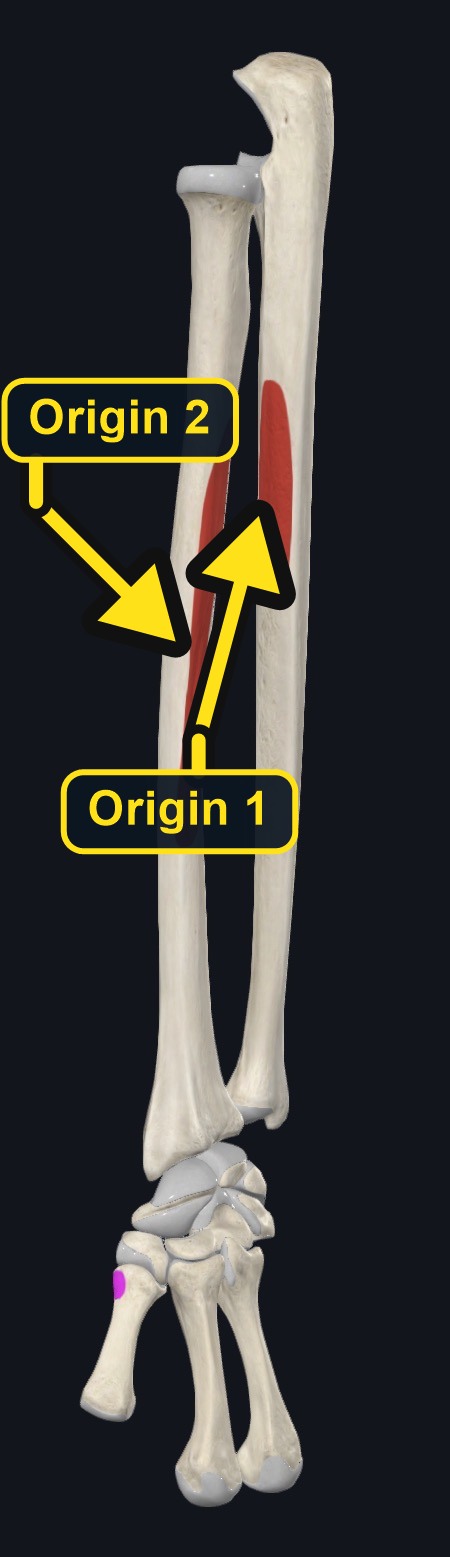
Origin
| Origin | Posterior surface of the ulna below the anconeus insertion, the interosseous membrane, and the middle third of the posterior surface of the radius. |
|---|
Section 03 of 20
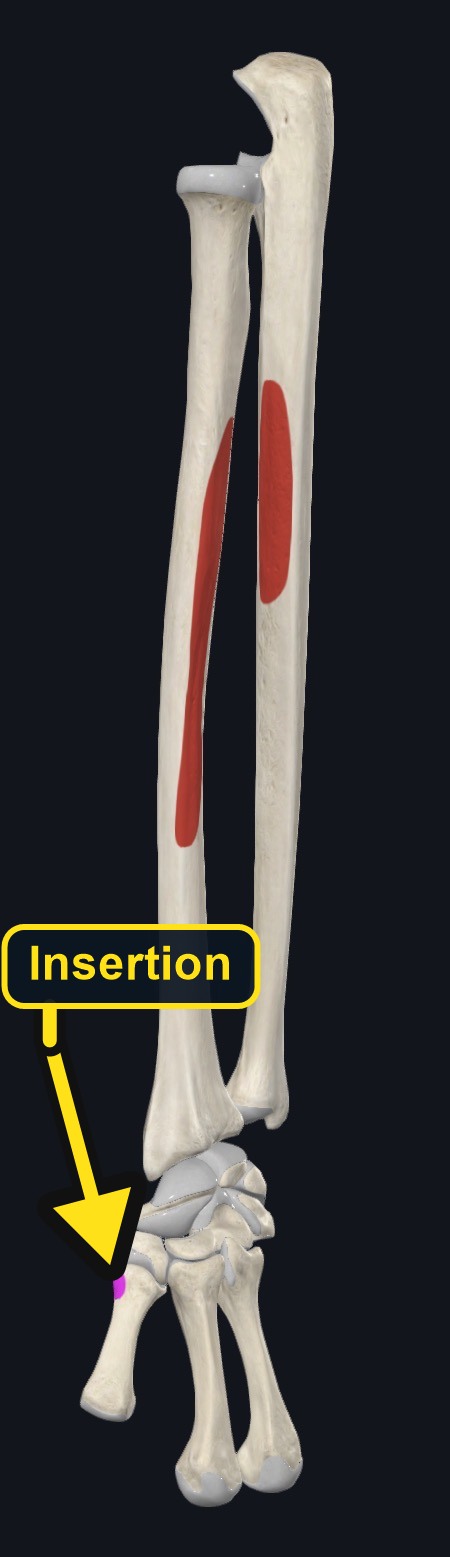
Insertion
| Insertion | Lateral side of the base of the first metacarpal, with a slip to the trapezium. |
|---|
Section 04 of 20
Actions
| Primary action | Abduction of the thumb at the carpometacarpal joint (moving the thumb away from the hand in the plane of the palm). |
|---|---|
| Secondary actions | Assists thumb extension at the carpometacarpal joint and radial deviation of the wrist. |
| Movement at the joint | First carpometacarpal joint; wrist (radial deviation, weak flexion contribution). |
| Heads / fiber groups | Single muscle belly with a tendon that may be split into slips. |
| Functional examples | Opening the hand to grasp a large object; starting a pinch; stabilizing the thumb while typing or texting. |
Thumb abduction
Abducts the thumb at the carpometacarpal joint, moving the metacarpal away from the palm in the plane of the hand (radial abduction).
Thumb extension
Assists extension of the first carpometacarpal joint.
Wrist
Assists radial deviation and weak wrist flexion because the tendon lies slightly anterior to the wrist axis.
Section 05 of 20
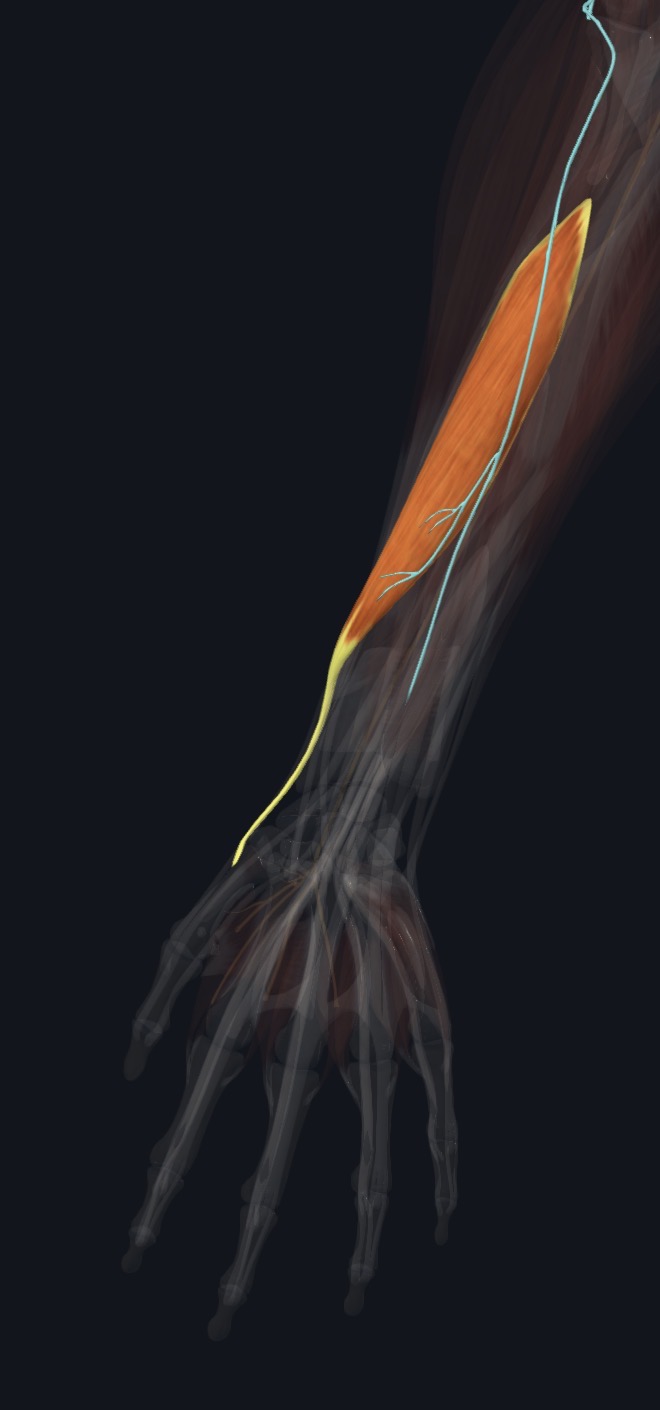
Nerve Innervation
| Nerve | Posterior interosseous nerve (deep branch of the radial nerve), C7–C8. |
|---|
Because the posterior interosseous nerve is a motor nerve, weakness of thumb abduction with extensor weakness suggests a nerve problem, not a simple muscle strain.
Section 06 of 20
Blood Supply
| Blood | Posterior interosseous artery, with contributions from the anterior interosseous artery and dorsal carpal branches of the radial artery. |
|---|
Section 07 of 20
Pictures and Visual Anatomy
Section 08 of 20
Functional Movement
The muscle is active when opening the hand wide to grasp a large object, when starting a pinch, and when stabilizing the thumb base during typing, texting, and tool use.
Section 09 of 20
Synergists and Antagonists
Synergists: extensor pollicis brevis (with which it shares a compartment), extensor carpi radialis longus, and flexor carpi radialis for radial deviation. Antagonists: adductor pollicis and the ulnar-side wrist muscles for adduction and ulnar deviation.
Section 10 of 20
Palpation and Location
Client position and technique
Position the client seated with the forearm supported and slightly pronated. Ask them to extend the thumb and draw it away from the hand while you feel the radial side of the wrist. The tendon of abductor pollicis longus, with extensor pollicis brevis, forms the anterior border of the snuffbox. Follow the tendon proximally to the belly, which crosses the wrist extensors on the radial side of the distal forearm.
Protect nearby structures
Avoid strong pressure over the radial styloid and snuffbox, where the superficial radial nerve branches and the radial artery lie, and over an inflamed first dorsal compartment. Do not compress the tendons if the area is swollen, hot, or painfully crepitant.
Section 11 of 20
Massage Therapy Relevance
The muscle and its tendon are frequently overloaded by repetitive thumb use, so radial-sided wrist and thumb pain is common in clinic. The pain has several possible sources, and the first dorsal compartment is a key area to recognize.
Section 12 of 20
Dysfunction: What Happens When Movement Goes Wrong
Changes in how a muscle works can change how a joint moves. The points below describe possibilities that may be associated with altered muscle function; they are not diagnoses, and one muscle is never assumed to be the sole cause of a problem.
When the muscle is weak
Weakness may reduce thumb opening and may shift the load to the thumb joint; combined finger and thumb extensor weakness may suggest a nerve problem.
When it is tight or shortened
Tightness may be associated with radial-sided wrist tension and may contribute to discomfort with ulnar deviation or with gripping.
When it is overused
Repetitive thumb use may irritate the first dorsal compartment and may be associated with pain and swelling at the radial wrist.
When it is strained
A strain may cause pain with resisted thumb abduction; radial wrist pain can also involve the scaphoid, the joint, or nearby nerves.
When it is inhibited or others compensate
Reduced activation may be associated with compensating from other thumb muscles and altered pinch mechanics.
When it does not coordinate well with synergists and antagonists
Poor coordination with extensor pollicis brevis and the thumb flexors may change how the thumb opens and may load the tendon sheath.
Section 13 of 20
Conditions, Pathologies, and Pain Relationships
De Quervain tenosynovitis
Pain and swelling over the radial wrist with thumb use, often with a positive Finkelstein test, involves the first dorsal compartment tendons. Avoid aggressive local pressure and refer persistent symptoms.
Intersection syndrome
Pain about 4 to 8 cm proximal to the wrist where the first-compartment muscles cross the wrist extensors may cause crepitus and can resemble De Quervain.
Thumb carpometacarpal osteoarthritis
Thumb-base pain with pinching and gripping can overlap with tendon symptoms.
Differential considerations
Scaphoid fracture, radial sensory neuritis, cervical radiculopathy, and inflammatory arthritis can all cause radial-sided wrist pain.
Section 14 of 20
Example Clinical Relationship
A client who uses a phone or hand tools heavily reports pain at the radial wrist. The first dorsal compartment tendons may be involved, and this pattern may be associated with De Quervain tenosynovitis, but scaphoid injury or thumb-base arthritis can look similar. Gentle work above the wrist may support comfort, while snuffbox pain after a fall needs referral.
Section 15 of 20
Massage and Treatment Approaches
For healthy, non-acute tissue, support the forearm and begin with broad effleurage and kneading along the posterior forearm, including the deep extensor mass. Progress to gentle, comfortable work along the muscle toward the radial wrist.
| Movement | Use gentle active thumb movements within comfort; do not force stretch into painful radial deviation. |
|---|---|
| Regional work | Consider the extensor group, supinator, thumb muscles, and shoulder and neck posture when appropriate. |
| Avoid | Deep friction or compression over an inflamed first dorsal compartment or the snuffbox. |
Section 16 of 20
Precautions and Contraindications
Precautions and contraindications
- Acute wrist or thumb injury, suspected fracture, or recent surgery.
- Use caution with tenosynovitis, inflammatory arthritis, or reduced sensation.
- Avoid open wounds, infection, and marked swelling.
- Ask about anticoagulant use and easy bruising.
Section 17 of 20
Red Flags and When to Refer
Red flags and referral
- Pain in the snuffbox after a fall, which may indicate a scaphoid fracture.
- Sudden inability to extend the thumb or fingers.
- Hot, red, swollen wrist with fever.
- Progressive weakness, spreading numbness, or neck pain radiating into the arm.
Section 18 of 20
Study Summary
Attachments
Posterior ulna, radius, and interosseous membrane to the lateral base of the first metacarpal.
Actions
Abducts and extends the thumb at the carpometacarpal joint; assists radial deviation.
Supply
Posterior interosseous nerve (C7–C8); posterior interosseous artery.
Section 19 of 20
Instructor Narration
Open narration transcript
Abductor pollicis longus is a deep muscle of the posterior forearm. Its tendon travels with extensor pollicis brevis in the first dorsal compartment and forms the radial border of the anatomical snuffbox.
It arises from the posterior surfaces of the ulna and radius and from the interosseous membrane, and it inserts on the lateral base of the first metacarpal.
It abducts and extends the thumb at the carpometacarpal joint and helps with radial deviation of the wrist. Its synergist is extensor pollicis brevis, and its antagonist is adductor pollicis.
The posterior interosseous nerve, a branch of the radial nerve, supplies it from roots C7 to C8. Blood comes from the posterior interosseous artery.
To palpate, have the client extend the thumb and feel the radial side of the wrist. The tendon is the front border of the snuffbox. Avoid strong pressure over the radial styloid and snuffbox.
De Quervain tenosynovitis, intersection syndrome, thumb base arthritis, and scaphoid injury can all cause radial wrist pain. Refer snuffbox pain after a fall, sudden loss of thumb or finger extension, hot swelling with fever, or progressive weakness.
Remember: posterior ulna, radius, and membrane to the first metacarpal; thumb abduction and extension; posterior interosseous nerve.
Section 20 of 20